







Question: Q 6. From Assignment 2, we know that (Z; ) is a group, where x y := x 3 + y for all x; y
Q 6. From Assignment 2, we know that (Z; ) is a group, where x y := x 3 + y for all x; y 2 Z. Let ': Z ! Z be dened by '(x) :=x+3 for all x 2 Z. Show that ' is an isomorphism from (Z; +) to (Z; ). To show that ' is invertible, it is enough to write down the inverse function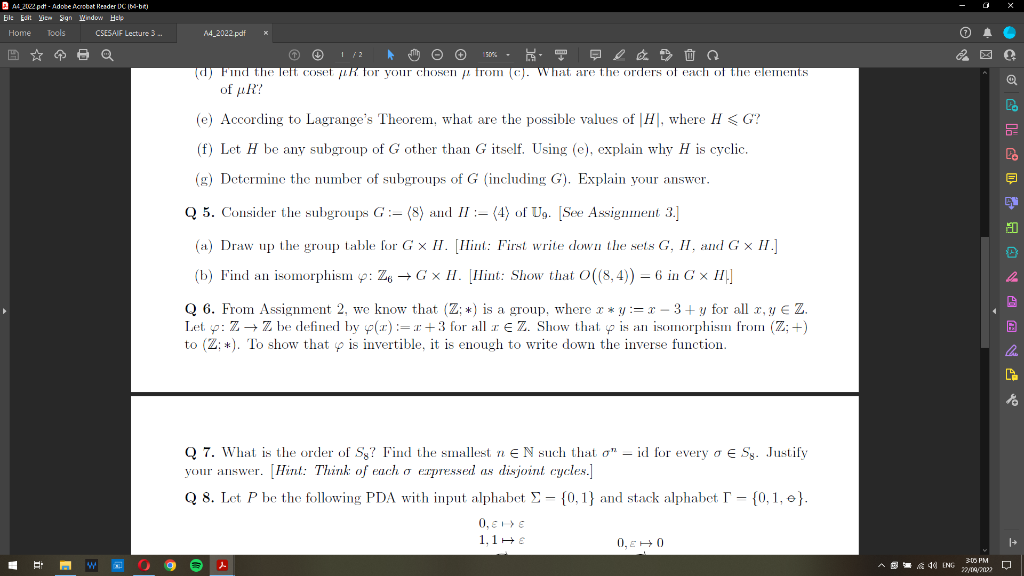
(d) Find the left coset R for your chosen from (c). What are the orders of eact of the elements of R ? (e) According to Lagrange's Theorem, what are the possible values of H, where HG ? (f) Let H be any subgroup of G other than G itself. Using (e), explain why H is cyclic. (g) Determine the number of subgroups of G (including G ). Explain your answer. Q 5. Consider the subgroups G:8 and II:4 of U9. [See Assignment 3.] (a) Draw up the group table for GH. [Hint: First write down the sets G,H, and GH.] (b) Find an isomorphism :Z6GH. [Hint: Show that O((8,4))=6 in GH.] Q 6. From Assignment 2, we know that (Z;) is a group, where xy:=x3+y for all x,yZ. Let. :ZZ be defined by (x):=x+3 for all xZ. Show that is an isomorphism from (Z;+) to (Z:). To show that is invertible, it is enough to write down the inverse function. Q 7. What is the order of S8 ? Find the smallest nN such that n id for every S8. Justify your answer. [Hint: Think of each expressed as disjoint cycles.] Q 8. Let P be the following PDA with input alphabet {0,1} and stack alphabet {0,1,}. 0,1,10,0
Step by Step Solution
There are 3 Steps involved in it

Get step-by-step solutions from verified subject matter experts
 Study Help