







Question: Q. Implement the branch-and-bound algorithm for the Partial Digest Problem (PDP) using your favoriate programming language (e.g., C, C++, Java or Python). Test your program
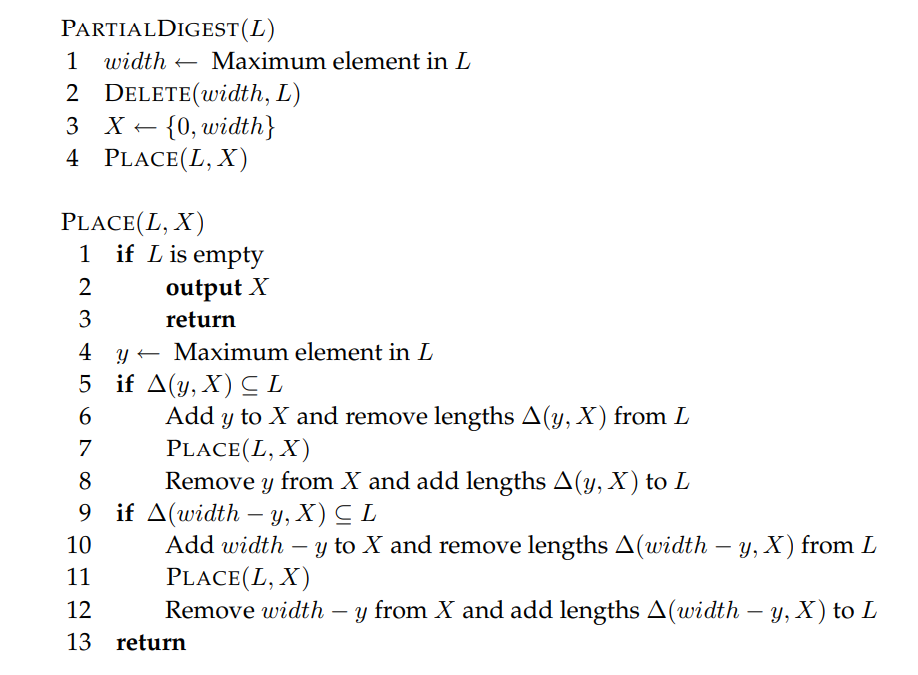
Q. Implement the branch-and-bound algorithm for the Partial Digest Problem (PDP) using your favoriate programming language (e.g., C, C++, Java or Python). Test your program on the following three datasets. Here, each number in parentheses indicates the multiplicity of the preceding number. L1 = {1(9), 2(8), 3(7), 4(6), 5(5), 6(4), 7(3), 8(2), 9(1)}. L2 = {1(1), 2(1), 3(2), 4(1), 5(2), 6(1), 7(1), 9(2), 10(1), 12(1), 14(1), 15(1)}. L3 = {1(16), 2(15), 3(14), 4(13), 5(12), 6(11), 7(10), 8(9), 9(8), 10(9), 11(8), 12(7), 13(6), 14(5), 15(4), 16(3), 17(2), 18(1)}. To simpify your output, please print only the number of distinct solutions for each dataset (symmetric solutions are considered as the same) and up to three actual distinct solutions (in any order).
PARTIALDIGEST(L) 1 width = Maximum element in L 2 DELETE(width, L) 3 X = {0, width} 4 PLACE(L, X) + PLACE(L, X) 1 if L is empty 2 output X 3 return 4 y Maximum element in L 5 if Aly, X) CL 6 Add y to X and remove lengths Aly, X) from L y 7 PLACE(L, X) 8 Remove y from X and add lengths Aly, X) to L 9 if Alwidth y, X) CL 10 Add width y to X and remove lengths A(width y, X) from L X , 11 PLACE(L, X) 12 Remove width y from X and add lengths A(width y, X) to L 13 return
Step by Step Solution
There are 3 Steps involved in it

Get step-by-step solutions from verified subject matter experts
 Study Help