



Question: Q1) A hostile CEO yells at employees or throws things at them. According to your text, hostility is a _____ displayed by people with a
Q1) A hostile CEO yells at employees or throws things at them. According to your text, hostility is a _____ displayed by people with a disposition called _____.
Multiple Choice
emotion; locus of control
mood; positive affectivity
mood; negative affectivity
emotion; trait
mood; locus of control
Q2) If a CEO has a high negative affect, it can result in lower
Multiple Choice
commitment to the organization.
perceived fairness.
preference for positive reinforcement.
job and life satisfaction.
tenure as CEO.
Q3) Which of the following is something a CEO with higher negative affect might say?
Multiple Choice
Most of the things I do every day are stressful.
I need to be tough to help others reach their goals.
Most people in the organization are not as smart as me.
The stock price has increased because of me.
You wont meet a person more conscientious than me.
Q4) When Michael OLeary insisted that it was possible to fly through the volcanic ash over Europe despite aviation experts advice, he was demonstrating that he could handle the situation when others could not. This showed his
Multiple Choice
high neuroticism
low volatility
external locus of control
internal locus of control
high volatility
Q5) Tim Kendall is energized after an ice bath and Elon Musk keeps moving through the day with 5-minute tasks, eccentricities that indicate which two types of moods?
Multiple Choice
centric and pleasant
activated and unpleasant
activated and pleasant
deactivated and pleasant
deactivated and unpleasant
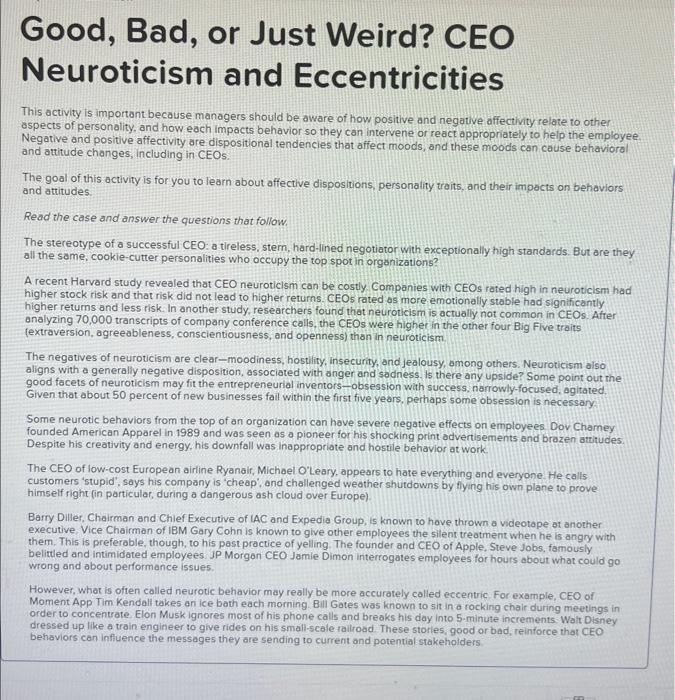
GOo, Bad, or Just Weird? Neuroticism and Eccentricities This activity is important because managers should be aware of how positive and negative affectivity relate to other aspects of personality, and how each impacts behavior so they can intervene or react appropriately to help the employee Negative and positive affectivity are dispositional tendencies that affect moods, and these moods can cause behavioral and attitude changes, including in CEO. The goal of this activity is for you to learn about affective dispositions, personality traits, and their impacts on behaviors and attitudes Read the case and answer the questions that follow. The stereotype of a successful CEO: a tireless, stem, hard-lined negotiator with exceptionally high standards. But are they all the same, cookie-cutter personalities who occupy the top spot in organizations? A recent Harvard study revealed that CEO neuroticlsm can be costly Companies with CEOs rated high in neuroticism had higher stock risk and that risk did not lead to higher returns. CEOs rated as more emotionally stable had significantly higher returns and less risk. In another study, researchers found that neuroticism is actually not common in CEOs. After analyzing 70,000 transcripts of company conference calls, the CEOs were higher in the other four Big Five traits (extraversion, agreeableness, conscientiousness, and openness) than in neuroticism. The negatives of neuroticism are clear-moodiness, hostility, insecurity, and jealousy, omong others. Neuroticism also aligns with a generally negative disposition, associated with anger and sadness. Is there any upside? Some point out the good facets of neuroticism may fit the entrepreneurial inventors-obsession with success, narrowly-focused, agitated. Given that about 50 percent of new businesses fail within the first five years, perhaps some obsession is necessary? Some neurotic behaviors from the top of an organization can have severe negative effects on employees. Dov Chamey founded American Apparel in 1989 and was seen as a pioneer for his shocking print advertisements and brazen attitudes. Despite his creativity and energy, his downfall was inappropriate and hostile behavior at work. The CEO of low-cost European airline Ryanair, Michael O'Leary, appears to hate everything and everyone. He calls customers 'stupid', says his company is 'cheap', and challenged weather shutdowns by tlying his own plane to prove himself right (in particular, during a dangerous ash cloud over Europe). Barry Diller, Chairman and Chief Executive of LAC and Expedia Group, is known to hove thrown a videotape ot another executive. Vice Chairman of IBM Gary Cohn is known to give other employees the silent treatment when he is angry with them. This is preferable, though, to his past practice of yelling. The founder and CEO of Apple, Steve Jobs, famously belitted and intimidated employees. JP Morgon CEO Jamie Dimon interrogates employees for hours about what could go wrong and about performance issues. However, what is often called neurotic behavior may really be more accurately called eccentric. For example, CEO of Moment App Tim Kendali takes an ice bath each moming. Bill Gates was known to sit in a rocking chair during meetings in order to concentrate. Elon Musk ignores most of his phone calls and breaks his day into 5 -minute increments Wait Disney dressed up like a train engineer to give rides on his small-scale raliroad. These storles, good or bad, reinforce that CEO behaviors can influence the messages they are sending to current and potential stakeholders
Step by Step Solution
There are 3 Steps involved in it

Get step-by-step solutions from verified subject matter experts