







Question: Q1. Based on the assigned reading that outlines Indigenous perspectives on the environment and the land, what specific concerns should you be able to address
Q1. Based on the assigned reading that outlines Indigenous perspectives on the environment and the land, what specific concerns should you be able to address when negotiating? List a minimum of 4 and explain fully why these would be concerns. What way would you come up with solutions to these concerns that respects Indigenous traditional ways? Explain fully.
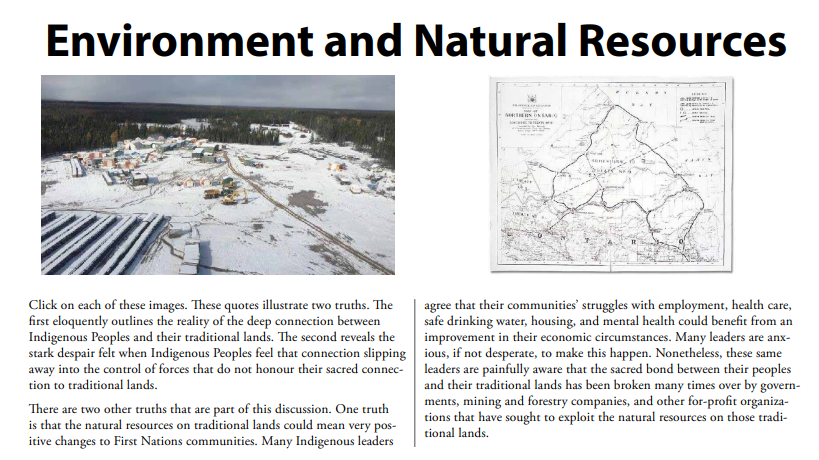
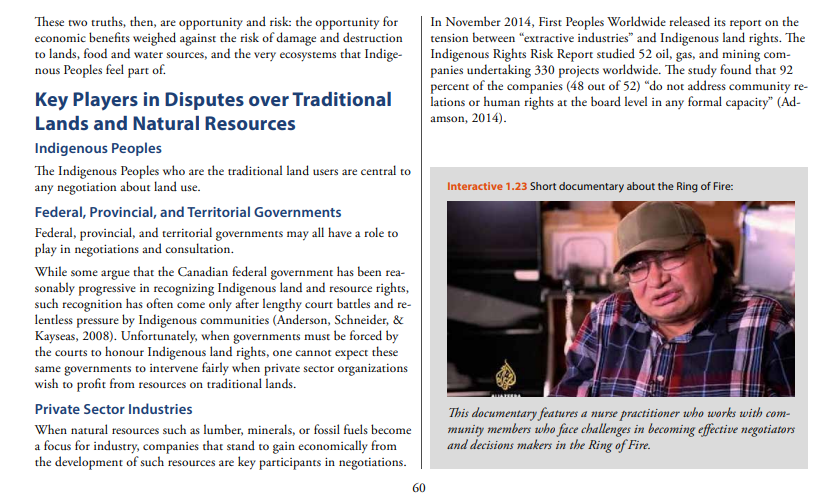
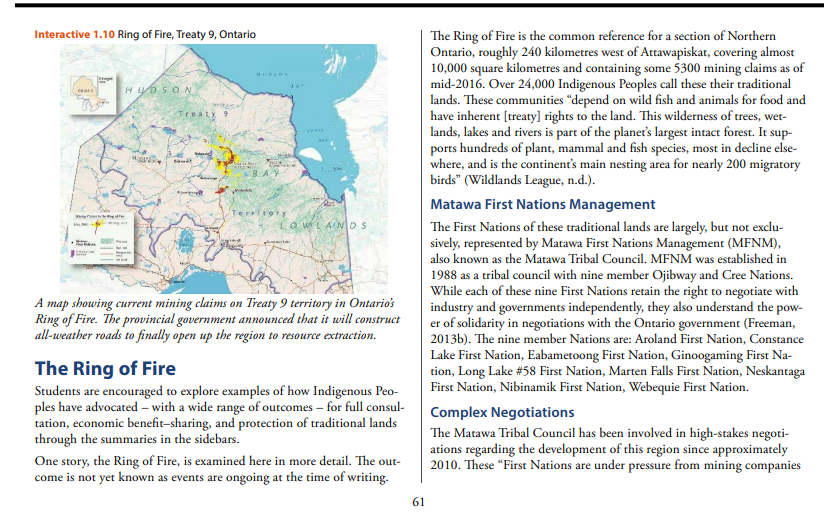
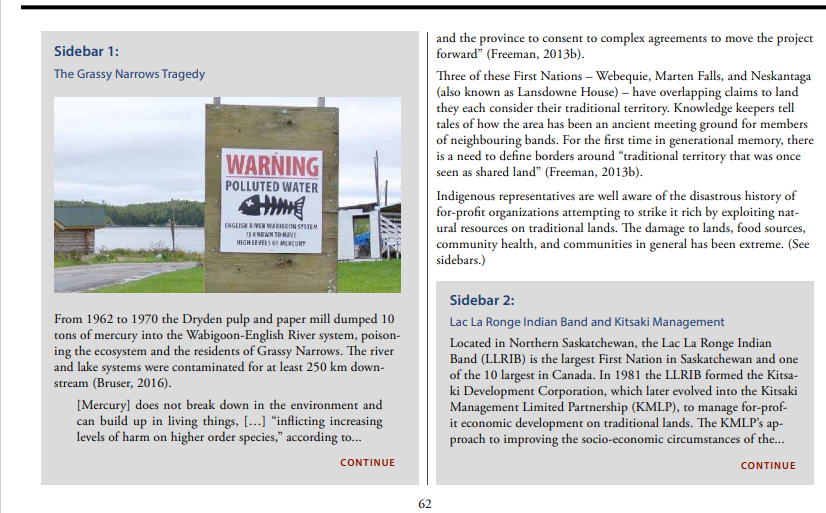
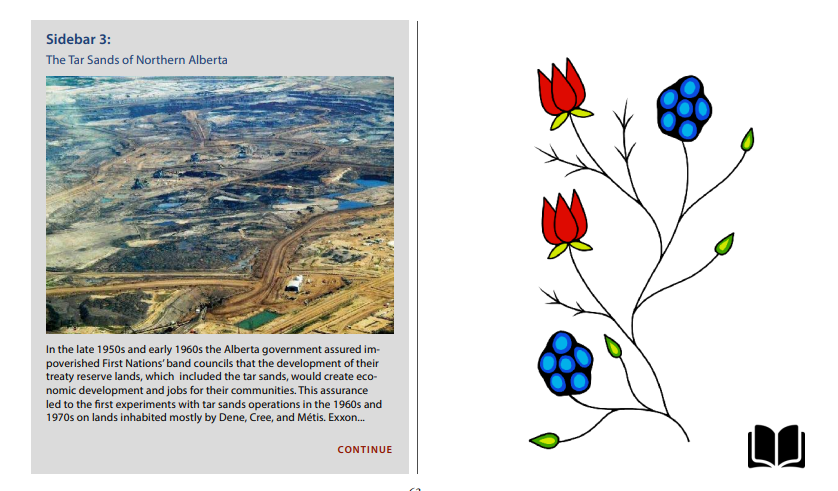
Environment and Natural Resources Click on each of these images. These quotes illustrate two truths. The agree that their communities' struggles with employment, health care, first eloquently outlines the reality of the deep connection between safe drinking water, housing, and mental health could benefit from an Indigenous peoples and their traditional lands. The second reveals the improvement in their economic circumstances. Many leaders are anx- stark despair felt when Indigenous Peoples feel that connection slipping ious, if not desperate, to make this happen. Nonetheless, these same away into the control of forces that do not honour their sacred connec- leaders are painfully aware that the sacred bond between their peoples tion to traditional lands. and their traditional lands has been broken many times over by govern- There are two other truths that are part of this discussion. One truth ments, mining and forestry companies, and other for-profit organiza- is that the natural resources on traditional lands could mean very pos- tions that have sought to exploit the natural resources on those tradi- tional lands. itive changes to First Nations communities. Many Indigenous leaders In November 2014, First Peoples Worldwide released its report on the tension between "extractive industries and Indigenous land rights. The Indigenous Rights Risk Report studied 52 oil, gas, and mining com- panies undertaking 330 projects worldwide. The study found that 92 percent of the companies (48 out of 52) "do not address community re- lations or human rights at the board level in any formal capacity" (Ad- amson, 2014). Interactive 1.23 Short documentary about the Ring of Fire: These two truths, then, are opportunity and risk: the opportunity for economic benefits weighed against the risk of damage and destruction to lands, food and water sources, and the very ecosystems that Indige- nous Peoples feel part of Key Players in Disputes over Traditional Lands and Natural Resources Indigenous Peoples The Indigenous Peoples who are the traditional land users are central to any negotiation about land use. Federal, Provincial, and Territorial Governments Federal, provincial, and territorial governments may all have a role to play in negotiations and consultation. While some argue that the Canadian federal government has been rea- sonably progressive in recognizing Indigenous land and resource rights, such recognition has often come only after lengthy court battles and re- lentless pressure by Indigenous communities (Anderson, Schneider, & Kayseas, 2008). Unfortunately, when governments must be forced by the courts to honour Indigenous land rights, one cannot expect these same governments to intervene fairly when private sector organizations wish to profit from resources on traditional lands. Private Sector Industries When natural resources such as lumber, minerals, or fossil fuels become a focus for industry, companies that stand to gain economically from the development of such resources are key participants in negotiations. This documentary features a nurse practitioner who works with com- munity members who face challenges in becoming effective negotiators and decisions makers in the Ring of Fire. 60 Interactive 1.10 Ring of Fire, Treaty 9, Ontario HD SON Treaty BA Teritory LOWLANDS The Ring of Fire is the common reference for a section of Northern Ontario, roughly 240 kilometres west of Attawapiskat, covering almost 10,000 square kilometres and containing some 5300 mining claims as of mid-2016. Over 24,000 Indigenous Peoples call these their traditional lands. These communities depend on wild fish and animals for food and have inherent [treaty rights to the land. This wilderness of trees, wet- lands, lakes and rivers is part of the planet's largest intact forest. It sup- ports hundreds of plant, mammal and fish species, most in decline else- where, and is the continent's main nesting area for nearly 200 migratory birds (Wildlands League, n.d.). Matawa First Nations Management The First Nations of these traditional lands are largely, but not exclu- sively, represented by Matawa First Nations Management (MFNM), also known as the Matawa Tribal Council. MFNM was established in 1988 as a tribal council with nine member Ojibway and Cree Nations. While each of these nine First Nations retain the right to negotiate with industry and governments independently, they also understand the pow- er of solidarity in negotiations with the Ontario government (Freeman, 2013b). The nine member Nations are: Aroland First Nation, Constance Lake First Nation, Eabametoong First Nation, Ginoogaming First Na- tion, Long Lake #58 First Nation, Marten Falls First Nation, Neskantaga First Nation, Nibinamik First Nation, Webequie First Nation. Complex Negotiations The Matawa Tribal Council has been involved in high-stakes negoti- ations regarding the development of this region since approximately 2010. These "First Nations are under pressure from mining companies A map showing current mining claims on Treaty 9 territory in Ontario's Ring of Fire. The provincial government announced that it will construct all-weather roads to finally open up the region to resource extraction. The Ring of Fire Students are encouraged to explore examples of how Indigenous Peo- ples have advocated with a wide range of outcomes - for full consul- tation, economic benefit-sharing, and protection of traditional lands through the summaries in the sidebars. One story, the Ring of Fire, is examined here in more detail. The out- come is not yet known as events are ongoing at the time of writing. 61 Sidebar 1: The Grassy Narrows Tragedy and the province to consent to complex agreements to move the project forward" (Freeman, 2013b). Three of these First Nations - Webequie, Marten Falls, and Neskantaga (also known as Lansdowne House) have overlapping claims to land they each consider their traditional territory. Knowledge keepers tell tales of how the area has been an ancient meeting ground for members of neighbouring bands. For the first time in generational memory, there is a need to define borders around "traditional territory that was once seen as shared land" (Freeman, 2013b). Indigenous representatives are well aware of the disastrous history of for-profit organizations attempting to strike it rich by exploiting nat- ural resources on traditional lands. The damage to lands, food sources, community health, and communities in general has been extreme. (See sidebars.) WARNING POLLUTED WATER ENGLISRINER WARICOON SYSTEM IS KNOWN TO HANE HIGH LEVELS OF MERCURT From 1962 to 1970 the Dryden pulp and paper mill dumped 10 tons of mercury into the Wabigoon-English River system, poison- ing the ecosystem and the residents of Grassy Narrows. The river and lake systems were contaminated for at least 250 km down- stream (Bruser, 2016). [Mercury] does not break down in the environment and can build up in living things, [...] "inflicting increasing levels of harm on higher order species," according to... Sidebar 2: Lac La Ronge Indian Band and Kitsaki Management Located in Northern Saskatchewan, the Lac La Ronge Indian Band (LLRIB) is the largest First Nation in Saskatchewan and one of the 10 largest in Canada. In 1981 the LLRIB formed the Kitsa- ki Development Corporation, which later evolved into the Kitsaki Management Limited Partnership (KMLP), to manage for-prof- it economic development on traditional lands. The KMLP's ap- proach to improving the socio-economic circumstances of the... CONTINUE CONTINUE 62 Sidebar 3: The Tar Sands of Northern Alberta In the late 1950s and early 1960s the Alberta government assured im- poverished First Nations' band councils that the development of their treaty reserve lands, which included the tar sands, would create eco- nomic development and jobs for their communities. This assurance led to the first experiments with tar sands operations in the 1960s and 1970s on lands inhabited mostly by Dene, Cree, and Mtis. Exxon... CONTINUE LAStep by Step Solution
There are 3 Steps involved in it
1 Expert Approved Answer
Step: 1 Unlock

Question Has Been Solved by an Expert!
Get step-by-step solutions from verified subject matter experts
Step: 2 Unlock
Step: 3 Unlock
 Study Help