







Question: Q1: Consider a joint density f(x1, x2) = 27,expl-(3+ -)], for x1, x2 > 0. For the following, enter the answers as algebraic expressions in
Q1:
![Q1: Consider a joint density f(x1, x2) = 27,expl-(3+ -)], for x1,](https://dsd5zvtm8ll6.cloudfront.net/si.experts.images/questions/2024/10/670476a3be031_763670476a395fff.jpg)
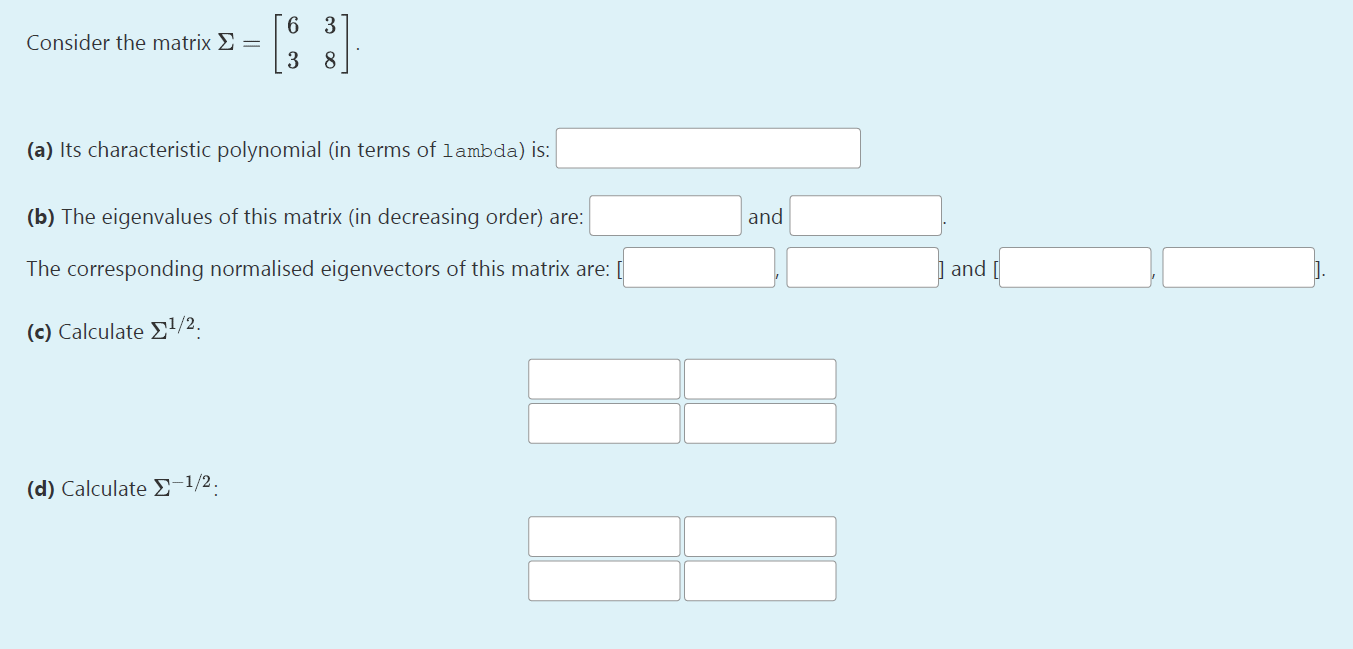
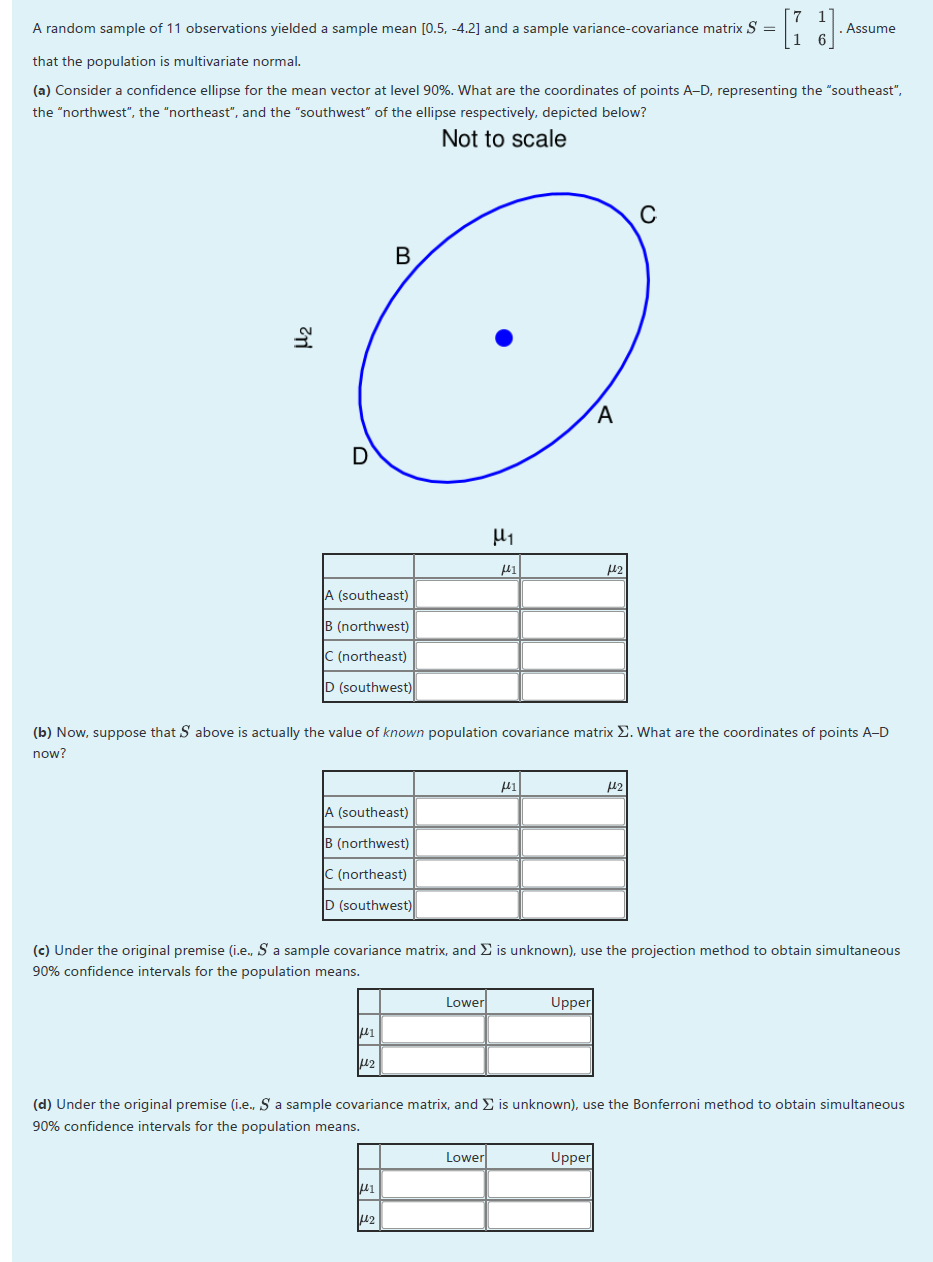
Consider a joint density f(x1, x2) = 27,expl-(3+ -)], for x1, x2 > 0. For the following, enter the answers as algebraic expressions in terms of x1, x2, and/or common functions such as exp, log, and cos, e.g., x2 *exp (x2/x1) . (a) Derive fX2 (22) : (b) Derive fx; X2 (21 |202) (c) Give the best approximation g*(X2) in mean square sense for X1 (i.e. find explicitly g* (X2) that minimises E[(X1 - g(X2))2(X2 = 22] over all possible choices of g(X2) such that Elg(X2)? | X2 = 22] is unknown), use the projection method to obtain simultaneous 90% confidence intervals for the population means. Lower Upper (d) Under the original premise (i.e., S a sample covariance matrix, and > is unknown), use the Bonferroni method to obtain simultaneous 90% confidence intervals for the population means. Lower Upper
Step by Step Solution
There are 3 Steps involved in it

Get step-by-step solutions from verified subject matter experts
 Study Help