



Question: Q#1: Consider the constraint C on four variables VI, V2, V3, V4} each of which has the domain {true, false}, with C = {(true, true,
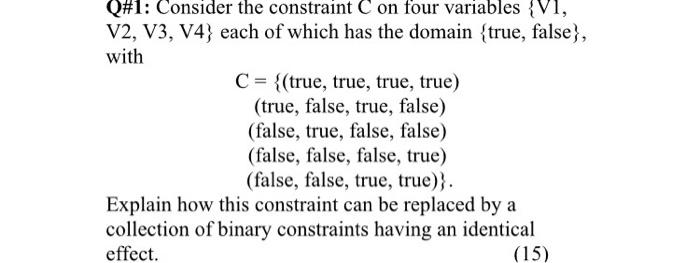
Q#1: Consider the constraint C on four variables VI, V2, V3, V4} each of which has the domain {true, false}, with C = {(true, true, true, true) (true, false, true, false) (false, true, false, false) (false, false, false, true) (false, false, true, true)). Explain how this constraint can be replaced by a collection of binary constraints having an identical effect. (15) Q#1: Consider the constraint C on four variables VI, V2, V3, V4} each of which has the domain {true, false}, with C = {(true, true, true, true) (true, false, true, false) (false, true, false, false) (false, false, false, true) (false, false, true, true)). Explain how this constraint can be replaced by a collection of binary constraints having an identical effect. (15)
Step by Step Solution
There are 3 Steps involved in it

Get step-by-step solutions from verified subject matter experts