







Question: Q.1. Given vectors A = 2-3+2, B=2-+23, and C = *2+1-21, show that C is perpendicular to both A and B. Q.2. Vector A
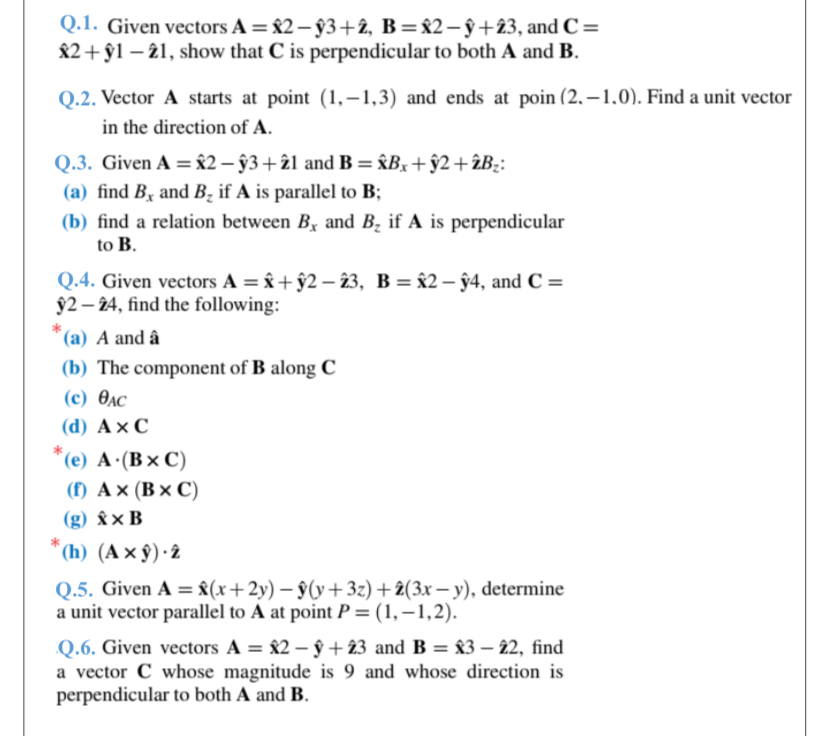
Q.1. Given vectors A = 2-3+2, B=2-+23, and C = *2+1-21, show that C is perpendicular to both A and B. Q.2. Vector A starts at point (1,-1,3) and ends at poin (2.-1.0). Find a unit vector in the direction of A. Q.3. Given A=2-3+21 and B=Bx+2+B: (a) find By and B if A is parallel to B; (b) find a relation between Bx and B if A is perpendicular to B. Q.4. Given vectors A = +2-23, B = x2 - 4, and C = 2-24, find the following: *(a) A and (b) The component of B along C (c) BAC (d) Ax C *(e) A (BxC) (f) Ax (BXC) (g) xB (h) (Ax)-2 Q.5. Given A=(x+2y) - (y+3z) + 2(3x-y), determine a unit vector parallel to A at point P = (1,-1,2). Q.6. Given vectors A = 2-+23 and B = 3-22, find a vector C whose magnitude is 9 and whose direction is perpendicular to both A and B.
Step by Step Solution
There are 3 Steps involved in it

Get step-by-step solutions from verified subject matter experts
 Study Help