Question: Q1. How does big data analytics enable ineffective service delivery for frontline employees (FLEs)? ANSWER All QUESTIONS Each question carries 25 points (the total number
 Q1. How does big data analytics enable ineffective service delivery for frontline employees (FLEs)?
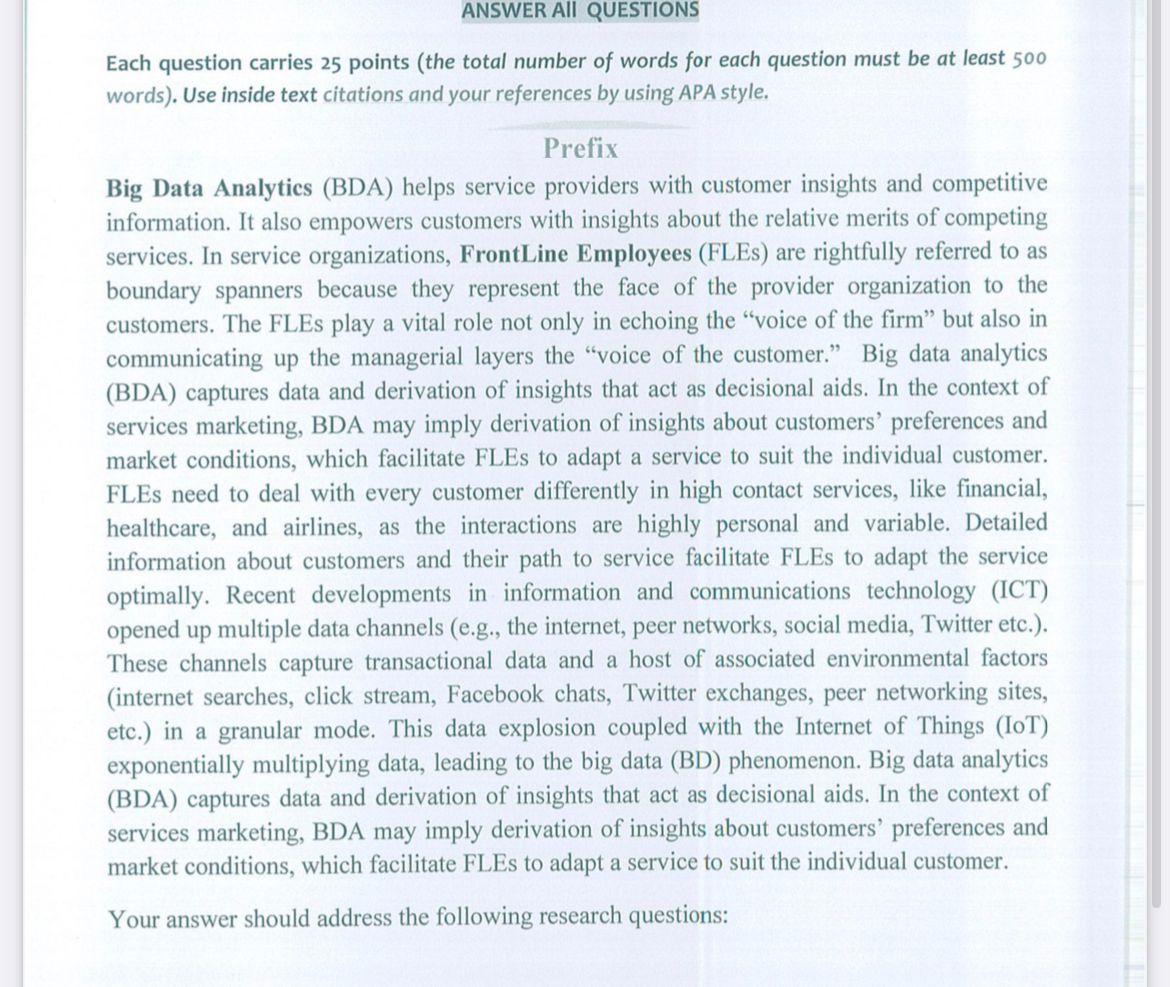
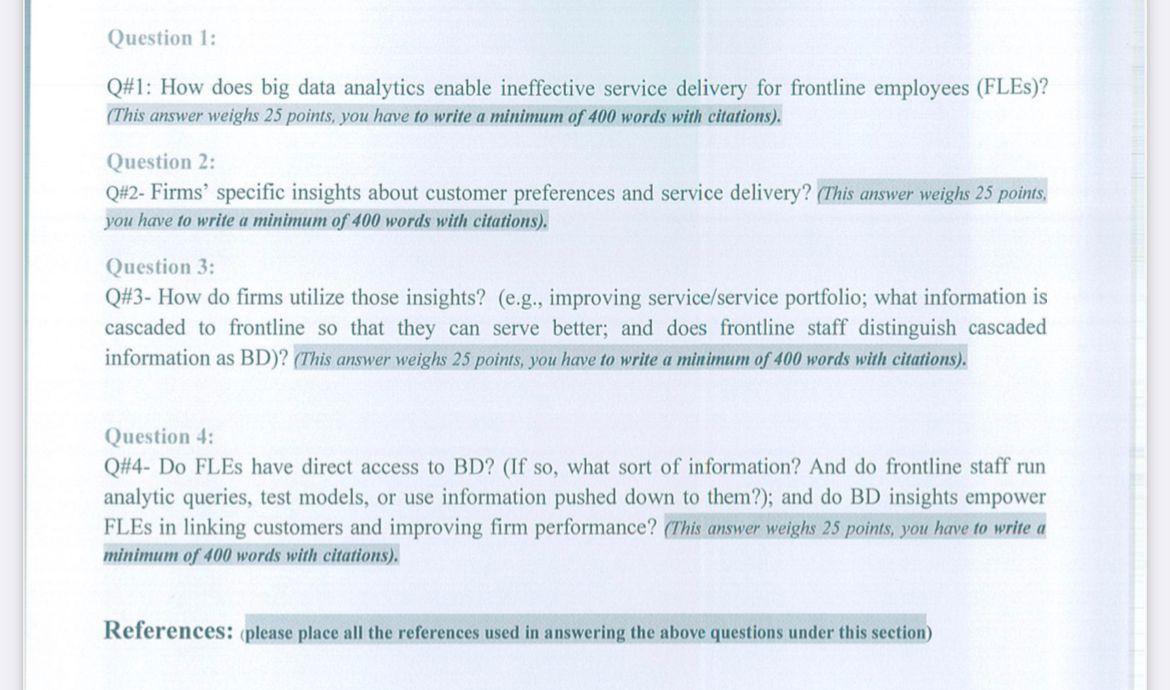
ANSWER All QUESTIONS Each question carries 25 points (the total number of words for each question must be at least 500 words). Use inside text citations and your references by using APA style. Prefix Big Data Analytics (BDA) helps service providers with customer insights and competitive information. It also empowers customers with insights about the relative merits of competing services. In service organizations, FrontLine Employees (FLES) are rightfully referred to as boundary spanners because they represent the face of the provider organization to the customers. The FLEs play a vital role not only in echoing the "voice of the firm" but also in communicating up the managerial layers the "voice of the customer. Big data analytics (BDA) captures data and derivation of insights that act as decisional aids. In the context of services marketing, BDA may imply derivation of insights about customers' preferences and market conditions, which facilitate FLEs to adapt a service to suit the individual customer. FLEs need to deal with every customer differently in high contact services, like financial, healthcare, and airlines, as the interactions are highly personal and variable. Detailed information about customers and their path to service facilitate FLEs to adapt the service optimally. Recent developments in information and communications technology (ICT) opened up multiple data channels (e.g., the internet, peer networks, social media, Twitter etc.). These channels capture transactional data and a host of associated environmental factors (internet searches, click stream, Facebook chats, Twitter exchanges, peer networking sites, etc.) in a granular mode. This data explosion coupled with the Internet of Things (IoT) exponentially multiplying data, leading to the big data (BD) phenomenon. Big data analytics (BDA) captures data and derivation of insights that act as decisional aids. In the context of services marketing, BDA may imply derivation of insights about customers' preferences and market conditions, which facilitate FLEs to adapt a service to suit the individual customer. Your answer should address the following research questions: Question 1: Q#1: How does big data analytics enable ineffective service delivery for frontline employees (FLEs)? (This answer weighs 25 points, you have to write a minimum of 400 words with citations), Question 2: Q#2- Firms' specific insights about customer preferences and service delivery? (This answer weighs 25 points, you have to write a minimum of 400 words with citations). Question 3: Q#3- How do firms utilize those insights? (e.g., improving service/service portfolio; what information is cascaded to frontline so that they can serve better; and does frontline staff distinguish cascaded information as BD)? (This answer weighs 25 points, you have to write a minimum of 400 words with citations), Question 4: Q#4- Do FLEs have direct access to BD? (If so, what sort of information? And do frontline staff run analytic queries, test models, or use information pushed down to them?); and do BD insights empower FLEs in linking customers and improving firm performance? (This answer weighs 25 points, you have to write a minimum of 400 words with citations), References: (please place all the references used in answering the above questions under this section) ANSWER All QUESTIONS Each question carries 25 points (the total number of words for each question must be at least 500 words). Use inside text citations and your references by using APA style. Prefix Big Data Analytics (BDA) helps service providers with customer insights and competitive information. It also empowers customers with insights about the relative merits of competing services. In service organizations, FrontLine Employees (FLES) are rightfully referred to as boundary spanners because they represent the face of the provider organization to the customers. The FLEs play a vital role not only in echoing the "voice of the firm" but also in communicating up the managerial layers the "voice of the customer. Big data analytics (BDA) captures data and derivation of insights that act as decisional aids. In the context of services marketing, BDA may imply derivation of insights about customers' preferences and market conditions, which facilitate FLEs to adapt a service to suit the individual customer. FLEs need to deal with every customer differently in high contact services, like financial, healthcare, and airlines, as the interactions are highly personal and variable. Detailed information about customers and their path to service facilitate FLEs to adapt the service optimally. Recent developments in information and communications technology (ICT) opened up multiple data channels (e.g., the internet, peer networks, social media, Twitter etc.). These channels capture transactional data and a host of associated environmental factors (internet searches, click stream, Facebook chats, Twitter exchanges, peer networking sites, etc.) in a granular mode. This data explosion coupled with the Internet of Things (IoT) exponentially multiplying data, leading to the big data (BD) phenomenon. Big data analytics (BDA) captures data and derivation of insights that act as decisional aids. In the context of services marketing, BDA may imply derivation of insights about customers' preferences and market conditions, which facilitate FLEs to adapt a service to suit the individual customer. Your answer should address the following research questions: Question 1: Q#1: How does big data analytics enable ineffective service delivery for frontline employees (FLEs)? (This answer weighs 25 points, you have to write a minimum of 400 words with citations), Question 2: Q#2- Firms' specific insights about customer preferences and service delivery? (This answer weighs 25 points, you have to write a minimum of 400 words with citations). Question 3: Q#3- How do firms utilize those insights? (e.g., improving service/service portfolio; what information is cascaded to frontline so that they can serve better; and does frontline staff distinguish cascaded information as BD)? (This answer weighs 25 points, you have to write a minimum of 400 words with citations), Question 4: Q#4- Do FLEs have direct access to BD? (If so, what sort of information? And do frontline staff run analytic queries, test models, or use information pushed down to them?); and do BD insights empower FLEs in linking customers and improving firm performance? (This answer weighs 25 points, you have to write a minimum of 400 words with citations), References: (please place all the references used in answering the above questions under this section)









 Study Help