



Question: Q1. How true is the opening quotation in this case today, given all of the workplace hazards discussed in this chapter? What can be done
Q1. How true is the opening quotation in this case today, given all of the workplace hazards discussed in this chapter? What can be done at any and all levels to make this quotation true? 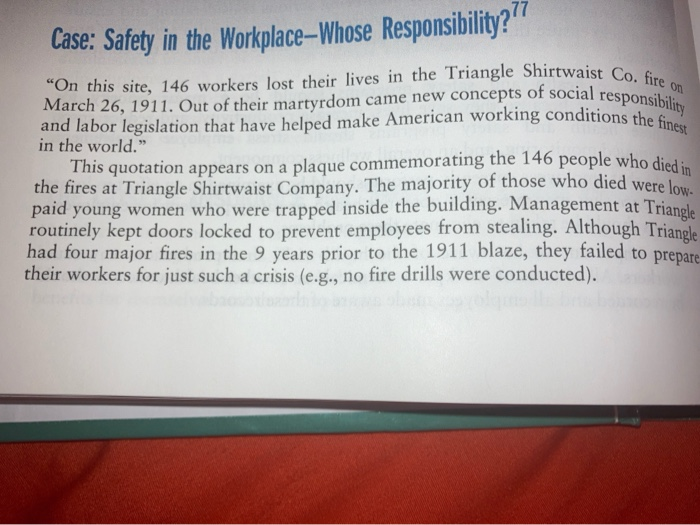
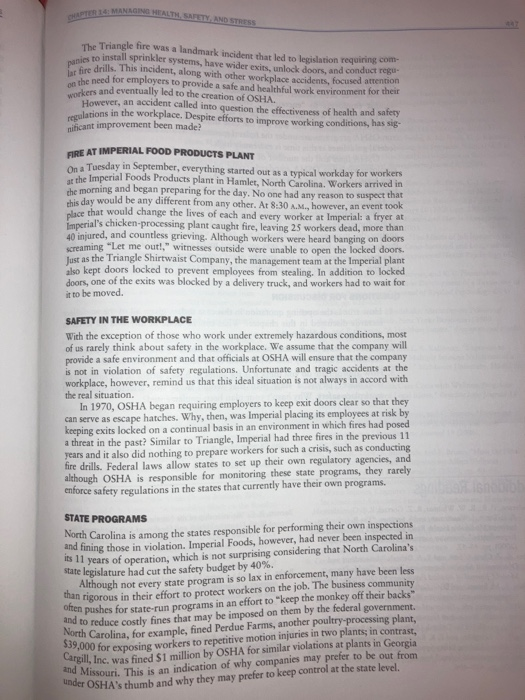
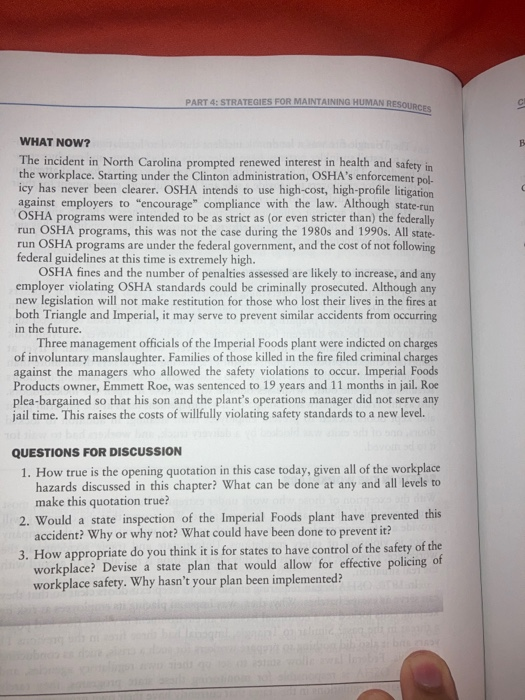
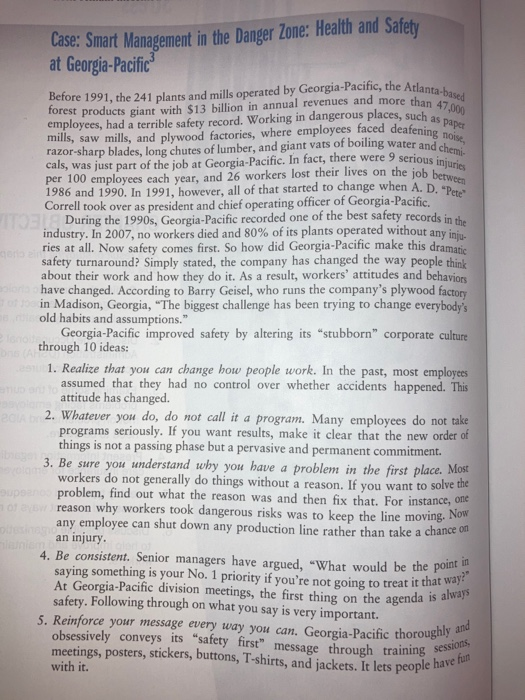
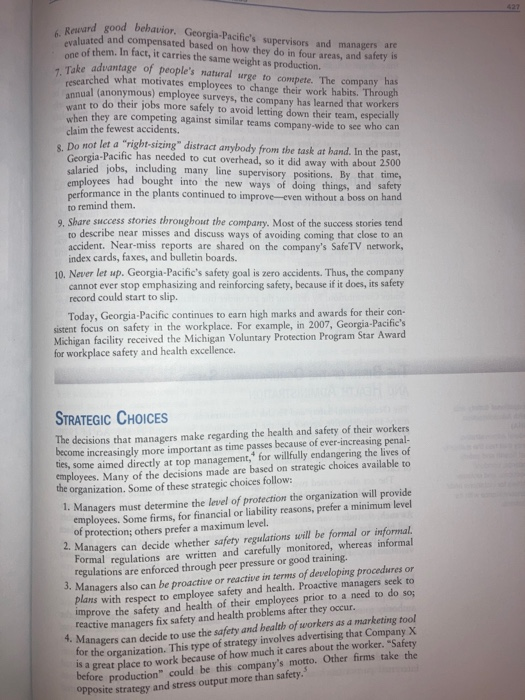
Case: Safety in the Workplace-Whose Responsibility?" "On this site, 146 workers lost their lives in the Triangle Shirtwaist Co. fire on and labor legislation that have helped make American working conditions the finest March 26, 1911. Out of their martyrdom came new concepts of social responsibility This quotation appears on a plaque commemorating the 146 people who died in in the world." the fires at Triangle Shirtwaist Company. The majority of those who died were low. paid young women who were trapped inside the building. Management at Triangle routinely kept doors locked to prevent employees from stealing. Although Triangle had four major fires in the 9 years prior to the 1911 blaze, they failed to prepare their workers for just such a crisis (e.g., no fire drills were conducted). CHA MANAGING HEALTH, SARILAND SWENS panies to install sprinkler systems, have wider exits, unlock doors, and conduct regu Iar fire drills. This incident, along with other workplace accidents, focused attention Cargill, Inc. was fined $1 million by OSHA for similar violations at plants in Georgia and Missouri. This is an indication of why companies may prefer to be out from workers and eventually led to the creation of OSHA. FIRE AT IMPERIAL FOOD PRODUCTS PLANT under OSHA's thumb and why they may prefer to keep control at the state level. The Triangle fire was a landmark incident that led to legislation requiring com- However, an accident called into question the effectiveness of health and safety regulations in the workplace. Despite efforts to improve working conditions, has sig nificant improvement been made: On a Tuesday in September, everything started out as a typical workday for workers at the Imperial Foods Products plant in Hamlet, North Carolina. Workers arrived in the morning and began preparing for the day. No one had any reason to suspect that place that would change the lives of each and every worker at Imperial: a fryer at Imperial's chicken-processing plant caught fire, leaving 25 workers dead, more than 40 injured, and countless grieving. Although workers were heard banging on doors screaming "Let me out!," witnesses outside were unable to open the locked doors. Just as the Triangle Shirtwaist Company, the management team at the Imperial plant also kept doors locked to prevent employees from stealing. In addition to locked doors, one of the exits was blocked by a delivery truck, and workers had to wait for it to be moved. SAFETY IN THE WORKPLACE With the exception of those who work under extremely hazardous conditions, most of us rarely think about safety in the workplace. We assume that the company will provide a safe environment and that officials at OSHA will ensure that the company is not in violation of safety regulations. Unfortunate and tragic accidents at the workplace, however, remind us that this ideal situation is not always in accord with the real situation. In 1970, OSHA began requiring employers to keep exit doors clear so that they can serve as escape hatches. Why, then, was Imperial placing its employees at risk by keeping exits locked on a continual basis in an environment in which fires had posed a threat in the past? Similar to Triangle, Imperial had hree fires in the previous 11 years and it also did nothing to prepare workers for such a crisis, such as conducting fire drills. Federal laws allow states to set up their own regulatory agencies, and although OSHA is responsible for monitoring these state programs, they rarely enforce safety regulations in the states that currently have their own programs. STATE PROGRAMS North Carolina is among the states responsible for performing their own inspections and fining those in violation. Imperial Foods, however, had never been inspected in is 11 years of operation, which is not surprising considering that North Carolina's state legislature had cut the safety budget by 40% Although not every state program is so lax in enforcement, many have been less than rigorous in their effort to protect workers on the job. The business community often pushes for state-run programs in an effort to "keep the monkey off their backs and to reduce costly fines that may be imposed on them by the federal government. North Carolina, for example, fined Perdue Farms, another poultry-processing plant, $39,000 for exposing workers to repetitive motion injuries in two plants; in contrast, PART 4: STRATEGIES FOR MAINTAINING HUMAN RESOURCES WHAT NOW? B The incident in North Carolina prompted renewed interest in health and safety in the workplace. Starting under the Clinton administration, OSHA's enforcement pol- icy has never been clearer. OSHA intends to use high-cost, high-profile litigation against employers to encourage" compliance with the law. Although state-run OSHA programs were intended to be as strict as (or even stricter than the federally run OSHA programs, this was not the case during the 1980s and 1990s. All state- run OSHA programs are under the federal government, and the cost of not following federal guidelines at this time is extremely high. OSHA fines and the number of penalties assessed are likely to increase, and any employer violating OSHA standards could be criminally prosecuted. Although any new legislation will not make restitution for those who lost their lives in the fires at both Triangle and Imperial, it may serve to prevent similar accidents from occurring in the future. Three management officials of the Imperial Foods plant were indicted on charges of involuntary manslaughter. Families of those killed in the fire filed criminal charges against the managers who allowed the safety violations to occur. Imperial Foods Products owner, Emmett Roe, was sentenced to 19 years and 11 months in jail. Roe plea-bargained so that his son and the plant's operations manager did not serve any jail time. This raises the costs of willfully violating safety standards to a new level. QUESTIONS FOR DISCUSSION 1. How true is the opening quotation in this case today, given all of the workplace hazards discussed in this chapter? What can be done at any and all levels to make this quotation true? 2. Would a state inspection of the Imperial Foods plant have prevented this accident? Why or why not? What could have been done to prevent it? 3. How appropriate do you think it is for states to have control of the safety of the workplace? Devise a state plan that would allow for effective policing of workplace safety. Why hasn't your plan been implemented? Before 1991, the 241 plants and mills operated by Georgia-Pacific, the Atlanta-based employees, had a terrible safety record. Working in dangerous places, such as paper forest products giant with $13 billion in annual revenues and more than 47,000 mills, saw mills, and plywood factories, where employees faced deafening noise, razor-sharp blades, long chutes of lumber, and giant vats of boiling water and chemi- cals, was just part of the job at Georgia-Pacific. In fact, there were 9 serious injuries per 100 employees each year, and 26 workers lost their lives on the job between At Georgia-Pacific division meetings, the first thing on the agenda is always 5. Reinforce your message every way you can. Georgia-Pacific thoroughly and obsessively conveys its "safety first" message through training sessions, meetings, posters, stickers, buttons, T-shirts, and jackets. It lets people have fun Case: Smart Management in the Danger Zone: Health and Safety at Georgia-Pacific 1986 and 1990. In 1991, however, all of that started to change when A. D. Peter Correll took over as president and chief operating officer of Georgia-Pacific. During the 1990s, Georgia-Pacific recorded one of the best safety records in the industry. In 2007, no workers died and 80% of its plants operated without any inju. en ries at all . Now safety comes first. So how did Georgia-Pacific make this dramatic safety turnaround? Simply stated, the company has changed the way people think about their work and how they do it. As a result , workers' attitudes and behaviors have changed. According to Barry Geisel, who runs the company's plywood factory in Madison, Georgia, "The biggest challenge has been trying to change everybody's old habits and assumptions.". Georgia-Pacific improved safety by altering its "stubborn" corporate culture through 10 ideas: 1. Realize that you can change how people work. In the past, most employees assumed that they had no control over whether accidents happened. This attitude has changed 2. Whatever you do, do not call it a program. Many employees do not take programs seriously. If you want results, make it clear that the new order of things is not a passing phase but a pervasive and permanent commitment. 3. Be sure you understand why you have a problem in the first place. Most workers do not generally do things without a reason. If you want to solve the problem, find out what the reason was and then fix that. For instance, one reason why workers took dangerous risks was to keep the line moving. Now any employee can shut down any production line rather than take a chance on an injury. 4. Be consistent. Senior managers have argued, "What would be the point in saying something is your No. 1 priority if you're not going to treat it that way? safety. Following through on what you say is very important. with it. 6. Round good behavior. Georgia-Pacific's supervisors and managers are evaluated and compensated based on how they do in four areas, and safety is one of them. In fact, it carries the same weight as production. 1. Take advantage of people's natural urge to compete. The company has rescarched what motivates employees to change their work habits. Through annual (anonymous) employee surveys, the company has learned that workers want to do their jobs more safely to avoid letting down their team, especially when they are competing against similar teams company-wide to see who can claim the fewest accidents. 8. Do not let a "right-sizing" distract anybody from the task at hand. In the past, Georgia-Pacific has needed to cut overhead, so it did away with about 2500 salaried jobs, including many line supervisory positions. By that time, employees had bought into the new ways of doing things, and safety performance in the plants continued to improve-even without a boss on hand to remind them. 9. Share success stories throughout the company. Most of the success stories tend to describe near misses and discuss ways of avoiding coming that close to an accident. Near-miss reports are shared on the company's SafeTV network, index cards, faxes, and bulletin boards. 10. Never let up. Georgia-Pacific's safety goal is zero accidents. Thus, the company cannot ever stop emphasizing and reinforcing safety, because if it does, its safety record could start to slip. Today, Georgia-Pacific continues to earn high marks and awards for their con- sistent focus on safety in the workplace. For example, in 2007, Georgia-Pacific's Michigan facility received the Michigan Voluntary Protection Program Star Award for workplace safety and health excellence. STRATEGIC CHOICES The decisions that managers make regarding the health and safety of their workers become increasingly more important as time passes because of ever-increasing penal- ties, some aimed directly at top management, for willfully endangering the lives of employees. Many of the decisions made are based on strategic choices available to the organization. Some of these strategic choices follow: 1. Managers must determine the level of protection the organization will provide employees. Some firms, for financial or liability reasons, prefer a minimum level of protection; others prefer a maximum level. 2. Managers can decide whether safety regulations will be formal or informal. Formal regulations are written and carefully monitored, whereas informal regulations are enforced through peer pressure or good training. 3. Managers also can be proactive or reactive in terms of developing procedures or plans with respect to employee safety and health. Proactive managers seek to improve the safety and health of their employees prior to a need to do so reactive managers fix safety and health problems after they occur. 4. Managers can decide to use the safety and health of workers as a marketing tool for the organization. This type of strategy involves advertising that Company X is a great place to work because of how much it cares about the worker. Safety before production" could be this company's motto. Other firms take the opposite strategy and stress output more than safety
Step by Step Solution
There are 3 Steps involved in it
1 Expert Approved Answer
Step: 1 Unlock

Question Has Been Solved by an Expert!
Get step-by-step solutions from verified subject matter experts
Step: 2 Unlock
Step: 3 Unlock