



Question: Q1. list *[24 points ] List is a very common data structure in Python programming. Being comfortable with using it will make your life easier
![Q1. list *[24 points ] List is a very common data](https://dsd5zvtm8ll6.cloudfront.net/si.experts.images/questions/2024/09/66f456c7885aa_03166f456c728303.jpg)
![life easier in many cases. Let's warm up with lists! *[3 points]](https://dsd5zvtm8ll6.cloudfront.net/si.experts.images/questions/2024/09/66f456c8b9c62_03266f456c861ffa.jpg)
![your boolean value in variable x. [ ] element =8 l=[3,1,4,1,5,9,2,6,5,3,5,8,9,7] \#\#\#\#\#\#\#\#\#\#\#\#\#\#\#\#\#\#\#\#\#\#\#\#\#\#\#\#\#\#\#\#\#](https://dsd5zvtm8ll6.cloudfront.net/si.experts.images/questions/2024/09/66f456c9ec35d_03366f456c98b232.jpg)
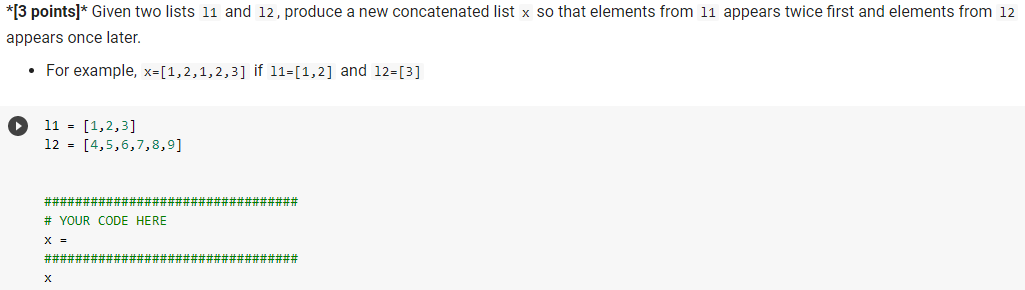
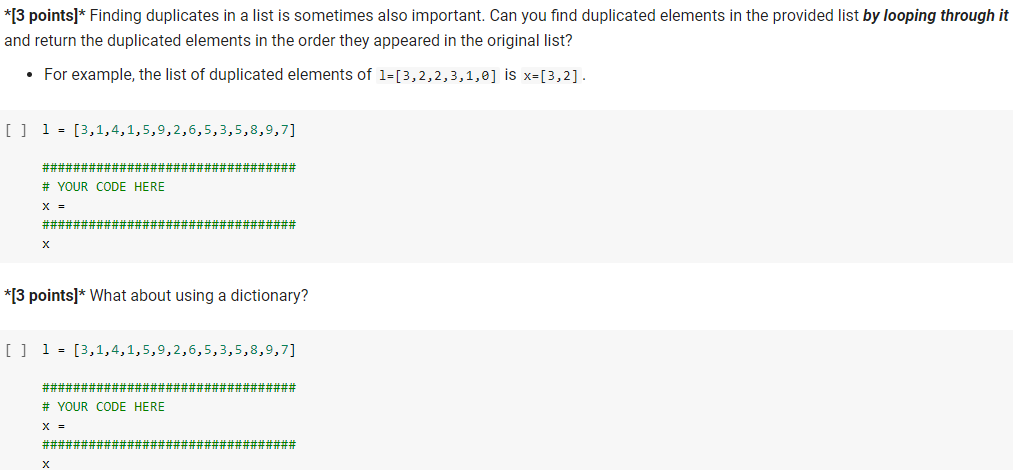
Q1. list *[24 points ] List is a very common data structure in Python programming. Being comfortable with using it will make your life easier in many cases. Let's warm up with lists! *[3 points] Tell if a particular element is present in the given list. Store your boolean value in variable x. [ ] element =8 l=[3,1,4,1,5,9,2,6,5,3,5,8,9,7] \#\#\#\#\#\#\#\#\#\#\#\#\#\#\#\#\#\#\#\#\#\#\#\#\#\#\#\#\#\#\#\#\# \# YOUR CODE HERE x= \#\#\#\#\#\#\#\#\#\#\#\#\#\#\#\#\#\#\#\#\#\#\#\#\#\#\#\#\#\#\#\#\# x *[3 points] Given two lists 11 and 12 , produce a new concatenated list x so that elements from 11 appears twice first and elements from 12 appears once later. - For example, x=[1,2,1,2,3] if 11=[1,2] and 12=[3] 11=[1,2,3]12=[4,5,6,7,8,9] \#\#\#\#\#\#\#\#\#\#\#\#\#\#\#\#\#\#\#\#\#\#\#\#\#\#\#\#\#\#\#\#\# \# YOUR CODE HERE X= \#\#\#\#\#\#\#\#\#\#\#\#\#\#\#\#\#\#\#\#\#\#\#\#\#\#\#\#\#\#\#\#\# x *[ 3 points ] Given a list, calculate its length by using the len() function []1=[3,1,4,1,5,9,2,6,5,3,5,8,9,7] \#\#\#\#\#\#\#\#\#\#\#\#\#\#\#\#\#\#\#\#\#\#\#\#\#\#\#\#\#\#\#\#\# \# YOUR CODE HERE x= \#\#\#\#\#\#\#\#\#\#\#\#\#\#\#\#\#\#\#\#\#\#\#\#\#\#\#\#\#\#\#\#\# x [3 points What about calculating the length without len()? - Can you do that with a for loop? - Hint: there are two types of for loops we discussed in class. One is iterating by index. What's the other one? Can you use that in this question? [ ] 1=[3,1,4,1,5,9,2,6,5,3,5,8,9,7] \#\#\#\#\#\#\#\#\#\#\#\#\#\#\#\#\#\#\#\#\#\#\#\#\#\#\#\#\#\#\#\#\# \# YOUR CODE HERE x= \#\#\#\#\#\#\#\#\#\#\#\#\#\#\#\#\#\#\#\#\#\#\#\#\#\#\#\#\#\#\#\#\# x *[3 points] Finding duplicates in a list is sometimes also important. Can you find duplicated elements in the provided list by looping through it and return the duplicated elements in the order they appeared in the original list? - For example, the list of duplicated elements of 1=[3,2,2,3,1,0] is x=[3,2]. []1=[3,1,4,1,5,9,2,6,5,3,5,8,9,7] \#\#\#\#\#\#\#\#\#\#\#\#\#\#\#\#\#\#\#\#\#\#\#\#\#\#\#\# \# YOUR CODE HERE x= \#\#\#\#\#\#\#\#\#\#\#\#\#\#\#\#\#\#\#\#\#\#\#\#\#\#\#\#\#\# x *[3 points] What about using a dictionary? []]=[3,1,4,1,5,9,2,6,5,3,5,8,9,7] \#\#\#\#\#\#\#\#\#\#\#\#\#\#\#\#\#\#\#\#\#\#\#\#\#\#\# \# YOUR CODE HERE x= \#\#\#\#\#\#\#\#\#\#\#\#\#\#\#\#\#\#\#\#\#\#\#\#\#\#\#\#\#\# x [3 points] Slicing is a great feature of Python. Can you return the 3rd element to the 5 th element (inclusive both ends) of the given list? Store your returned list in x. []1=[3,1,4,1,5,9,2,6,5,3,5,8,9,7] \#\#\#\#\#\#\#\#\#\#\#\#\#\#\#\#\#\#\#\#\#\#\#\#\#\#\#\#\#\#\#\#\# \# YOUR CODE HERE X= \#\#\#\#\#\#\#\#\#\#\#\#\#\#\#\#\#\#\#\#\#\#\#\#\#\#\#\#\#\#\#\#\# x *[3 points] ] Let's go deeper into slicing! Can you return the 5th to the 10th element in reverse order? Store your result in variable x. []]=[3,1,4,1,5,9,2,6,5,3,5,8,9,7] \#\#\#\#\#\#\#\#\#\#\#\#\#\#\#\#\#\#\#\#\#\#\#\#\#\#\#\#\#\#\#\#\# \# YOUR CODE HERE x= \#\#\#\#\#\#\#\#\#\#\#\#\#\#\#\#\#\#\#\#\#\#\#\#\#\#\#\#\#\#\#\#\# x
Step by Step Solution
There are 3 Steps involved in it

Get step-by-step solutions from verified subject matter experts