







Question: Q1. Multi-server Queues. You are asked to compare three system configurations. The first configuration uses two standard servers, each of which having its own queue.
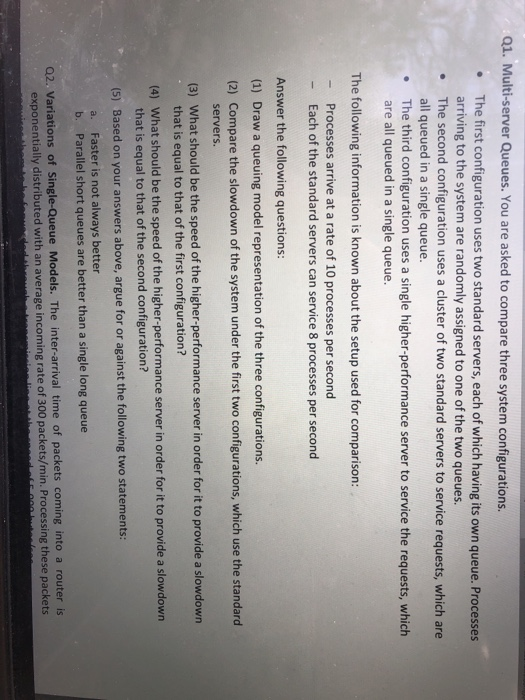
Q1. Multi-server Queues. You are asked to compare three system configurations. The first configuration uses two standard servers, each of which having its own queue. Processes .The second configuration uses a cluster of two standard servers to service requests, which are .The third configuration uses a single higher-performance server to service the requests, which arriving to the system are randomly assigned to one of the two queues. all queued in a single queue. are all queued in a single queue The following information is known about the setup used for comparison: - Processes arrive at a rate of 10 processes per second -Each of the standard servers can service 8 processes per second Answer the following questions: (1) Draw a queuing model representation of the three configurations. (2) Compare the slowdown of the system under the first two configurations, which use the standard servers. (3) What should be the speed of the higher-performance server in order for it to provide a slowdown that is equal to that of the first configuration? (4) What should be the speed of the higher-performance server in order for it to provide a slowdown that is equal to that of the second configuration? (5) Based on your answers above, argue for or against the following two statements Faster is not always better Parallel short queues are better than a single long queue a. b. Q2. Variations of Single-Queue Models. The inter-arrival time of packets coming into a router is ponentially distributed with an average incoming rate of 300 packets/min. Processing these packets Q1. Multi-server Queues. You are asked to compare three system configurations. The first configuration uses two standard servers, each of which having its own queue. Processes .The second configuration uses a cluster of two standard servers to service requests, which are .The third configuration uses a single higher-performance server to service the requests, which arriving to the system are randomly assigned to one of the two queues. all queued in a single queue. are all queued in a single queue The following information is known about the setup used for comparison: - Processes arrive at a rate of 10 processes per second -Each of the standard servers can service 8 processes per second Answer the following questions: (1) Draw a queuing model representation of the three configurations. (2) Compare the slowdown of the system under the first two configurations, which use the standard servers. (3) What should be the speed of the higher-performance server in order for it to provide a slowdown that is equal to that of the first configuration? (4) What should be the speed of the higher-performance server in order for it to provide a slowdown that is equal to that of the second configuration? (5) Based on your answers above, argue for or against the following two statements Faster is not always better Parallel short queues are better than a single long queue a. b. Q2. Variations of Single-Queue Models. The inter-arrival time of packets coming into a router is ponentially distributed with an average incoming rate of 300 packets/min. Processing these packets
Step by Step Solution
There are 3 Steps involved in it

Get step-by-step solutions from verified subject matter experts
 Study Help