



Question: Q-1: Paging is a memory-management scheme that permits the physical address space of a process to be noncontiguous. However, paging avoids external fragmentation and the
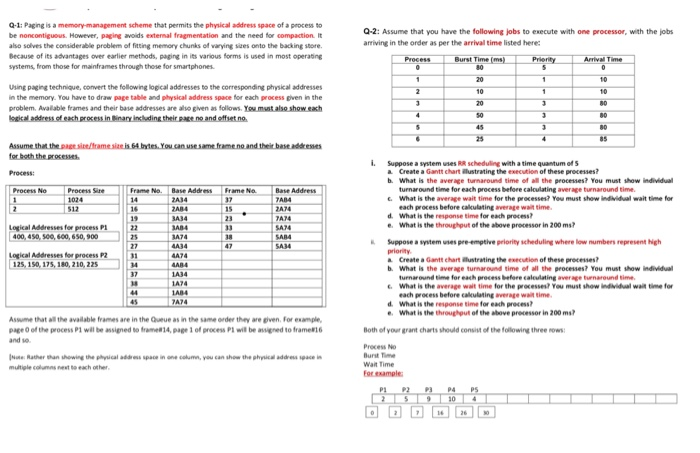

Q-1: Paging is a memory-management scheme that permits the physical address space of a process to be noncontiguous. However, paging avoids external fragmentation and the need for compaction It also solves the considerable problem of fitting memory chunks of varying sizes onto the backing store Because of its advantages over earlier methods, paging in its various forms is used in most operating systems, from those for mainframes through those for smartphones Q-2: Assume that you have the following jobs to execute with one processor, with the jobs ariving in the order as per the arrival time listed here Using paging technique, convert the following logical addresses to the corresponding physical addresses in the memory. You have to draw page table and physical address space for each process pven in the problem. Available frames and their base addresses are also given as follows. Youmust also show each and al d alse show.ach 85 i. Suppose a system uses RR scheduling with a time quantum of!S a Create a Gantt chart lustrating the execution of these processes? b. What is the average turnaround time of al the processes? You must show individual No Process turnaround time for each process before caloulating average turnaround time. . What is the average wait time for the processes? You must show indvidual wait time for Frame No. Base Frame N Base Address each process before calkulating average wait time d. What is the response time for each process $12 15 e. What is the throughput of the above processor in 200 ms Logical Addresses for process P 400,450, 500, 600, 650, 900 A74 Suppose a system utes pre-emptive priority scheduling where low numbers represent High A74 Logical Addresses for process 125, 150 175, 180, 210, 225 Create a Gantt chart ustrating the execution of these precesses? b. What is the average turnaround time ef ll the processes? You must show individual 37 . What is the average walt time for the processes You must show indvidual wait time for each process before calkulating average wait time d. What is the response time for each process? .What is the throughput of the above prcessor in 200 ms Assume that all the available frames are in the Queue as in the same order they are given, For esample, page o oreerrocess P1 wal be assigned to trame#14, page 1 of process Pl wil be as signed to frame#16 and so Both of your grant charts should consist of the following three ows Process NO Burst Tme Wait Time For example Nte Rather than howing the physical address space in one colu, you can show the physical address pace in multigle columns net to each other Q-1: Paging is a memory-management scheme that permits the physical address space of a process to be noncontiguous. However, paging avoids external fragmentation and the need for compaction It also solves the considerable problem of fitting memory chunks of varying sizes onto the backing store Because of its advantages over earlier methods, paging in its various forms is used in most operating systems, from those for mainframes through those for smartphones Q-2: Assume that you have the following jobs to execute with one processor, with the jobs ariving in the order as per the arrival time listed here Using paging technique, convert the following logical addresses to the corresponding physical addresses in the memory. You have to draw page table and physical address space for each process pven in the problem. Available frames and their base addresses are also given as follows. Youmust also show each and al d alse show.ach 85 i. Suppose a system uses RR scheduling with a time quantum of!S a Create a Gantt chart lustrating the execution of these processes? b. What is the average turnaround time of al the processes? You must show individual No Process turnaround time for each process before caloulating average turnaround time. . What is the average wait time for the processes? You must show indvidual wait time for Frame No. Base Frame N Base Address each process before calkulating average wait time d. What is the response time for each process $12 15 e. What is the throughput of the above processor in 200 ms Logical Addresses for process P 400,450, 500, 600, 650, 900 A74 Suppose a system utes pre-emptive priority scheduling where low numbers represent High A74 Logical Addresses for process 125, 150 175, 180, 210, 225 Create a Gantt chart ustrating the execution of these precesses? b. What is the average turnaround time ef ll the processes? You must show individual 37 . What is the average walt time for the processes You must show indvidual wait time for each process before calkulating average wait time d. What is the response time for each process? .What is the throughput of the above prcessor in 200 ms Assume that all the available frames are in the Queue as in the same order they are given, For esample, page o oreerrocess P1 wal be assigned to trame#14, page 1 of process Pl wil be as signed to frame#16 and so Both of your grant charts should consist of the following three ows Process NO Burst Tme Wait Time For example Nte Rather than howing the physical address space in one colu, you can show the physical address pace in multigle columns net to each other
Step by Step Solution
There are 3 Steps involved in it

Get step-by-step solutions from verified subject matter experts