



Question: Q1: Two elections are held between candidates A, B, and C. They are similar, except that a few voters changed their preferences. The preference tables
Q1: Two elections are held between candidates A, B, and C. They are similar, except that a few voters changed their preferences. The preference tables for each election are shown below.
Q2: Two elections are held between candidates A, B, and C. They are similar, except that a few voters changed their preferences. The preference tables for each election are shown below.
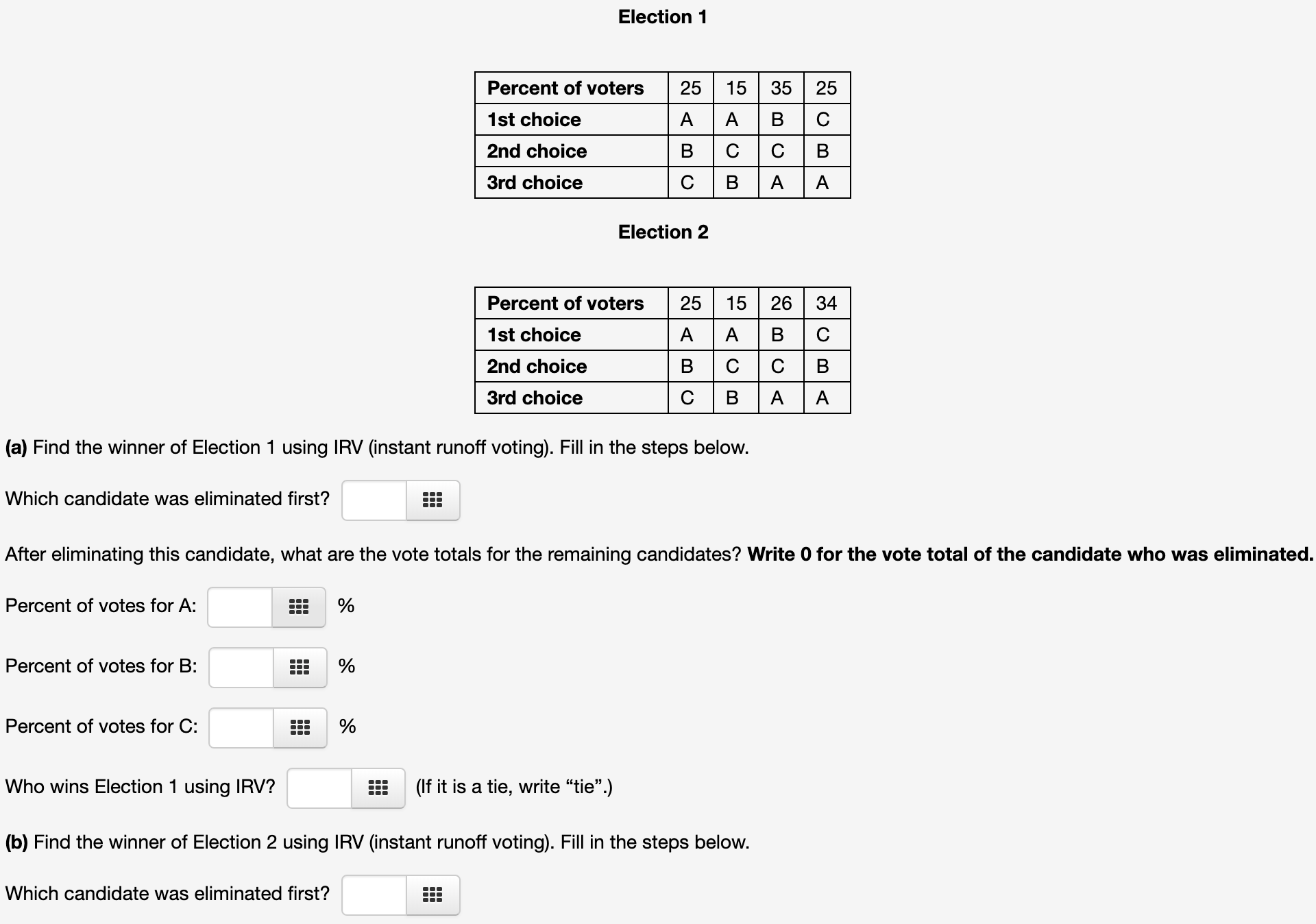
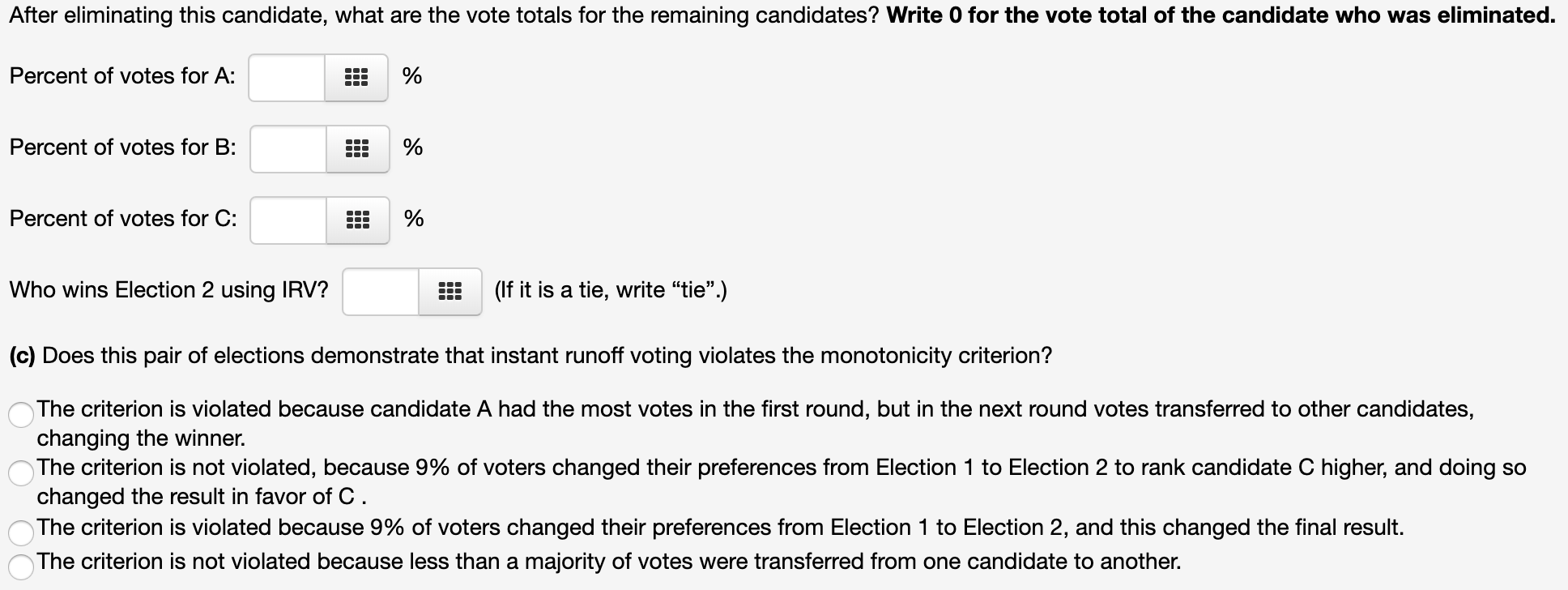
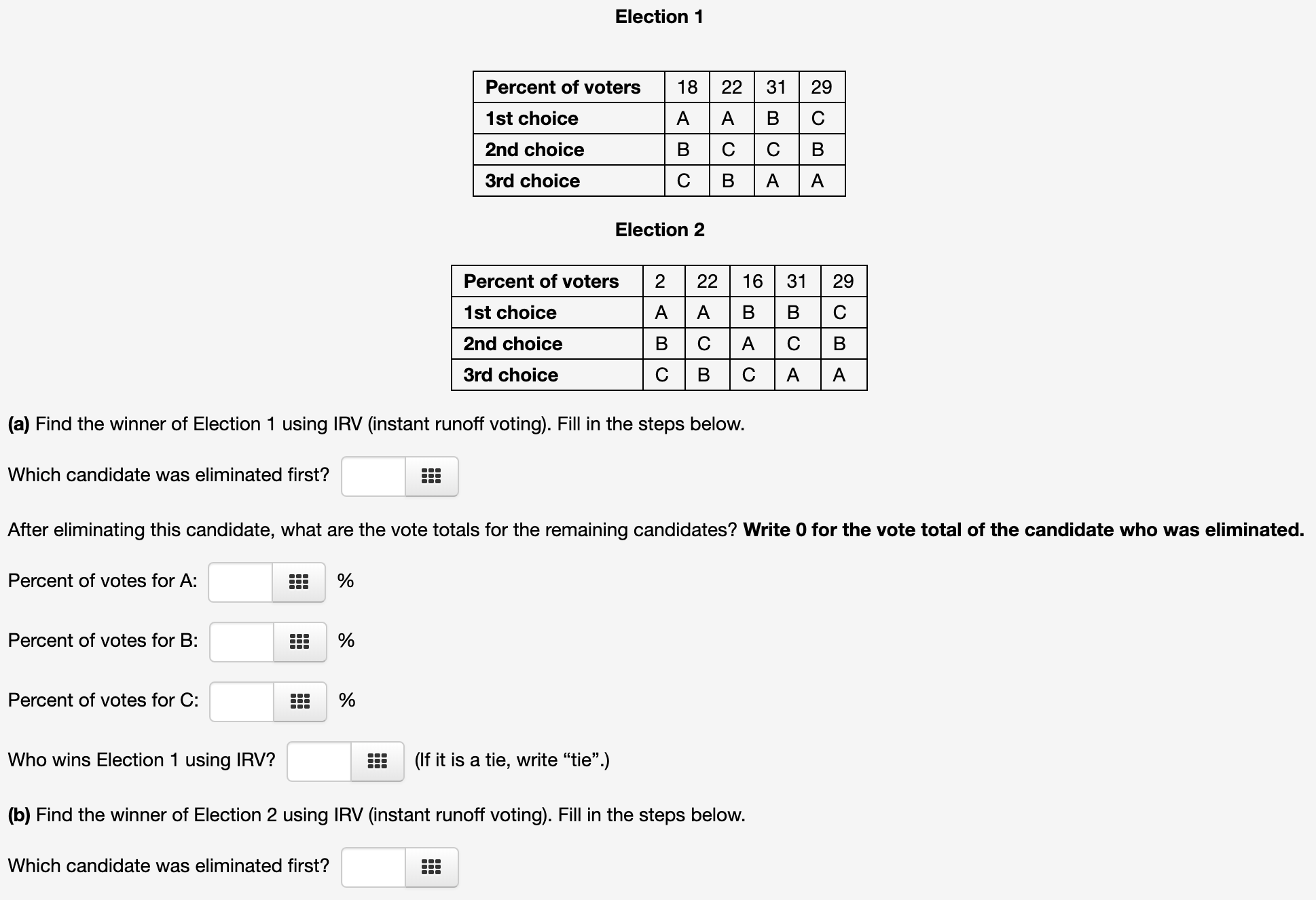
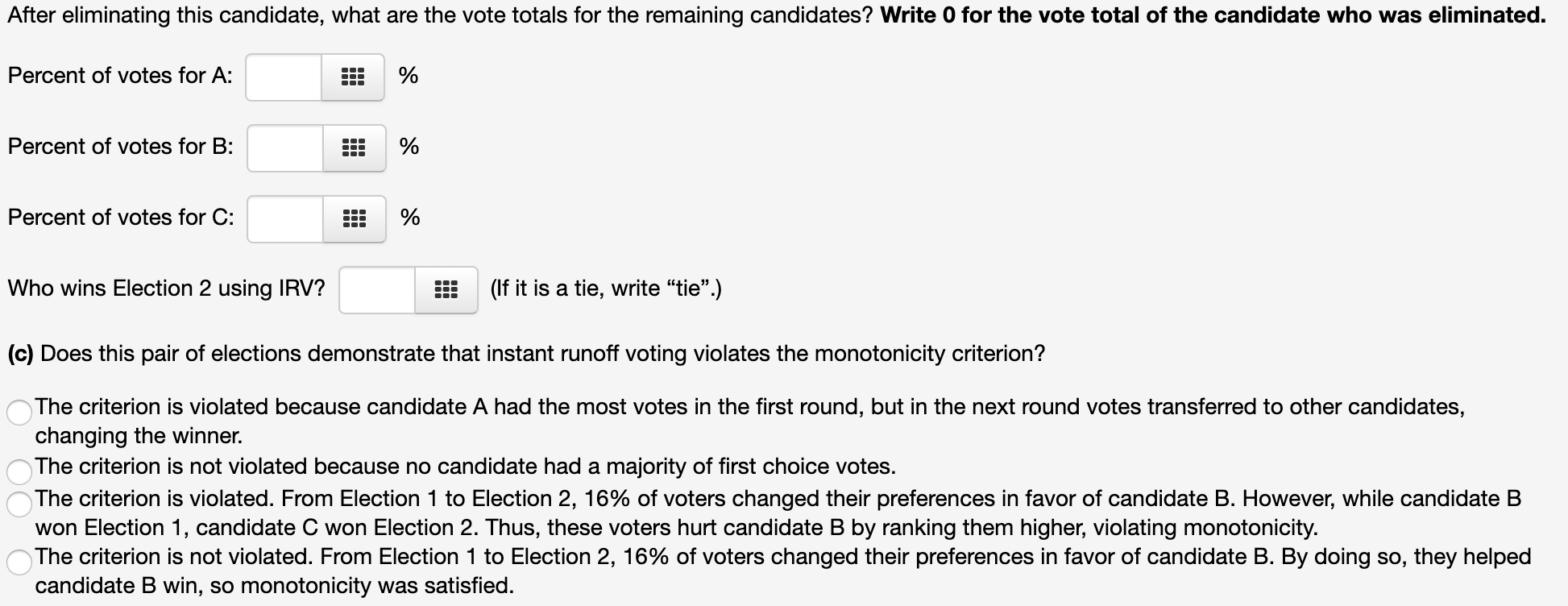
Election 1 Percent of voters 1 st choice 2nd choice 3rd choice Election 2 Percent of voters 25 15 26 34 1 st choice 2nd choice 3rd choice (a) Find the winner of Election 1 using IRV (instant runoff voting). Fill in the steps below. Which candidate was eliminated first? ::: After eliminating this candidate, what are the vote totals for the remaining candidates? Write O for the vote total of the candidate who was eliminated. Percent of votes for A: 5!! % Percent of votes for B: 555 % Percent of votes for C: 555 % Who wins Election 1 using IRV? 555 (If it is a tie, write \"tie".) (b) Find the winner of Election 2 using IRV (instant runoff voting). Fill in the steps below. Which candidate was eliminated first? ::: After eliminating this candidate, what are the vote totals for the remaining candidates? Write O for the vote total of the candidate who was eliminated. Percent of votes for A: 55! % Percent of votes for B: 555 % Percent of votes for C: 555 % Who wins Election 2 using IRV? 5!! (If it is a tie, write \"tie".) (c) Does this pair of elections demonstrate that instant runoff voting violates the monotonicity criterion? (The criterion is violated because candidate A had the most votes in the first round, but in the next round votes transferred to other candidates, ' changing the winner. FThe criterion is not violated, because 9% of voters changed their preferences from Election 1 to Election 2 to rank candidate C higher, and doing so ' changed the result in favor of C . (\"The criterion is violated because 9% of voters changed their preferences from Election 1 to Election 2, and this changed the final result. behe criterion is not violated because less than a majority of votes were transferred from one candidate to another. Election 1 -E-El Election 2 Percent of voters 2 22 16 31 29 1st choice A A B B C 2nd choice B C A C E 3rd choice C B C A A (3) Find the winner of Election 1 using IRV (instant runoff voting). Fill in the steps below. Which candidate was eliminated first? === After eliminating this candidate, what are the vote totals for the remaining candidates? Write 0 for the vote total of the candidate who was eliminated. Percent of votes for A: 555 % Percent of votes for B: 555 % Percent of votes for C: 555 % Who wins Election 1 using IRV'? 555 (If it is a tie, write \"tie".) (b) Find the winner of Election 2 using IRV (instant runoff voting). Fill in the steps below. Which candidate was eliminated first? === After eliminating this candidate, what are the vote totals for the remaining candidates? Write 0 for the vote total of the candidate who was eliminated. Percent of votes for A: 555 % Percent of votes for B: 555 % Percent of votes for C: 555 % Who wins Election 2 using IRV? iii (If it is a tie, write \"tie\".) (c) Does this pair of elections demonstrate that instant runoff voting violates the monotonicity criterion? .dThe criterion is violated because candidate A had the most votes in the first round, but in the next round votes transferred to other candidates, 7 changing the winner. .dThe criterion is not violated because no candidate had a majority of first choice votes. KWThe criterion is violated. From Election 1 to Election 2, 16% of voters changed their preferences in favor of candidate B. However, while candidate B won Election 1, candidate C won Election 2. Thus, these voters hurt candidate B by ranking them higher, violating monotonicity. .dThe criterion is not violated. From Election 1 to Election 2, 16% of voters changed their preferences in favor of candidate B. By doing so, they helped 7 candidate B win, so monotonicity was satisfied
Step by Step Solution
There are 3 Steps involved in it

Get step-by-step solutions from verified subject matter experts