







Question: Q1) Use mixed-integer linear programming to solve the problem regarding the monthly demand. Suppose that holding cost is applied to the ending inventory. Develop the
Q1) Use mixed-integer linear programming to solve the problem regarding the monthly demand. Suppose that holding cost is applied to the ending inventory.
Develop the mathematical model with a Microsoft Excel File. (please send it to " j j d e j i @ g m a i l . c o m" ) Will give you a like.
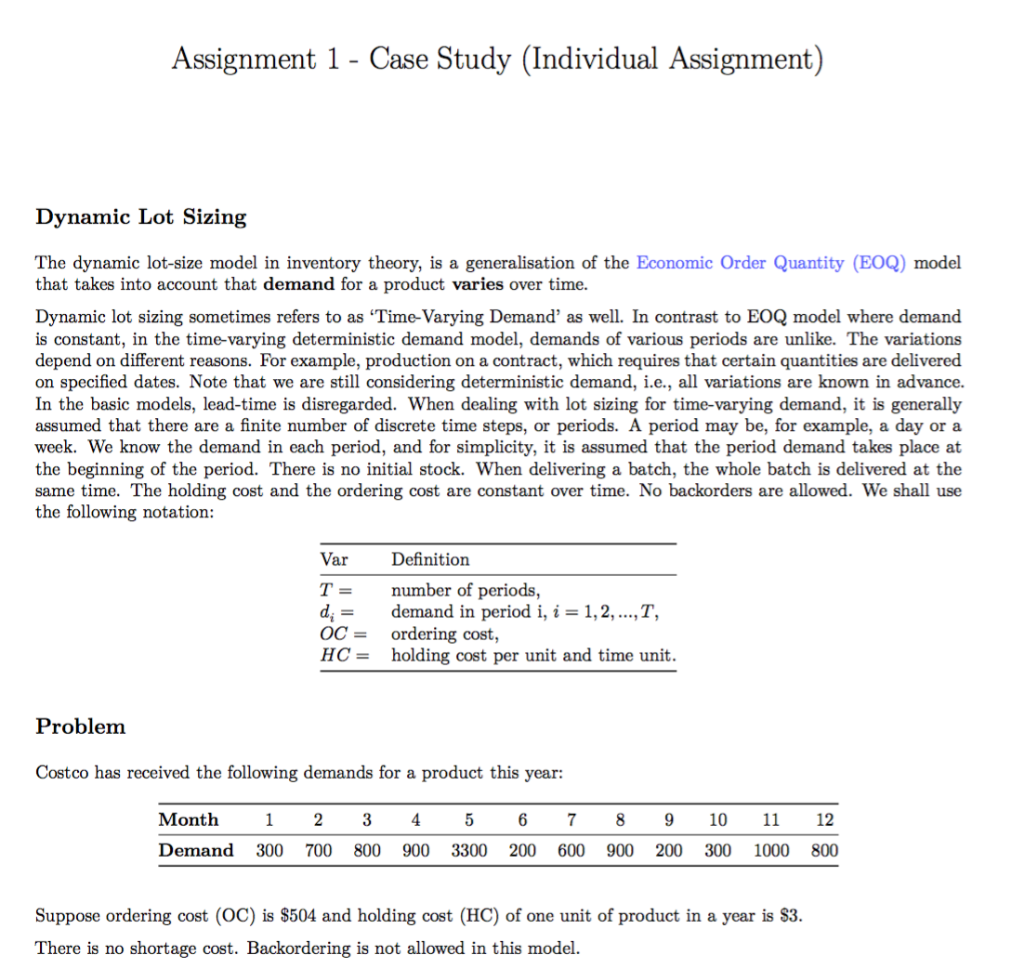
Assignment 1 - Case Study (Individual Assignment) Dynamic Lot Sizing The dynamic lot-size model in inventory theory, is a generalisation of the Economic Order Quantity (EOQ) model that takes into account that demand for a product varies over time. Dynamic lot sizing sometimes refers to as 'Time-varying Demand' as well. In contrast to EOQ model where demand is constant, in the time-varying deterministic demand model, demands of various periods are unlike. The variations depend on different reasons. For example, production on a contract, which requires that certain quantities are delivered on specified dates. Note that we are still considering deterministic demand, i.e., all variations are known in advance. In the basic models, lead-time is disregarded. When dealing with lot sizing for time-varying demand, it is generally assumed that there are a finite number of discrete time steps, or periods. A period may be, for example, a day or a week. We know the demand in each period, and for simplicity, it is assumed that the period demand takes place at the beginning of the period. There is no initial stock. When delivering a batch, the whole batch is delivered at the same time. The holding cost and the ordering cost are constant over time. No backorders are allowed. We shall use the following notation: Var T = di = OCE HC= Definition number of periods, demand in period i, i = 1, 2, ...,T, ordering cost, holding cost per unit and time unit. Problem Costco has received the following demands for a product this year: Month 1 2 3 4 5 6 7 8 9 10 11 12 Demand 300 700 800 900 3300 200 600 900 200 300 1000 800 Suppose ordering cost (OC) is $504 and holding cost (HC) of one unit of product in a year is $3. There is no shortage cost. Backordering is not allowed in this model. Assignment 1 - Case Study (Individual Assignment) Dynamic Lot Sizing The dynamic lot-size model in inventory theory, is a generalisation of the Economic Order Quantity (EOQ) model that takes into account that demand for a product varies over time. Dynamic lot sizing sometimes refers to as 'Time-varying Demand' as well. In contrast to EOQ model where demand is constant, in the time-varying deterministic demand model, demands of various periods are unlike. The variations depend on different reasons. For example, production on a contract, which requires that certain quantities are delivered on specified dates. Note that we are still considering deterministic demand, i.e., all variations are known in advance. In the basic models, lead-time is disregarded. When dealing with lot sizing for time-varying demand, it is generally assumed that there are a finite number of discrete time steps, or periods. A period may be, for example, a day or a week. We know the demand in each period, and for simplicity, it is assumed that the period demand takes place at the beginning of the period. There is no initial stock. When delivering a batch, the whole batch is delivered at the same time. The holding cost and the ordering cost are constant over time. No backorders are allowed. We shall use the following notation: Var T = di = OCE HC= Definition number of periods, demand in period i, i = 1, 2, ...,T, ordering cost, holding cost per unit and time unit. Problem Costco has received the following demands for a product this year: Month 1 2 3 4 5 6 7 8 9 10 11 12 Demand 300 700 800 900 3300 200 600 900 200 300 1000 800 Suppose ordering cost (OC) is $504 and holding cost (HC) of one unit of product in a year is $3. There is no shortage cost. Backordering is not allowed in this model
Step by Step Solution
There are 3 Steps involved in it
1 Expert Approved Answer
Step: 1 Unlock

Question Has Been Solved by an Expert!
Get step-by-step solutions from verified subject matter experts
Step: 2 Unlock
Step: 3 Unlock
 Study Help