







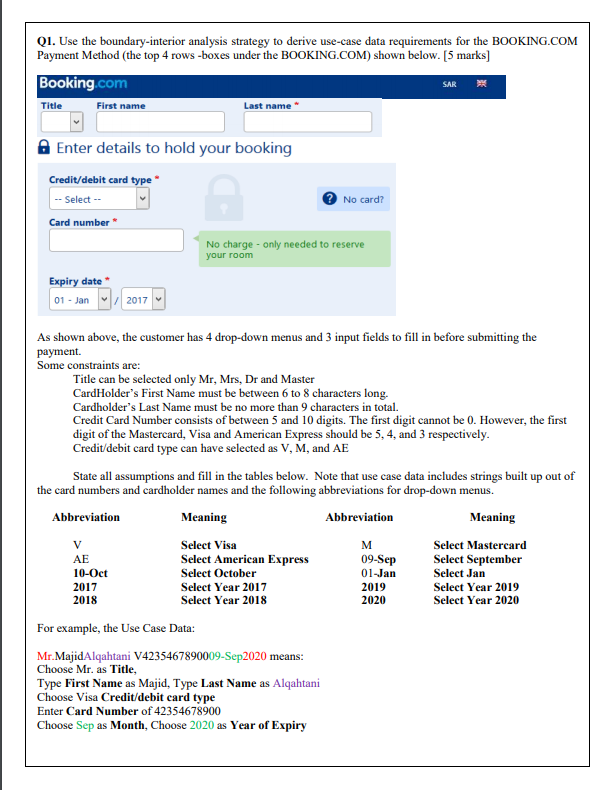
Question: ? Q1. Use the boundary-interior analysis strategy to derive use-case data requirements for the BOOKING.COM Payment Method (the top 4 rows -boxes under the BOOKING.COM)
?
![BOOKING.COM) shown below. (5 marks] Booking.com First name Last name SAR Title](https://dsd5zvtm8ll6.cloudfront.net/si.experts.images/questions/2024/09/66f523ac55b8a_48366f523abeab13.jpg)
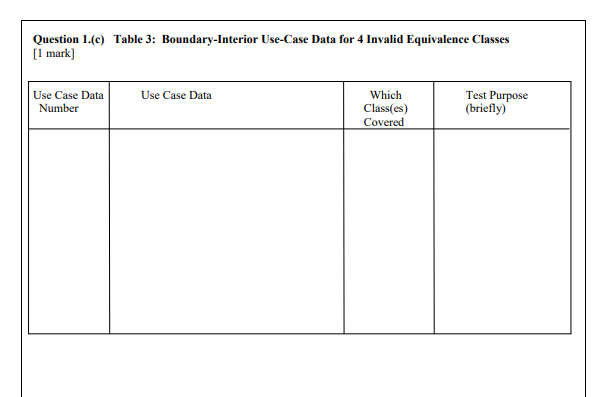
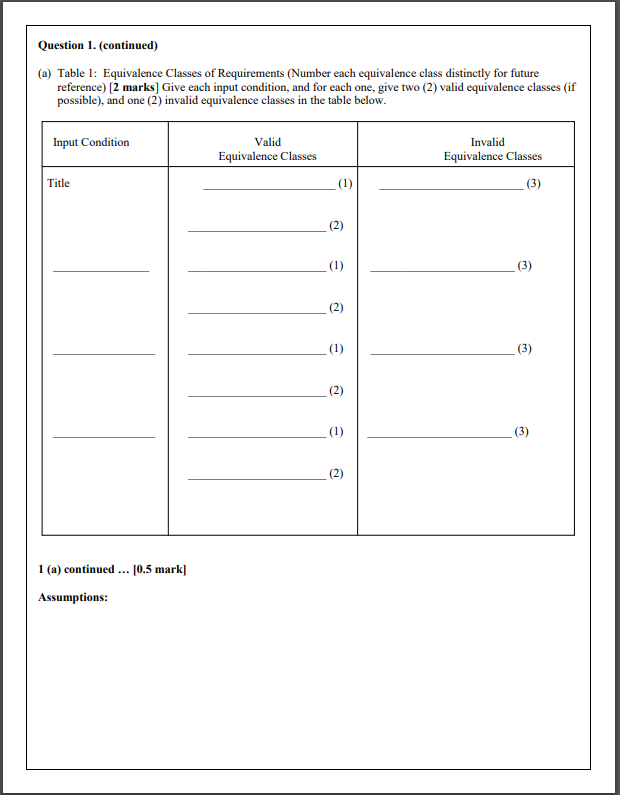
Q1. Use the boundary-interior analysis strategy to derive use-case data requirements for the BOOKING.COM Payment Method (the top 4 rows -boxes under the BOOKING.COM) shown below. (5 marks] Booking.com First name Last name SAR Title Enter details to hold your booking Credit/debit card type -- Select -- Card number No card? No charge - only needed to reserve your room Expiry date 01 - Jan 2017 As shown above, the customer has 4 drop-down menus and 3 input fields to fill in before submitting the payment. Some constraints are: Title can be selected only Mr, Mrs, Dr and Master Card Holder's First Name must be between 6 to 8 characters long. Cardholder's Last Name must be no more than 9 characters in total. Credit Card Number consists of between 5 and 10 digits. The first digit cannot be 0. However, the first digit of the Mastercard, Visa and American Express should be 5, 4, and 3 respectively. Credit/debit card type can have selected as V, M, and AE State all assumptions and fill in the tables below. Note that use case data includes strings built up out of the card numbers and cardholder names and the following abbreviations for drop-down menus. Abbreviation Meaning Abbreviation Meaning V Select Visa M Select Mastercard Select American Express 09-Sep Select September 10-Oct Select October 01-Jan Select Jan 2017 Select Year 2017 2019 Select Year 2019 2018 Select Year 2018 2020 Select Year 2020 For example, the Use Case Data: Mr.MajidAlqahtani V4235467890009-Sep2020 means: Choose Mr. as Title Type First Name as Majid, Type Last Name as Alqahtani Choose Visa Credit/debit card type Enter Card Number of 42354678900 Choose Sep as Month, Choose 2020 as Year of Expiry AE Question 1. (continued) (a) Table 1: Equivalence Classes of Requirements (Number each equivalence class distinctly for future reference) [2 marks] Give each input condition, and for each one, give two (2) valid equivalence classes (if possible), and one (2) invalid equivalence classes in the table below. Input Condition Valid Equivalence Classes Invalid Equivalence Classes Title (1) (3) (2) (1) (2) (1) (2) (1) (2) 1 (a) continued ... 10.5 mark] Assumptions: Question 1. (b) Table 2: Boundary-Interior Use Case Data to cover Valid Equivalence Classes [1.5 marks] Use Case Use Case Data Boundaries Class(es) Number Covered Covered Question 1.(e) Table 3: Boundary-Interior Use-Case Data for 4 Invalid Equivalence Classes [1 mark] Use Case Data Number Use Case Data Which Class(es) Covered Test Purpose (briefly) Q1. Use the boundary-interior analysis strategy to derive use-case data requirements for the BOOKING.COM Payment Method (the top 4 rows -boxes under the BOOKING.COM) shown below. (5 marks] Booking.com First name Last name SAR Title Enter details to hold your booking Credit/debit card type -- Select -- Card number No card? No charge - only needed to reserve your room Expiry date 01 - Jan 2017 As shown above, the customer has 4 drop-down menus and 3 input fields to fill in before submitting the payment. Some constraints are: Title can be selected only Mr, Mrs, Dr and Master Card Holder's First Name must be between 6 to 8 characters long. Cardholder's Last Name must be no more than 9 characters in total. Credit Card Number consists of between 5 and 10 digits. The first digit cannot be 0. However, the first digit of the Mastercard, Visa and American Express should be 5, 4, and 3 respectively. Credit/debit card type can have selected as V, M, and AE State all assumptions and fill in the tables below. Note that use case data includes strings built up out of the card numbers and cardholder names and the following abbreviations for drop-down menus. Abbreviation Meaning Abbreviation Meaning V Select Visa M Select Mastercard Select American Express 09-Sep Select September 10-Oct Select October 01-Jan Select Jan 2017 Select Year 2017 2019 Select Year 2019 2018 Select Year 2018 2020 Select Year 2020 For example, the Use Case Data: Mr.MajidAlqahtani V4235467890009-Sep2020 means: Choose Mr. as Title Type First Name as Majid, Type Last Name as Alqahtani Choose Visa Credit/debit card type Enter Card Number of 42354678900 Choose Sep as Month, Choose 2020 as Year of Expiry AE Question 1. (continued) (a) Table 1: Equivalence Classes of Requirements (Number each equivalence class distinctly for future reference) [2 marks] Give each input condition, and for each one, give two (2) valid equivalence classes (if possible), and one (2) invalid equivalence classes in the table below. Input Condition Valid Equivalence Classes Invalid Equivalence Classes Title (1) (3) (2) (1) (2) (1) (2) (1) (2) 1 (a) continued ... 10.5 mark] Assumptions: Question 1. (b) Table 2: Boundary-Interior Use Case Data to cover Valid Equivalence Classes [1.5 marks] Use Case Use Case Data Boundaries Class(es) Number Covered Covered Question 1.(e) Table 3: Boundary-Interior Use-Case Data for 4 Invalid Equivalence Classes [1 mark] Use Case Data Number Use Case Data Which Class(es) Covered Test Purpose (briefly)
Step by Step Solution
There are 3 Steps involved in it

Get step-by-step solutions from verified subject matter experts
 Study Help