







Question: Q1 was Computer Organization & Architecture (Allan Clements) Ch12 problem 8. THIS IS EVERYTHING FOR THIS QUESTIONS, DO NOT JUDGE THIS AS INCOMPLETE NOOB Question
Q1 was Computer Organization & Architecture (Allan Clements) Ch12 problem 8.
THIS IS EVERYTHING FOR THIS QUESTIONS, DO NOT JUDGE THIS AS INCOMPLETE NOOB
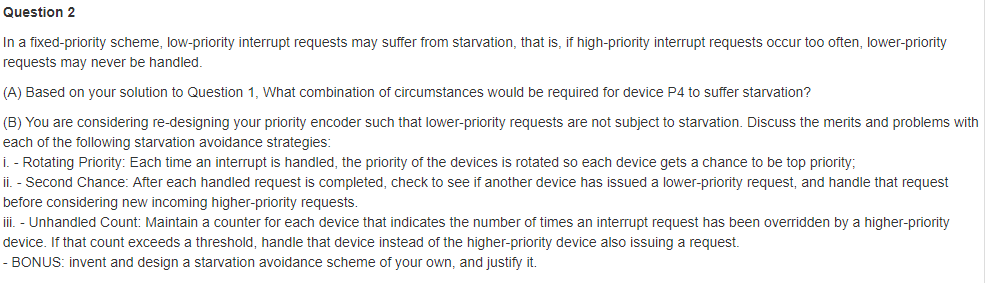
Question 2 In a fixed-priority scheme, low-priority interrupt requests may suffer from starvation, that is, if high-priority interrupt requests occur too often, lower-priority requests may never be handled (A) Based on your solution to Question 1, What combination of circumstances would be required for device P4 to suffer starvation? (B) You are considering re-designing your priority encoder such that lower-priority requests are not subject to starvation. Discuss the merits and problems with each of the following starvation avoidance strategies i. - Rotating Priority: Each time an interrupt is handled, the priority of the devices is rotated so each device gets a chance to be top priority; i. Second Chance: After each handled request is completed, check to see if another device has issued a lower-priority request, and handle that request before considering new incoming higher-priority requests ili. - Unhandled Count: Maintain a counter for each device that indicates the number of times an interrupt request has been overridden by a higher-priority device. If that count exceeds a threshold, handle that device instead of the higher-priority device also issuing a request. BONUS: invent and design a starvation avoidance scheme of your own, and justify it
Step by Step Solution
There are 3 Steps involved in it

Get step-by-step solutions from verified subject matter experts
 Study Help