







Question: Q1- What is the minimum project completion time? Q2- How many activities should be completed without interruption? Q3- How many critical paths are there in
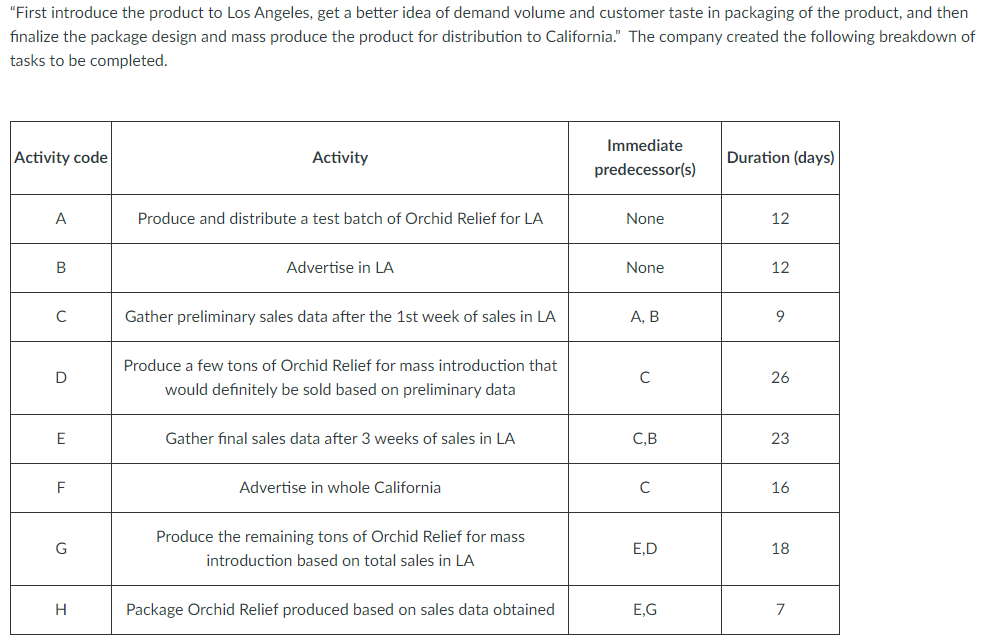
Q1- What is the minimum project completion time?
Q2- How many activities should be completed without interruption?
Q3- How many critical paths are there in this project?
Q4- In order to plan for mass production as soon as possible, Eli Orchid would like to obtain data from market research (activity E) as soon as possible. What is the earliest time the company would have this data fully available and can use it?
Q5- If activity A is delayed by 5 days, how many days of delay would the project completion time experience?
Q6- If activity E is delayed by 5 days, how many days of delay would the project completion time experience?
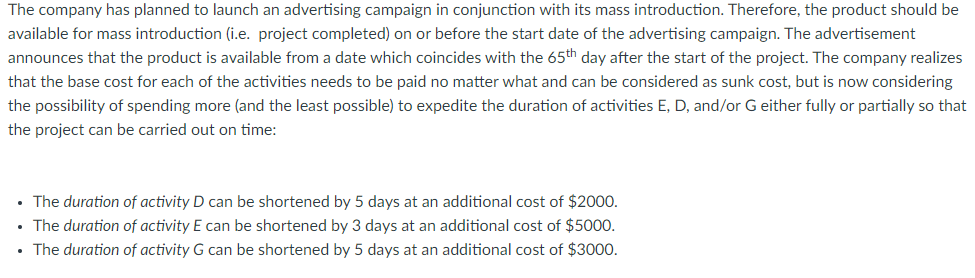
Q8- By how many days the duration of activity G is best to be shortened?
Q9- In doing the above expedition, how much additional cost will be incurred?
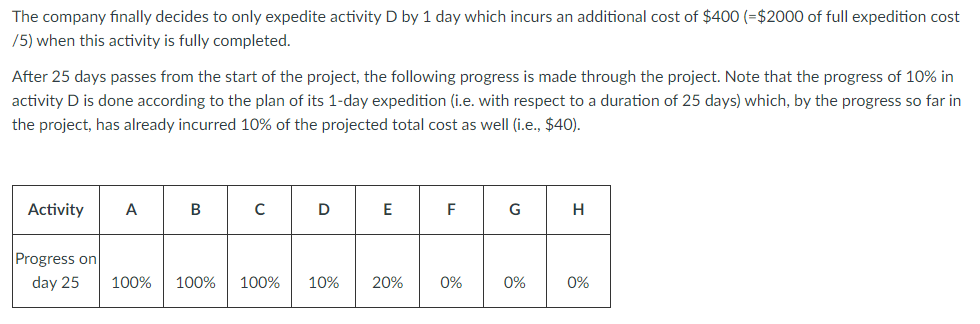
Q10- Continuing this progress, what is the earliest time the project can be expected to finish? (enter in unit of days and counted from the beginning of the project)
Q11- Eli Orchid is trying to figure how to expedite the project at this point, after seeing the progress until day 25. It can still expedite the same activities D, E, and G with the cost structure stated above. Since activity D is expedited a little bit so far, it is still possible to expedite it "further" for the remainder of this activity (but we cannot slow it down to no expedition at this point). Assume that the remaining duration and cost (both regular and expedited cases) are proportional to the remaining percentage progress of each activity. If the company still likes to finish the project by day 65, given the current progress, how much more would it have to pay from this point on (in addition to what is already spent for activity D, i.e. 10% of $400)?
"First introduce the product to Los Angeles, get a better idea of demand volume and customer taste in packaging of the product, and then finalize the package design and mass produce the product for distribution to California." The company created the following breakdown of tasks to be completed. The company has planned to launch an advertising campaign in conjunction with its mass introduction. Therefore, the product should be available for mass introduction (i.e. project completed) on or before the start date of the advertising campaign. The advertisement announces that the product is available from a date which coincides with the 65th day after the start of the project. The company realizes that the base cost for each of the activities needs to be paid no matter what and can be considered as sunk cost, but is now considering the possibility of spending more (and the least possible) to expedite the duration of activities E, D, and/or G either fully or partially so that the project can be carried out on time: - The duration of activity D can be shortened by 5 days at an additional cost of $2000. - The duration of activity E can be shortened by 3 days at an additional cost of $5000. - The duration of activity G can be shortened by 5 days at an additional cost of $3000. The company finally decides to only expedite activity D by 1 day which incurs an additional cost of $400 (= $2000 of full expedition cost /5) when this activity is fully completed. After 25 days passes from the start of the project, the following progress is made through the project. Note that the progress of 10% in activity D is done according to the plan of its 1-day expedition (i.e. with respect to a duration of 25 days) which, by the progress so far in the project, has already incurred 10% of the projected total cost as well (i.e., $40 ). "First introduce the product to Los Angeles, get a better idea of demand volume and customer taste in packaging of the product, and then finalize the package design and mass produce the product for distribution to California." The company created the following breakdown of tasks to be completed. The company has planned to launch an advertising campaign in conjunction with its mass introduction. Therefore, the product should be available for mass introduction (i.e. project completed) on or before the start date of the advertising campaign. The advertisement announces that the product is available from a date which coincides with the 65th day after the start of the project. The company realizes that the base cost for each of the activities needs to be paid no matter what and can be considered as sunk cost, but is now considering the possibility of spending more (and the least possible) to expedite the duration of activities E, D, and/or G either fully or partially so that the project can be carried out on time: - The duration of activity D can be shortened by 5 days at an additional cost of $2000. - The duration of activity E can be shortened by 3 days at an additional cost of $5000. - The duration of activity G can be shortened by 5 days at an additional cost of $3000. The company finally decides to only expedite activity D by 1 day which incurs an additional cost of $400 (= $2000 of full expedition cost /5) when this activity is fully completed. After 25 days passes from the start of the project, the following progress is made through the project. Note that the progress of 10% in activity D is done according to the plan of its 1-day expedition (i.e. with respect to a duration of 25 days) which, by the progress so far in the project, has already incurred 10% of the projected total cost as well (i.e., $40 )
Step by Step Solution
There are 3 Steps involved in it

Get step-by-step solutions from verified subject matter experts
 Study Help