







Question: Q11. If the aggregate demand parameter increases in the IS curve and the central bank wishes to stabilize output at potential, it should: a) raise
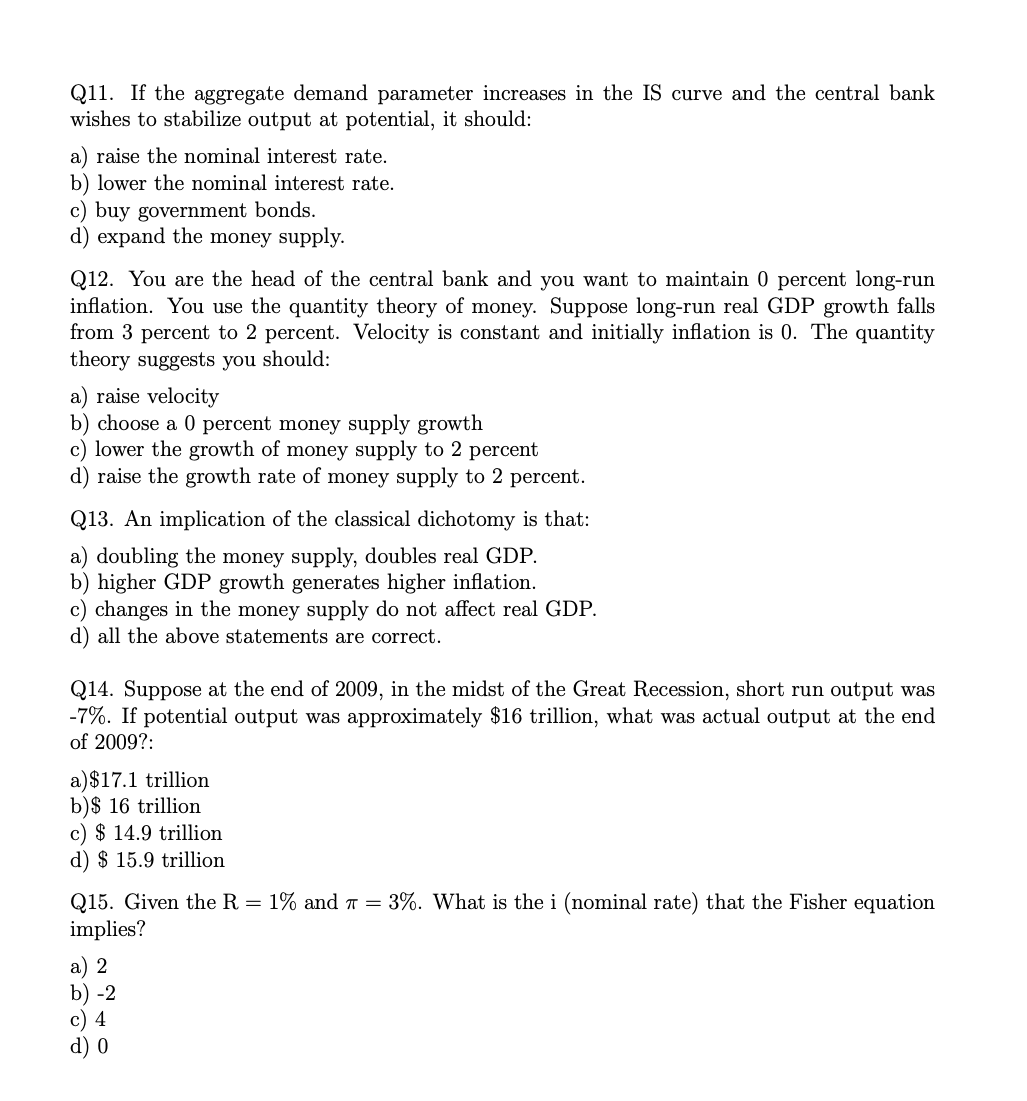
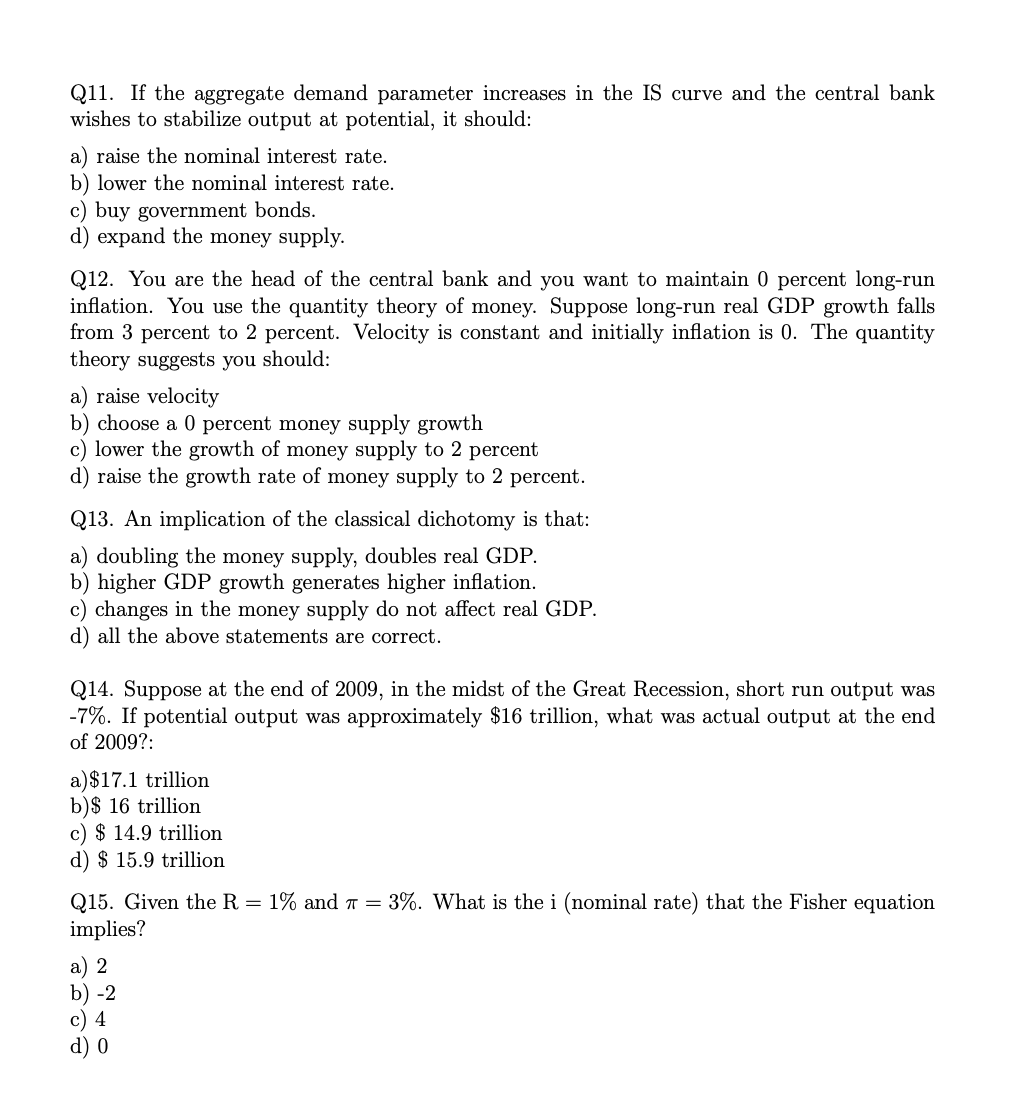
Q11. If the aggregate demand parameter increases in the IS curve and the central bank wishes to stabilize output at potential, it should: a) raise the nominal interest rate. b) lower the nominal interest rate. c) buy government bonds. (1) expand the money supply. Q12. You are the head of the central bank and you want to maintain 0 percent long-run ination. You use the quantity theory of money. Suppose long-run real GDP growth falls from 3 percent to 2 percent. Velocity is constant and initially ination is 0. The quantity theory suggests you should: a) raise velocity b) choose a 0 percent money supply growth c) lower the growth of money supply to 2 percent (1) raise the growth rate of money supply to 2 percent. Q13. An implication of the classical dichotomy is that: a) doubling the money supply, doubles real GDP. b) higher GDP growth generates higher ination. c) changes in the money supply do not aect real GDP. d] all the above statements are correct. Q14. Suppose at the end of 2009, in the midst of the Great Recession, short run output was -7%. If potential output was approximately $16 trillion, what was actual output at the end of 2009?: a)$17.1 trillion b)$ 16 trillion c) $ 14.9 trillion (1) $ 15.9 trillion Q15. Given the R = 1% and 11' = 3%. What is the i (nominal rate) that the Fisher equation implies? a) 2 b] -2 c) 4 d) 0
Step by Step Solution
There are 3 Steps involved in it

Get step-by-step solutions from verified subject matter experts
 Study Help