







Question: Q16. Let X , Y, and Z be continuous random variables. Show the following generalizations of the law of iterated expectations. 0) Elzl = E[E[Z
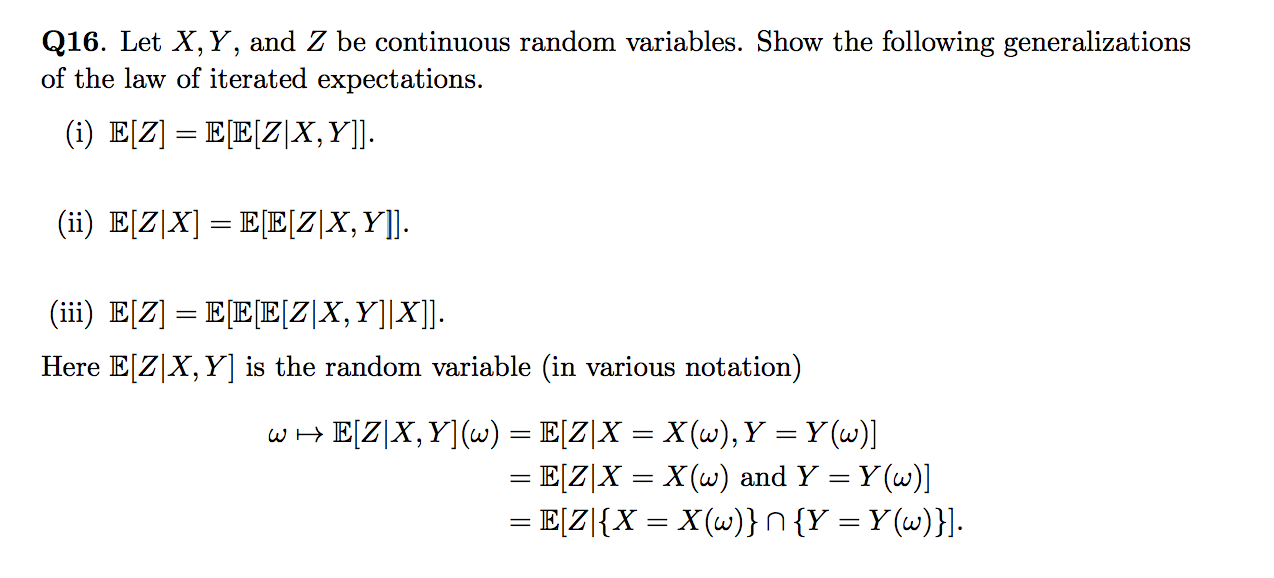
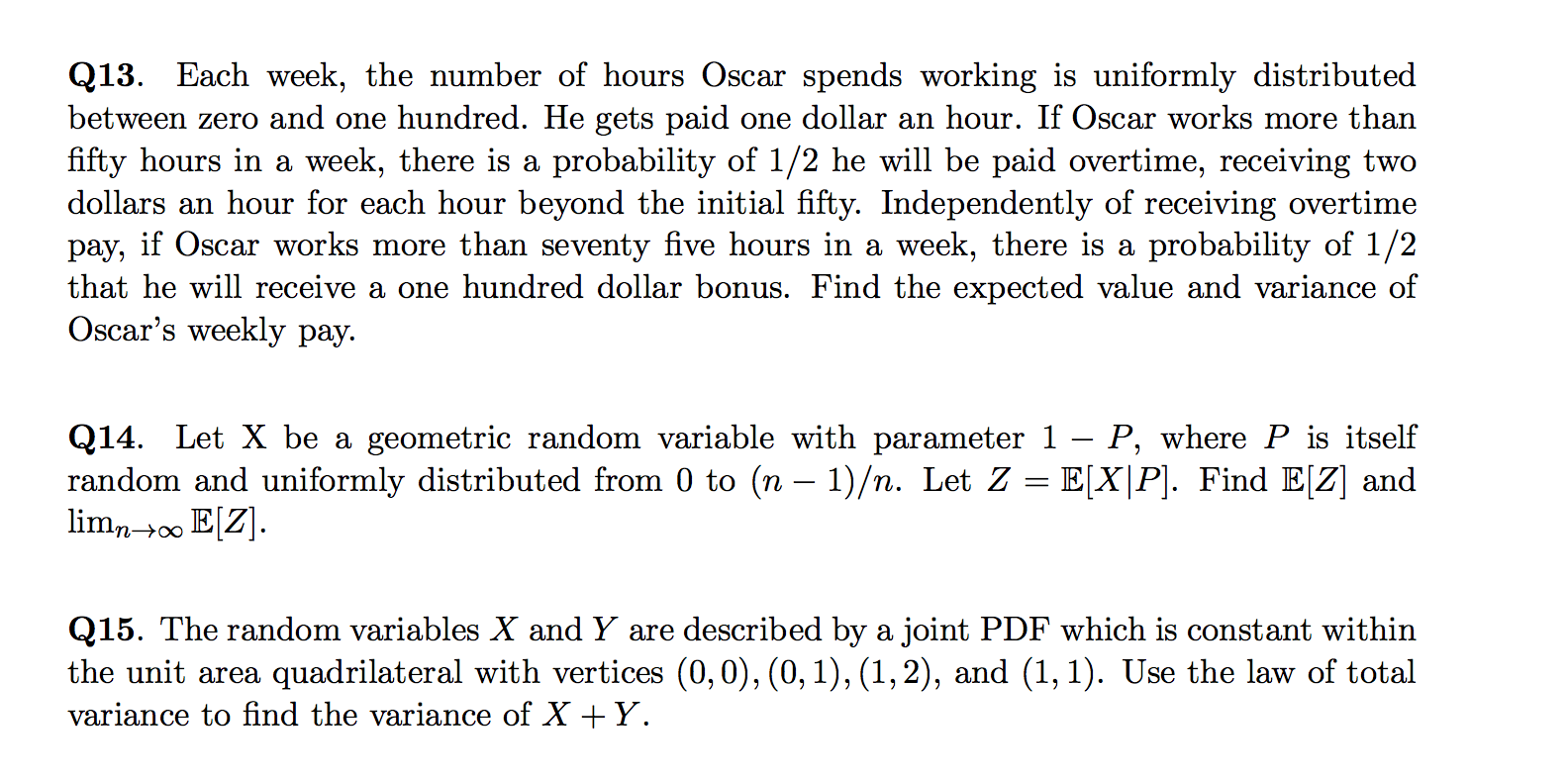
Q16. Let X , Y, and Z be continuous random variables. Show the following generalizations of the law of iterated expectations. 0) Elzl = E[E[Z IX, Y1]- (ii) ]E[Z|X] = ]E[IE[Z|X,Y|]. (iii) m2] = 1E[JE[1E[Z|X,Y]IX]]- Here IE[Z|X, Y] is the random variable (in various notation) to |) lE[Z|X, Y](w) 1E[Z|X = X(w),Y = Y(w)] 1E[Z|X = X(w) and Y = rm] 1E[Z|{X = KM} 0 {Y = Y(w)}]- Q13. Each week, the number of hours Oscar spends working is uniformly distributed between zero and one hundred. He gets paid one dollar an hour. If Oscar works more than fty hours in a week, there is a probability of 1/2 he will be paid overtime, receiving two dollars an hour for each hour beyond the initial fty. Independently of receiving overtime pay, if Oscar works more than seventy ve hours in a week, there is a probability of 1/2 that he will receive a one hundred dollar bonus. Find the expected value and variance of Oscar's weekly pay. Q14. Let X be a geometric random variable with parameter 1 P, where P is itself random and uniformly distributed from 0 to (n 1) / n. Let Z = lE[X|P]. Find lE[Z] and Q15. The random variables X and Y are described by a joint PDF which is constant within the unit area quadrilateral with vertices (0,0), (0, 1), (1, 2), and (1, 1). Use the law of total variance to nd the variance of X + Y
Step by Step Solution
There are 3 Steps involved in it

Get step-by-step solutions from verified subject matter experts
 Study Help