







Question: Q16: thumbs up for a correct quick answer Q16. [8 points] After long computations, we find the following information about a function f(I). . The
![Q16: thumbs up for a correct quick answer Q16. [8 points]](https://s3.amazonaws.com/si.experts.images/answers/2024/06/666235227780b_1626662352257b03.jpg)
Q16: thumbs up for a correct quick answer
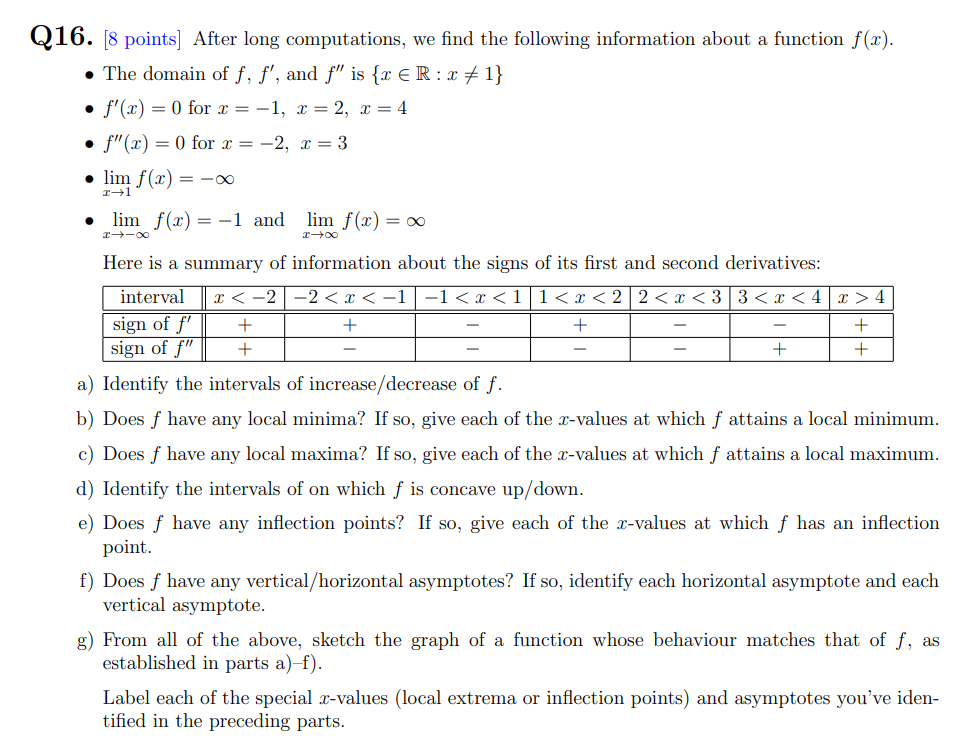
Q16. [8 points] After long computations, we find the following information about a function f(I). . The domain of f, f', and f" is {re R : x / 1} . f'(x) = 0 for r = -1, r = 2, x =4 . f"(x) = 0 for x = -2, x = 3 . lim f (r) = -00 r-+1 . lim f(x) = -1 and lim f(x) = 00 r-+ I-+Do Here is a summary of information about the signs of its first and second derivatives: interval x4 sign of f' + + + + sign of f" ] + + + a) Identify the intervals of increase/ decrease of f. b) Does f have any local minima? If so, give each of the r-values at which f attains a local minimum. c) Does f have any local maxima? If so, give each of the r-values at which f attains a local maximum. d) Identify the intervals of on which f is concave up/down. e) Does f have any inflection points? If so, give each of the r-values at which f has an inflection point. f) Does f have any vertical/horizontal asymptotes? If so, identify each horizontal asymptote and each vertical asymptote. g) From all of the above, sketch the graph of a function whose behaviour matches that of f, as established in parts a)-f). Label each of the special x-values (local extrema or inflection points) and asymptotes you've iden- tified in the preceding parts
Step by Step Solution
There are 3 Steps involved in it

Get step-by-step solutions from verified subject matter experts
 Study Help