







Question: Q1-iii. What factors should be considered when determining the sampling method to use? (List some factors that the auditor would have to consider to decide
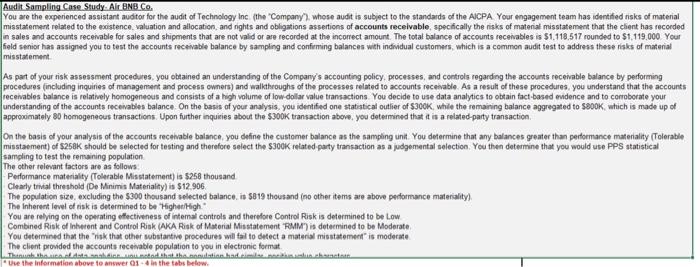
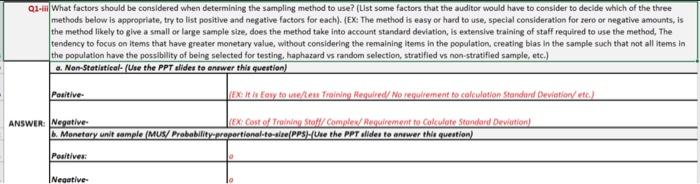
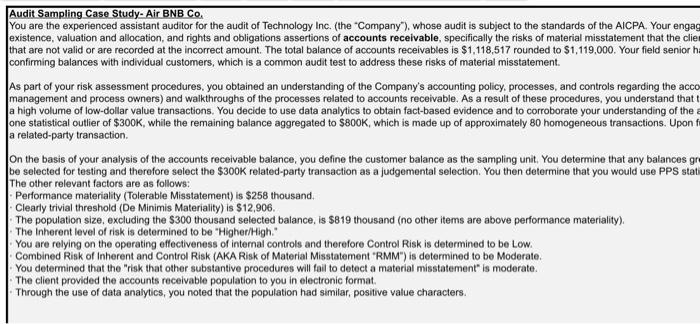
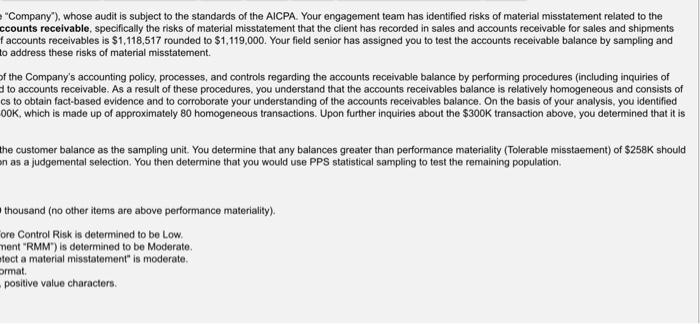
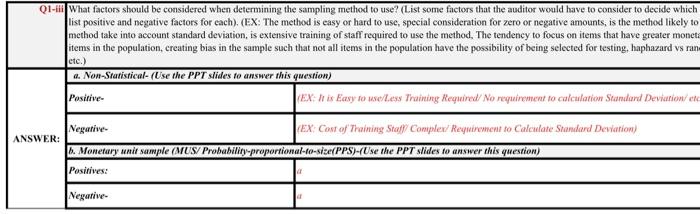
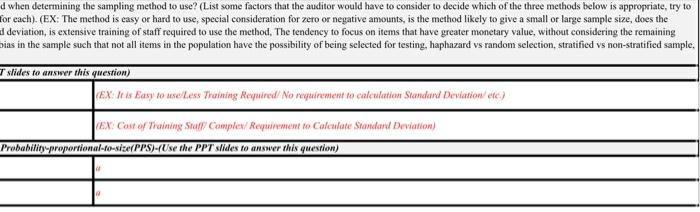
Audit Sampling Case Study: Alr BNB Co. You are the experienced assistant auditor for the audit of Technology Inc (the "Company), whose audit is subject to the standards of the AICPA Your engagement team has identified nisks of material misstatement related to the existence, valuation and allocation, and nights and obligations assertions of accounts receivable specifically the risks of material misstatement that the client has recorded in sales and accounts receivable for sales and shipments that are not valid or are recorded at the incorrect amount. The total balance of accounts receivables is $1.118,517 rounded to $1.119.000 Your field Senior has assigned you to test the accounts receivable balance by sampling and confirming balances with individual customers, which is a common audit test to address these risks of material misstatement As part of your risk assessment procedures, you obtained an understanding of the Company's accounting policy, processes, and controls regarding the accounts receivable balance by performing procedures including inquines of management and process owners) and walkthroughs of the processes related to accounts receivable. As a result of these procedures, you understand that the accounts recewables balance is relatively homogeneous and consists of a high volume of low dollar value transactions. You decide to use data analytics to obtain fact-based endence and to corroborate your understanding of the accounts receivables balance. On the basis of your analysis, you identified one statistical outlier of $300K, while the remaining balance aggregated to $800K, which is made up of approssimately 80 homogeneous transactions. Upon further inquiries about the $300K transaction above, you determined that it is a related party transaction On the basis of your analysis of the accounts receivable balance, you define the customer balance as the sampling unit. You determine that any balances greater than performance materiality (Tolerable minstament) of 5258 should be selected for testing and therefore select the $300K related party transaction as a judgemental selection. You then determine that you would ute PPS statistical sampling to test the remaining population The other relevant factors are as follows Performance materiality (Tolerable Misstatement) is 6258 thousand Clearly trivial threshold (De Minimis Materialty) is $12.906 The population size excluding the $300 thousand selected balance, is $819 thousand (no other items are above performance materiality) The inherent level of risk is determined to be "Higher High You are relying on the operating effectiveness of internal controls and therefore Control Risk is determined to be Low Combined Risk of inherent and Control Risk (AKA Risk of Material Mis statement RMM) is determined to be Moderate You determined that the risk that other substantive procedures will fail to detect a material misstatement is moderate The client provided the accounts receivable population to you in electronic format Then the cool data and noted that the annulation had been character * Use the information above to answer in the tabs below Q1- What factors should be considered when determining the sampling method to use? (List some factors that the auditor would have to consider to decide which of the three methods below is appropriate, try to list positive and negative factors for each). (EX: The method is easy or hard to use, special consideration for rero or negative amounts, is the method likely to give a small or large sample size, does the method take into account standard deviation, is extensive training of staff required to use the method, The tendency to focus on items that have greater monetary value, without considering the remaining items in the population, creating bias in the sample such that not all items in the population have the possibility of being selected for testing, haphazard vs random selection, stratified vs non-stratifled sample, etc.) a. Non-Statistical- (Use the PPT slides to answer this question) Positive Ex: it is ony towelen Training Required/ No requirement to calculation Standard Devitory/ etc.) ANSWER: Negative LEX Cost of Training Stoff/ Complex Requirement to calculate Standard Dewlution) 6. Monetary unit sample (MUS/ Probability proportional-to-sie(PPS)(Use the PPT allder to answer the question) Positives: Negative- Audit Sampling Case Study- Air BNB Co. You are the experienced assistant auditor for the audit of Technology Inc. (the "Company"), whose audit is subject to the standards of the AICPA. Your engag existence, valuation and allocation, and rights and obligations assertions of accounts receivable, specifically the risks of material misstatement that the clie that are not valid or are recorded at the incorrect amount. The total balance of accounts receivables is $1,118,517 rounded to $1,119,000. Your field senior h confirming balances with individual customers, which is a common audit test to address these risks of material misstatement. As part of your risk assessment procedures, you obtained an understanding of the Company's accounting policy, processes, and controls regarding the acco management and process owners) and walkthroughs of the processes related to accounts receivable. As a result of these procedures, you understand that a high volume of low-dollar value transactions. You decide to use data analytics to obtain fact-based evidence and to corroborate your understanding of the one statistical outlier of $300K, while the remaining balance aggregated to $800K, which is made up of approximately 80 homogeneous transactions. Upon f a related-party transaction On the basis of your analysis of the accounts receivable balance, you define the customer balance as the sampling unit. You determine that any balances gr be selected for testing and therefore select the $300K related-party transaction as a judgemental selection. You then determine that you would use PPS stati The other relevant factors are as follows: Performance materiality (Tolerable Misstatement) is $258 thousand. Clearly trivial threshold (De Minimis Materiality) is $12,906 The population size, excluding the $300 thousand selected balance, is $819 thousand (no other items are above performance materiality) The inherent level of risk is determined to be "Higher/High." You are relying on the operating effectiveness of internal controls and therefore Control Risk is determined to be Low. Combined Risk of inherent and Control Risk (AKA Risk of Material Misstatement RMM") is determined to be Moderate. You determined that the "risk that other substantive procedures will fail to detect a material misstatement is moderate The client provided the accounts receivable population to you in electronic format Through the use of data analytics, you noted that the population had similar, positive value characters. "Company"), whose audit is subject to the standards of the AICPA. Your engagement team has identified risks of material misstatement related to the ccounts receivable, specifically the risks of material misstatement that the client has recorded in sales and accounts receivable for sales and shipments f accounts receivables is $1,118,517 rounded to $1,119,000. Your field senior has assigned you to test the accounts receivable balance by sampling and to address these risks of material misstatement. of the Company's accounting policy, processes, and controls regarding the accounts receivable balance by performing procedures (including inquiries of to accounts receivable. As a result of these procedures, you understand that the accounts receivables balance is relatively homogeneous and consists of cs to obtain fact-based evidence and to corroborate your understanding of the accounts receivables balance. On the basis of your analysis, you identified OOK, which is made up of approximately 80 homogeneous transactions. Upon further inquiries about the $300K transaction above, you determined that it is the customer balance as the sampling unit. You determine that any balances greater than performance materiality (Tolerable misstaement) of $258K should n as a judgemental selection. You then determine that you would use PPS statistical sampling to test the remaining population. thousand (no other items are above performance materiality). ore Control Risk is determined to be Low. ment "RMM") is determined to be Moderate tect a material misstatement is moderate ormat positive value characters. Q1-1 What factors should be considered when determining the sampling method to use? (List some factors that the auditor would have to consider to decide which list positive and negative factors for cach). (EX: The method is easy or hard to use, special consideration for zero or negative amounts, is the method likely to method take into account standard deviation, is extensive training of staff required to use the method. The tendency to focus on items that have greater moneta items in the population, creating bias in the sample such that not all items in the population have the possibility of being selected for testing, haphazard vs ran etc.) 6. Non-Statistical- (Use the PPT slides to answer this question) Positive EX Iris Easy to useless Training Required No requirement to calculation Standard Deviation/ ANSWER: Negative EX: Cost of Training Staf Complex/ Requirement to Calculate Standard Deviation) . Monetary unit sample (MUS Probability-proportional-to-size(PPS)-(Use the PPT slides to answer this question) Positives: 41 Negative d when determining the sampling method to use? (List some factors that the auditor would have to consider to decide which of the three methods below is appropriate, try to for each). (EX: The method is easy or hard to use, special consideration for zero or negative amounts, is the method likely to give a small or large sample size, does the a deviation, is extensive training of staff required to use the method, The tendency to focus on items that have greater monetary value, without considering the remaining bias in the sample such that not all items in the population have the possibility of being selected for testing, haphazard vs random selection, stratified vs non-stratified sample, 7 slides to answer this question) Ex: It is Easy to useless Training Required No requirement to catenation Standard Deviation etc.) EX Cost of Training Staf Complex/ Requirement to Calcolate Standard deviation) Probability proportional-to-size(PPS)-(Use the PPT slides to answer this question) Audit Sampling Case Study: Alr BNB Co. You are the experienced assistant auditor for the audit of Technology Inc (the "Company), whose audit is subject to the standards of the AICPA Your engagement team has identified nisks of material misstatement related to the existence, valuation and allocation, and nights and obligations assertions of accounts receivable specifically the risks of material misstatement that the client has recorded in sales and accounts receivable for sales and shipments that are not valid or are recorded at the incorrect amount. The total balance of accounts receivables is $1.118,517 rounded to $1.119.000 Your field Senior has assigned you to test the accounts receivable balance by sampling and confirming balances with individual customers, which is a common audit test to address these risks of material misstatement As part of your risk assessment procedures, you obtained an understanding of the Company's accounting policy, processes, and controls regarding the accounts receivable balance by performing procedures including inquines of management and process owners) and walkthroughs of the processes related to accounts receivable. As a result of these procedures, you understand that the accounts recewables balance is relatively homogeneous and consists of a high volume of low dollar value transactions. You decide to use data analytics to obtain fact-based endence and to corroborate your understanding of the accounts receivables balance. On the basis of your analysis, you identified one statistical outlier of $300K, while the remaining balance aggregated to $800K, which is made up of approssimately 80 homogeneous transactions. Upon further inquiries about the $300K transaction above, you determined that it is a related party transaction On the basis of your analysis of the accounts receivable balance, you define the customer balance as the sampling unit. You determine that any balances greater than performance materiality (Tolerable minstament) of 5258 should be selected for testing and therefore select the $300K related party transaction as a judgemental selection. You then determine that you would ute PPS statistical sampling to test the remaining population The other relevant factors are as follows Performance materiality (Tolerable Misstatement) is 6258 thousand Clearly trivial threshold (De Minimis Materialty) is $12.906 The population size excluding the $300 thousand selected balance, is $819 thousand (no other items are above performance materiality) The inherent level of risk is determined to be "Higher High You are relying on the operating effectiveness of internal controls and therefore Control Risk is determined to be Low Combined Risk of inherent and Control Risk (AKA Risk of Material Mis statement RMM) is determined to be Moderate You determined that the risk that other substantive procedures will fail to detect a material misstatement is moderate The client provided the accounts receivable population to you in electronic format Then the cool data and noted that the annulation had been character * Use the information above to answer in the tabs below Q1- What factors should be considered when determining the sampling method to use? (List some factors that the auditor would have to consider to decide which of the three methods below is appropriate, try to list positive and negative factors for each). (EX: The method is easy or hard to use, special consideration for rero or negative amounts, is the method likely to give a small or large sample size, does the method take into account standard deviation, is extensive training of staff required to use the method, The tendency to focus on items that have greater monetary value, without considering the remaining items in the population, creating bias in the sample such that not all items in the population have the possibility of being selected for testing, haphazard vs random selection, stratified vs non-stratifled sample, etc.) a. Non-Statistical- (Use the PPT slides to answer this question) Positive Ex: it is ony towelen Training Required/ No requirement to calculation Standard Devitory/ etc.) ANSWER: Negative LEX Cost of Training Stoff/ Complex Requirement to calculate Standard Dewlution) 6. Monetary unit sample (MUS/ Probability proportional-to-sie(PPS)(Use the PPT allder to answer the question) Positives: Negative- Audit Sampling Case Study- Air BNB Co. You are the experienced assistant auditor for the audit of Technology Inc. (the "Company"), whose audit is subject to the standards of the AICPA. Your engag existence, valuation and allocation, and rights and obligations assertions of accounts receivable, specifically the risks of material misstatement that the clie that are not valid or are recorded at the incorrect amount. The total balance of accounts receivables is $1,118,517 rounded to $1,119,000. Your field senior h confirming balances with individual customers, which is a common audit test to address these risks of material misstatement. As part of your risk assessment procedures, you obtained an understanding of the Company's accounting policy, processes, and controls regarding the acco management and process owners) and walkthroughs of the processes related to accounts receivable. As a result of these procedures, you understand that a high volume of low-dollar value transactions. You decide to use data analytics to obtain fact-based evidence and to corroborate your understanding of the one statistical outlier of $300K, while the remaining balance aggregated to $800K, which is made up of approximately 80 homogeneous transactions. Upon f a related-party transaction On the basis of your analysis of the accounts receivable balance, you define the customer balance as the sampling unit. You determine that any balances gr be selected for testing and therefore select the $300K related-party transaction as a judgemental selection. You then determine that you would use PPS stati The other relevant factors are as follows: Performance materiality (Tolerable Misstatement) is $258 thousand. Clearly trivial threshold (De Minimis Materiality) is $12,906 The population size, excluding the $300 thousand selected balance, is $819 thousand (no other items are above performance materiality) The inherent level of risk is determined to be "Higher/High." You are relying on the operating effectiveness of internal controls and therefore Control Risk is determined to be Low. Combined Risk of inherent and Control Risk (AKA Risk of Material Misstatement RMM") is determined to be Moderate. You determined that the "risk that other substantive procedures will fail to detect a material misstatement is moderate The client provided the accounts receivable population to you in electronic format Through the use of data analytics, you noted that the population had similar, positive value characters. "Company"), whose audit is subject to the standards of the AICPA. Your engagement team has identified risks of material misstatement related to the ccounts receivable, specifically the risks of material misstatement that the client has recorded in sales and accounts receivable for sales and shipments f accounts receivables is $1,118,517 rounded to $1,119,000. Your field senior has assigned you to test the accounts receivable balance by sampling and to address these risks of material misstatement. of the Company's accounting policy, processes, and controls regarding the accounts receivable balance by performing procedures (including inquiries of to accounts receivable. As a result of these procedures, you understand that the accounts receivables balance is relatively homogeneous and consists of cs to obtain fact-based evidence and to corroborate your understanding of the accounts receivables balance. On the basis of your analysis, you identified OOK, which is made up of approximately 80 homogeneous transactions. Upon further inquiries about the $300K transaction above, you determined that it is the customer balance as the sampling unit. You determine that any balances greater than performance materiality (Tolerable misstaement) of $258K should n as a judgemental selection. You then determine that you would use PPS statistical sampling to test the remaining population. thousand (no other items are above performance materiality). ore Control Risk is determined to be Low. ment "RMM") is determined to be Moderate tect a material misstatement is moderate ormat positive value characters. Q1-1 What factors should be considered when determining the sampling method to use? (List some factors that the auditor would have to consider to decide which list positive and negative factors for cach). (EX: The method is easy or hard to use, special consideration for zero or negative amounts, is the method likely to method take into account standard deviation, is extensive training of staff required to use the method. The tendency to focus on items that have greater moneta items in the population, creating bias in the sample such that not all items in the population have the possibility of being selected for testing, haphazard vs ran etc.) 6. Non-Statistical- (Use the PPT slides to answer this question) Positive EX Iris Easy to useless Training Required No requirement to calculation Standard Deviation/ ANSWER: Negative EX: Cost of Training Staf Complex/ Requirement to Calculate Standard Deviation) . Monetary unit sample (MUS Probability-proportional-to-size(PPS)-(Use the PPT slides to answer this question) Positives: 41 Negative d when determining the sampling method to use? (List some factors that the auditor would have to consider to decide which of the three methods below is appropriate, try to for each). (EX: The method is easy or hard to use, special consideration for zero or negative amounts, is the method likely to give a small or large sample size, does the a deviation, is extensive training of staff required to use the method, The tendency to focus on items that have greater monetary value, without considering the remaining bias in the sample such that not all items in the population have the possibility of being selected for testing, haphazard vs random selection, stratified vs non-stratified sample, 7 slides to answer this question) Ex: It is Easy to useless Training Required No requirement to catenation Standard Deviation etc.) EX Cost of Training Staf Complex/ Requirement to Calcolate Standard deviation) Probability proportional-to-size(PPS)-(Use the PPT slides to answer this question)
Step by Step Solution
There are 3 Steps involved in it

Get step-by-step solutions from verified subject matter experts
 Study Help