


Question: Q2) (50 points) A simple industrial robot has four axes of motion, controlled by four separate motors. We will refer to the motions as Turn
Q2) (50 points) A simple industrial robot has

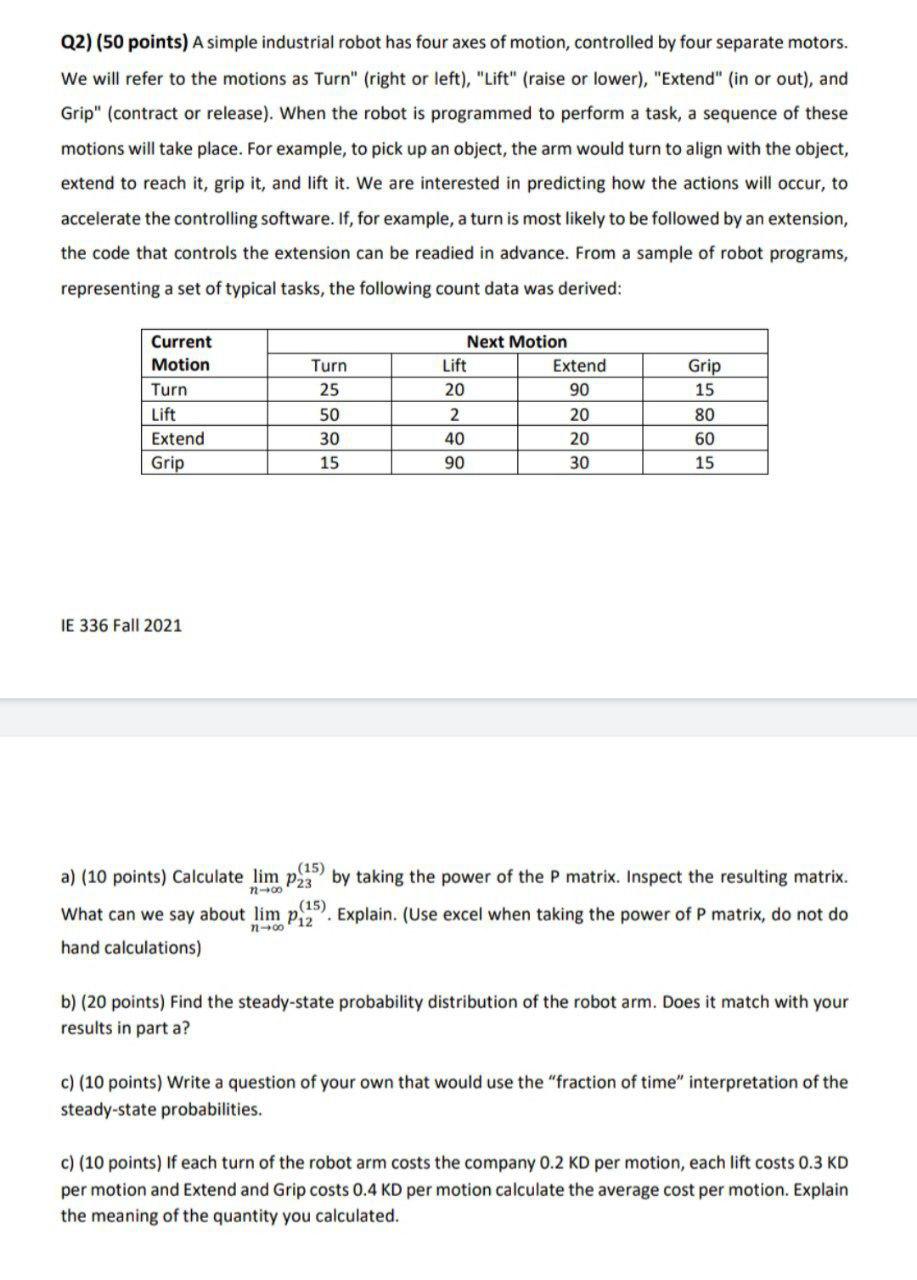
Q2) (50 points) A simple industrial robot has four axes of motion, controlled by four separate motors. We will refer to the motions as Turn" (right or left), "Lift" (raise or lower), "Extend" (in or out), and Grip" (contract or release). When the robot is programmed to perform a task, a sequence of these motions will take place. For example, to pick up an object, the arm would turn to align with the object, extend to reach it, grip it, and lift it. We are interested in predicting how the actions will occur, to accelerate the controlling software. If, for example, a turn is most likely to be followed by an extension, the code that controls the extension can be readied in advance. From a sample of robot programs, representing a set of typical tasks, the following count data was derived: Grip 15 Current Motion Turn Lift Extend Grip Turn 25 50 30 Next Motion Lift Extend 20 90 2 20 40 20 90 30 80 60 IE 336 Fall 2021 n-00 a) (10 points) Calculate lim p23 by taking the power of the P matrix. Inspect the resulting matrix. (15) What can we say about lim pi2. Explain. (Use excel when taking the power of P matrix, do not do (15) hand calculations) n b) (20 points) Find the steady-state probability distribution of the robot arm. Does it match with your results in part a? c) (10 points) Write a question of your own that would use the "fraction of time" interpretation of the steady-state probabilities. c) (10 points) If each turn of the robot arm costs the company 0.2 KD per motion, each lift costs 0.3 KD per motion and Extend and Grip costs 0.4 KD per motion calculate the average cost per motion. Explain the meaning of the quantity you calculated

Step by Step Solution

There are 3 Steps involved in it

1 Expert Approved Answer
Step: 1 Unlock blur-text-image

Question Has Been Solved by an Expert!

Get step-by-step solutions from verified subject matter experts

Step: 2 Unlock
Step: 3 Unlock

Students Have Also Explored These Related General Management Questions!