





Question: Q2 (a) (b) (c) (d) (e) (f) A rm is considering two investment projects, Gamma and Kappa. These projects are NOT mutually exclusive. Assume the

Q2 (a) (b) (c) (d) (e) (f)
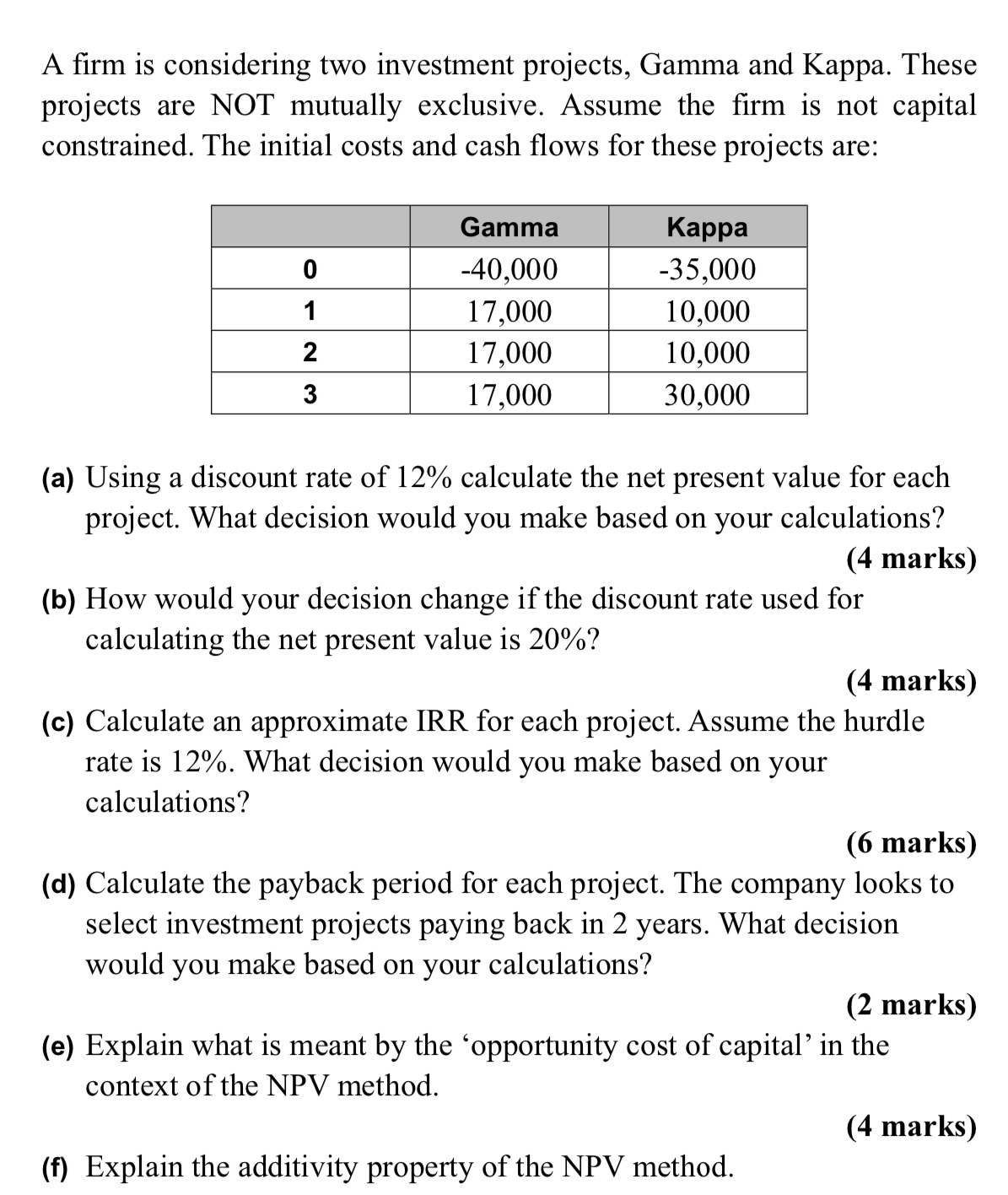
Q2 (a) (b) (c) (d) (e) (f) A rm is considering
A rm is considering two investment projects, Gamma and Kappa. These projects are NOT mutually exclusive. Assume the rm is not capital constrained. The initial costs and cash ows for these projects are: - 40,000 = -35,000 - 17,000 10,000 17,000 10,000 3 17,000 30,000 (a) Using a discount rate of 12% calculate the net present value for each project. What decision would you make based on your calculations? (4 marks) (b) How would your decision change if the discount rate used for calculating the net present value is 20%? (4 marks) (c) Calculate an approximate IRR for each project. Assume the hurdle rate is 12%. What decision would you make based on your calculations? (6 marks) (d) Calculate the payback period for each project. The company looks to select investment projects paying back in 2 years. What decision would you make based on your calculations? (2 marks) (e) Explain what is meant by the 'opportunity cost of capital' in the context of the NPV method. (4 marks) (1) Explain the additivity property of the NPV method

Step by Step Solution

There are 3 Steps involved in it

1 Expert Approved Answer
Step: 1 Unlock blur-text-image

Question Has Been Solved by an Expert!

Get step-by-step solutions from verified subject matter experts

Step: 2 Unlock
Step: 3 Unlock

Students Have Also Explored These Related Finance Questions!