







Question: Q2 Consider the following inverse demand function, p(Q) = a-bQ, Q = q1 + 92, where a and b are positive parameters and q; denotes
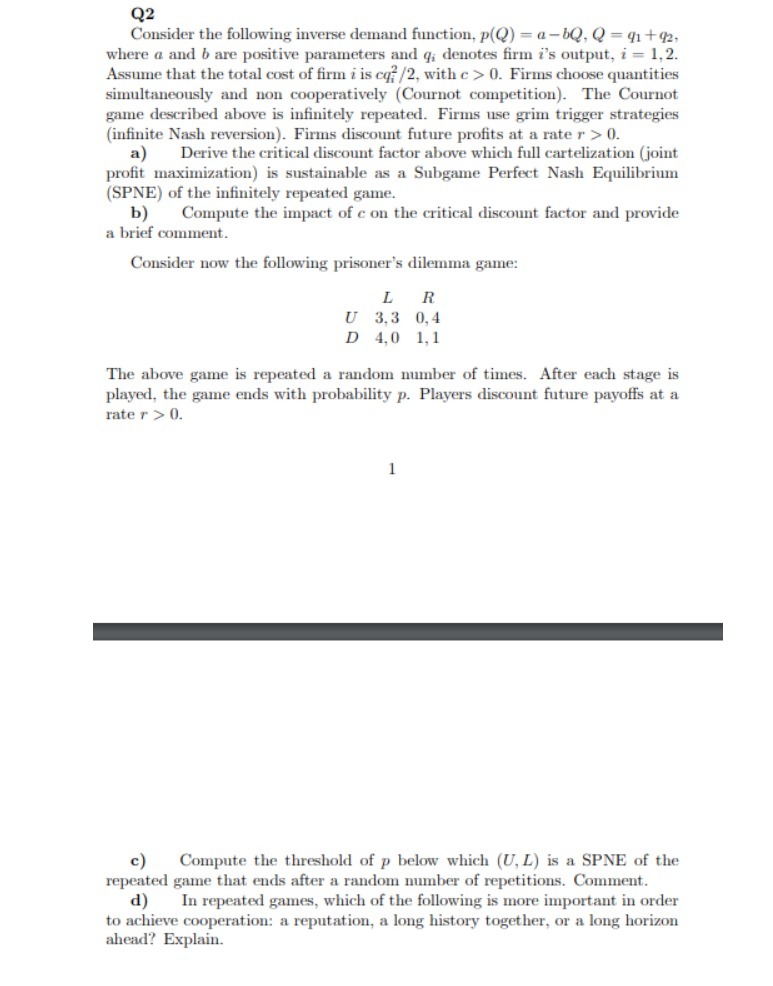
Q2 Consider the following inverse demand function, p(Q) = a-bQ, Q = q1 + 92, where a and b are positive parameters and q; denotes firm i's output, i = 1, 2. Assume that the total cost of firm i is cor/2, with c > 0. Firms choose quantities simultaneously and non cooperatively (Cournot competition). The Cournot game described above is infinitely repeated. Firms use grim trigger strategies (infinite Nash reversion). Firms discount future profits at a rate r > 0. a) Derive the critical discount factor above which full cartelization (joint profit maximization) is sustainable as a Subgame Perfect Nash Equilibrium (SPNE) of the infinitely repeated game. b) Compute the impact of c on the critical discount factor and provide a brief comment. Consider now the following prisoner's dilemma game: L R U 3,3 0,4 D 4,0 1,1 The above game is repeated a random number of times. After each stage is played, the game ends with probability p. Players discount future payoffs at a rate r > 0. c) Compute the threshold of p below which (U, L) is a SPNE of the repeated game that ends after a random number of repetitions. Comment. d) In repeated games, which of the following is more important in order to achieve cooperation: a reputation, a long history together, or a long horizon ahead? Explain
Step by Step Solution
There are 3 Steps involved in it

Get step-by-step solutions from verified subject matter experts
 Study Help