







Question: Q2: Efficient frontier for (P3-f(t)): omitted details (10 marks) Here we supply the details that were omitted when we wrote down the formulas for the
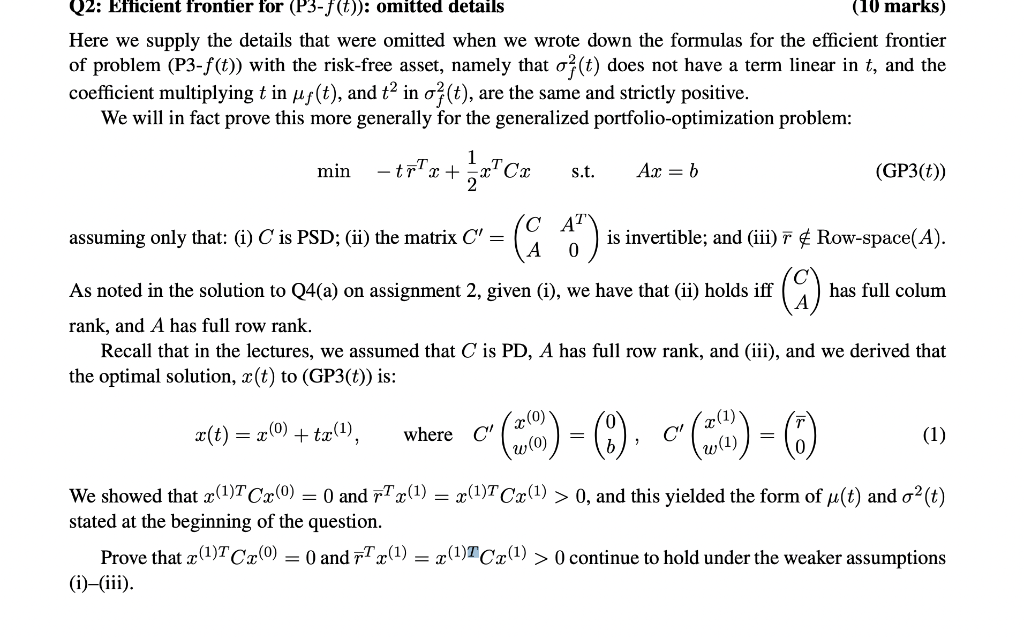
Q2: Efficient frontier for (P3-f(t)): omitted details (10 marks) Here we supply the details that were omitted when we wrote down the formulas for the efficient frontier of problem (P3-f(t)) with the risk-free asset, namely that of(t) does not have a term linear in t, and the coefficient multiplying t in uf(t), and t2 in o}(t), are the same and strictly positive. We will in fact prove this more generally for the generalized portfolio-optimization problem: min -tFT "+ s.t. Az = b (GP3(t)) c assuming only that: (i) C is PSD; (ii) the matrix C' = is invertible; and (iii) 7 Row-space(A). As noted in the solution to Q4(a) on assignment 2, given (i), we have that (ii) holds iff has full colum rank, and A has full row rank. Recall that in the lectures, we assumed that C is PD, A has full row rank, and (iii), and we derived that the optimal solution, x(t) to (GP3(t)) is: z(t) = x(0) + tz(1), where C c(.) = (*) = c" (O) = = (1) We showed that x(1)T Cx(0) = 0 and 1 x (1) x(1)T Cx(1) > 0, and this yielded the form of u(t) and o(t) stated at the beginning of the question. Prove that z(1)T C0) O and FT x(1) = 2(1)TCx(1) > 0) continue to hold under the weaker assumptions (i)-(iii). Q2: Efficient frontier for (P3-f(t)): omitted details (10 marks) Here we supply the details that were omitted when we wrote down the formulas for the efficient frontier of problem (P3-f(t)) with the risk-free asset, namely that of(t) does not have a term linear in t, and the coefficient multiplying t in uf(t), and t2 in o}(t), are the same and strictly positive. We will in fact prove this more generally for the generalized portfolio-optimization problem: min -tFT "+ s.t. Az = b (GP3(t)) c assuming only that: (i) C is PSD; (ii) the matrix C' = is invertible; and (iii) 7 Row-space(A). As noted in the solution to Q4(a) on assignment 2, given (i), we have that (ii) holds iff has full colum rank, and A has full row rank. Recall that in the lectures, we assumed that C is PD, A has full row rank, and (iii), and we derived that the optimal solution, x(t) to (GP3(t)) is: z(t) = x(0) + tz(1), where C c(.) = (*) = c" (O) = = (1) We showed that x(1)T Cx(0) = 0 and 1 x (1) x(1)T Cx(1) > 0, and this yielded the form of u(t) and o(t) stated at the beginning of the question. Prove that z(1)T C0) O and FT x(1) = 2(1)TCx(1) > 0) continue to hold under the weaker assumptions (i)-(iii)
Step by Step Solution
There are 3 Steps involved in it

Get step-by-step solutions from verified subject matter experts
 Study Help