







Question: Q2- Joint-cost allocation, sales value , physical measure, NRV methods . Instant Foods produces two types of microwavable productsbeef-flavored ramen and shrimp -flavored ramen .
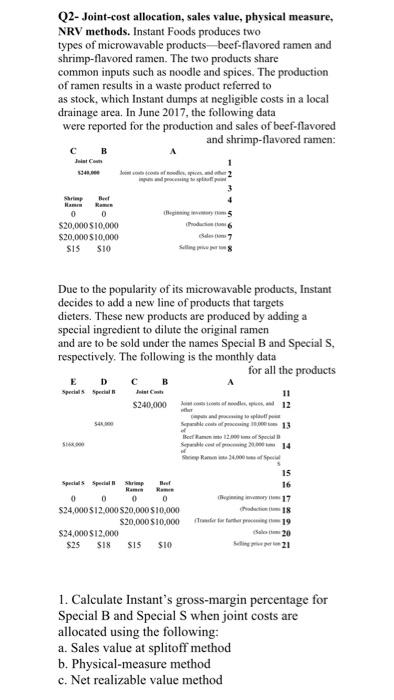
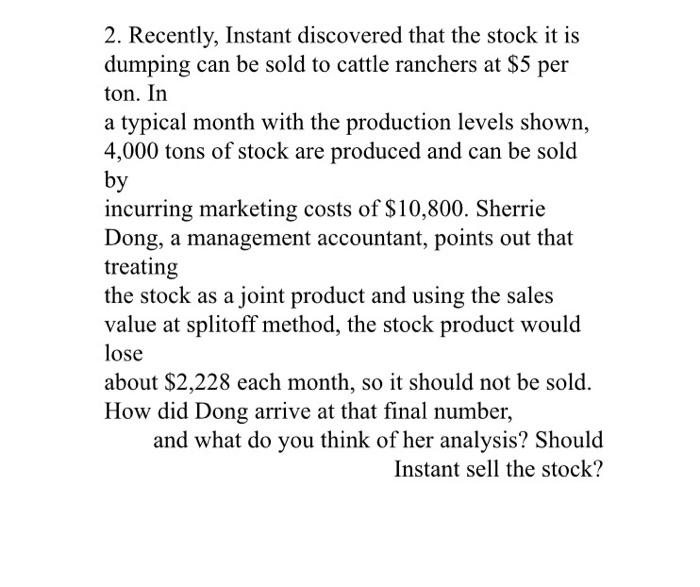
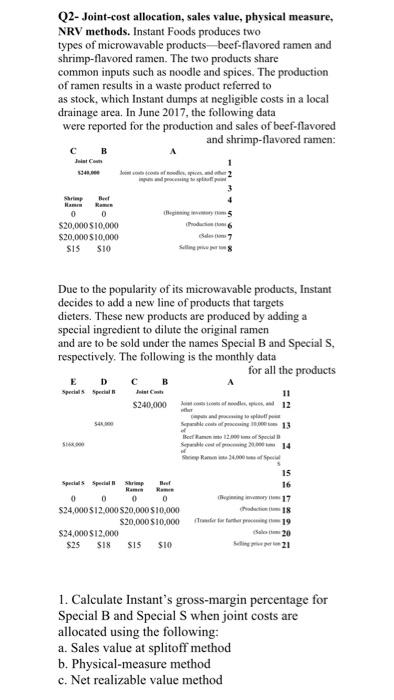
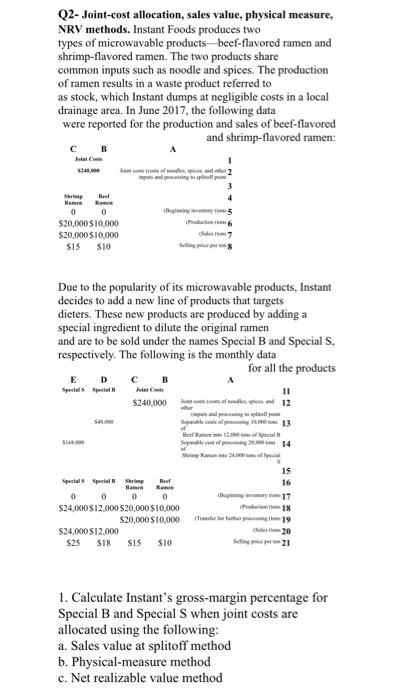
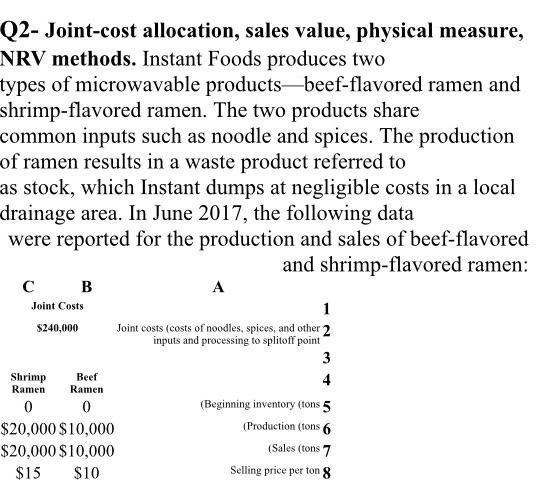
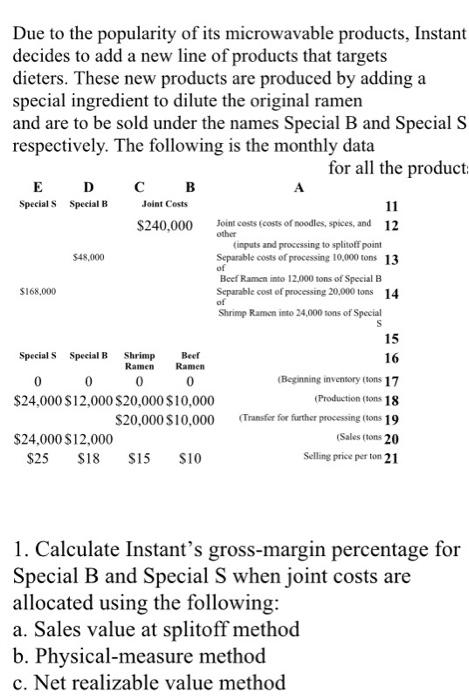
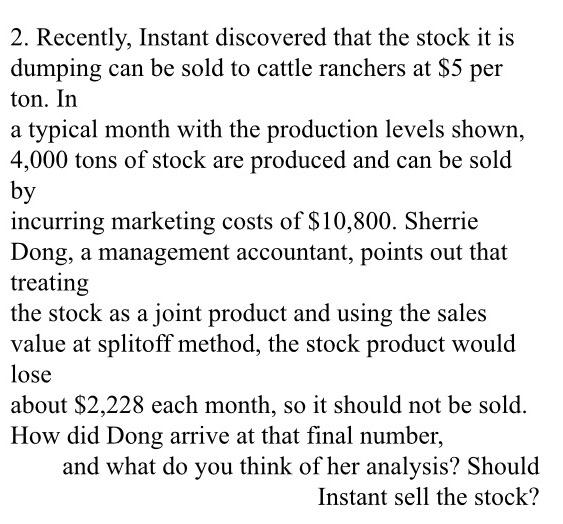
Q2- Joint-cost allocation, sales value, physical measure, NRV methods. Instant Foods produces two types of microwavable productsbeef-flavored ramen and shrimp-flavored ramen. The two products share common inputs such as noodle and spices. The production of ramen results in a waste product referred to as stock, which Instant dumps at negligible costs in a local drainage area. In June 2017, the following data were reported for the production and sales of beef-flavored and shrimp-flavored ramen: B Judet Com 0 0 $20,000 $10,000 $20,000 $10,000 SIS S10 Due to the popularity of its microwavable products, Instant decides to add a new line of products that targets dieters. These new products are produced by adding a special ingredient to dilute the original ramen and are to be sold under the names Special B and Specials, respectively. The following is the monthly data for all the products B Specials Special 11 $240,000 ... 12 Schweine 13 le m2.0 of Special SA St. 15 Specials Special Shrimp 0 0 0 0 $24,000 $12.000 $20,000 $10,000 $20,000 $10,000 $24,000 $12.000 $25 S18 SIS $10 Sales 20 1. Calculate Instant's gross-margin percentage for Special B and Special S when joint costs are allocated using the following: a. Sales value at splitoff method b. Physical measure method c. Net realizable value method 2. Recently, Instant discovered that the stock it is dumping can be sold to cattle ranchers at $5 per ton. In a typical month with the production levels shown, 4,000 tons of stock are produced and can be sold by incurring marketing costs of $10,800. Sherrie Dong, a management accountant, points out that treating the stock as a joint product and using the sales value at splitoff method, the stock product would lose about $2,228 each month, so it should not be sold. How did Dong arrive at that final number, and what do you think of her analysis? Should Instant sell the stock? Q2- Joint-cost allocation, sales value, physical measure, NRV methods. Instant Foods produces two types of microwavable productsbeef-flavored ramen and shrimp-flavored ramen. The two products share common inputs such as noodle and spices. The production of ramen results in a waste product referred to as stock, which Instant dumps at negligible costs in a local drainage area. In June 2017, the following data were reported for the production and sales of beef-flavored and shrimp-flavored ramen: B Judet Com 0 0 $20,000 $10,000 $20,000 $10,000 SIS S10 Due to the popularity of its microwavable products, Instant decides to add a new line of products that targets dieters. These new products are produced by adding a special ingredient to dilute the original ramen and are to be sold under the names Special B and Specials, respectively. The following is the monthly data for all the products B Specials Special 11 $240,000 ... 12 Schweine 13 le m2.0 of Special SA St. 15 Specials Special Shrimp 0 0 0 0 $24,000 $12.000 $20,000 $10,000 $20,000 $10,000 $24,000 $12.000 $25 S18 SIS $10 Sales 20 1. Calculate Instant's gross-margin percentage for Special B and Special S when joint costs are allocated using the following: a. Sales value at splitoff method b. Physical measure method c. Net realizable value method Q2- Joint-cost allocation, sales value, physical measure, NRV methods. Instant Foods produces two types of microwavable products beef-flavored ramen and shrimp-flavored ramen. The two products share common inputs such as noodle and spices. The production of ramen results in a waste product referred to as stock, which Instant dumps at negligible costs in a local drainage area. In June 2017, the following data were reported for the production and sales of beef-flavored and shrimp-flavored ramen: B Joint Cente Han Race 0 0 $20,000 $10,000 $20,000 $10,000 SIS 7 $10 Due to the popularity of its microwavable products, Instant decides to add a new line of products that targets dieters. These new products are produced by adding a special ingredient to dilute the original ramen and are to be sold under the names Special B and Specials, respectively. The following is the monthly data for all the products ED Specials Special Joint Costi $240,000 com.com 12 A Specc. 13 S000 Se Sans 15 16 Specials Special Shrimp Bed Ram Ram 0 0 0 0 S24.000 $12.000 $20,000 $10,000 $20,000 $10,000 $24,000 $12,000 $25 SIS SIS STO Top 19 1. Calculate Instant's gross-margin percentage for Special B and Special S when joint costs are allocated using the following: a. Sales value at splitoff method b. Physical-measure method c. Net realizable value method Q2- Joint-cost allocation, sales value, physical measure, NRV methods. Instant Foods produces two types of microwavable products-beef-flavored ramen and shrimp-flavored ramen. The two products share common inputs such as noodle and spices. The production of ramen results in a waste product referred to as stock, which Instant dumps at negligible costs in a local drainage area. In June 2017, the following data were reported for the production and sales of beef-flavored and shrimp-flavored ramen: B Joint Costs 1 Joint costs (costs of noodles, spices, and other 2 inputs and processing to splitoff point 3 Shrimp 4 0 0 (Beginning inventory (tons 5 $20,000 $10,000 (Production (tons 6 $20,000 $10,000 (Sales (tons 7 $15 $10 Selling price per ton 8 $240,000 Beef Ramen A Ramen other Due to the popularity of its microwavable products, Instant decides to add a new line of products that targets dieters. These new products are produced by adding a special ingredient to dilute the original ramen and are to be sold under the names Special B and Special S respectively. The following is the monthly data for all the product E D C B Specials Special B Joint Costs $240,000 Joint coses (costs of noodles, spices, and 12 inputs and processing to splitotf point Separable costs of processing 10,000 tons 13 Beef Ramen into 12.000 tons of Special B Separable cost of processing 20,000 tons 14 Shrimp Ramen into 24,000 tons of Special 15 Shrimp Beef Ramen Ramen 0 0 0 0 (Beginning inventory (tons 17 $24,000 $12,000 $20,000 $10,000 Production (tons 18 $20,000 $10,000 (Transfer for further processing (tons 19 $24,000 $12,000 (Sales (tons 20 $25 $18 $15 S10 Selling price per ton 21 $48.000 of S168,000 of S Specials Special B 16 1. Calculate Instant's gross-margin percentage for Special B and Special S when joint costs are allocated using the following: a. Sales value at splitoff method b. Physical-measure method c. Net realizable value method 2. Recently, Instant discovered that the stock it is dumping can be sold to cattle ranchers at $5 per ton. In a typical month with the production levels shown, 4,000 tons of stock are produced and can be sold by incurring marketing costs of $10,800. Sherrie Dong, a management accountant, points out that treating the stock as a joint product and using the sales value at splitoff method, the stock product would lose about $2,228 each month, so it should not be sold. How did Dong arrive at that final number, and what do you think of her analysis? Should Instant sell the stock? Q2- Joint-cost allocation, sales value, physical measure, NRV methods. Instant Foods produces two types of microwavable productsbeef-flavored ramen and shrimp-flavored ramen. The two products share common inputs such as noodle and spices. The production of ramen results in a waste product referred to as stock, which Instant dumps at negligible costs in a local drainage area. In June 2017, the following data were reported for the production and sales of beef-flavored and shrimp-flavored ramen: B Judet Com 0 0 $20,000 $10,000 $20,000 $10,000 SIS S10 Due to the popularity of its microwavable products, Instant decides to add a new line of products that targets dieters. These new products are produced by adding a special ingredient to dilute the original ramen and are to be sold under the names Special B and Specials, respectively. The following is the monthly data for all the products B Specials Special 11 $240,000 ... 12 Schweine 13 le m2.0 of Special SA St. 15 Specials Special Shrimp 0 0 0 0 $24,000 $12.000 $20,000 $10,000 $20,000 $10,000 $24,000 $12.000 $25 S18 SIS $10 Sales 20 1. Calculate Instant's gross-margin percentage for Special B and Special S when joint costs are allocated using the following: a. Sales value at splitoff method b. Physical measure method c. Net realizable value method 2. Recently, Instant discovered that the stock it is dumping can be sold to cattle ranchers at $5 per ton. In a typical month with the production levels shown, 4,000 tons of stock are produced and can be sold by incurring marketing costs of $10,800. Sherrie Dong, a management accountant, points out that treating the stock as a joint product and using the sales value at splitoff method, the stock product would lose about $2,228 each month, so it should not be sold. How did Dong arrive at that final number, and what do you think of her analysis? Should Instant sell the stock? Q2- Joint-cost allocation, sales value, physical measure, NRV methods. Instant Foods produces two types of microwavable productsbeef-flavored ramen and shrimp-flavored ramen. The two products share common inputs such as noodle and spices. The production of ramen results in a waste product referred to as stock, which Instant dumps at negligible costs in a local drainage area. In June 2017, the following data were reported for the production and sales of beef-flavored and shrimp-flavored ramen: B Judet Com 0 0 $20,000 $10,000 $20,000 $10,000 SIS S10 Due to the popularity of its microwavable products, Instant decides to add a new line of products that targets dieters. These new products are produced by adding a special ingredient to dilute the original ramen and are to be sold under the names Special B and Specials, respectively. The following is the monthly data for all the products B Specials Special 11 $240,000 ... 12 Schweine 13 le m2.0 of Special SA St. 15 Specials Special Shrimp 0 0 0 0 $24,000 $12.000 $20,000 $10,000 $20,000 $10,000 $24,000 $12.000 $25 S18 SIS $10 Sales 20 1. Calculate Instant's gross-margin percentage for Special B and Special S when joint costs are allocated using the following: a. Sales value at splitoff method b. Physical measure method c. Net realizable value method Q2- Joint-cost allocation, sales value, physical measure, NRV methods. Instant Foods produces two types of microwavable products beef-flavored ramen and shrimp-flavored ramen. The two products share common inputs such as noodle and spices. The production of ramen results in a waste product referred to as stock, which Instant dumps at negligible costs in a local drainage area. In June 2017, the following data were reported for the production and sales of beef-flavored and shrimp-flavored ramen: B Joint Cente Han Race 0 0 $20,000 $10,000 $20,000 $10,000 SIS 7 $10 Due to the popularity of its microwavable products, Instant decides to add a new line of products that targets dieters. These new products are produced by adding a special ingredient to dilute the original ramen and are to be sold under the names Special B and Specials, respectively. The following is the monthly data for all the products ED Specials Special Joint Costi $240,000 com.com 12 A Specc. 13 S000 Se Sans 15 16 Specials Special Shrimp Bed Ram Ram 0 0 0 0 S24.000 $12.000 $20,000 $10,000 $20,000 $10,000 $24,000 $12,000 $25 SIS SIS STO Top 19 1. Calculate Instant's gross-margin percentage for Special B and Special S when joint costs are allocated using the following: a. Sales value at splitoff method b. Physical-measure method c. Net realizable value method Q2- Joint-cost allocation, sales value, physical measure, NRV methods. Instant Foods produces two types of microwavable products-beef-flavored ramen and shrimp-flavored ramen. The two products share common inputs such as noodle and spices. The production of ramen results in a waste product referred to as stock, which Instant dumps at negligible costs in a local drainage area. In June 2017, the following data were reported for the production and sales of beef-flavored and shrimp-flavored ramen: B Joint Costs 1 Joint costs (costs of noodles, spices, and other 2 inputs and processing to splitoff point 3 Shrimp 4 0 0 (Beginning inventory (tons 5 $20,000 $10,000 (Production (tons 6 $20,000 $10,000 (Sales (tons 7 $15 $10 Selling price per ton 8 $240,000 Beef Ramen A Ramen other Due to the popularity of its microwavable products, Instant decides to add a new line of products that targets dieters. These new products are produced by adding a special ingredient to dilute the original ramen and are to be sold under the names Special B and Special S respectively. The following is the monthly data for all the product E D C B Specials Special B Joint Costs $240,000 Joint coses (costs of noodles, spices, and 12 inputs and processing to splitotf point Separable costs of processing 10,000 tons 13 Beef Ramen into 12.000 tons of Special B Separable cost of processing 20,000 tons 14 Shrimp Ramen into 24,000 tons of Special 15 Shrimp Beef Ramen Ramen 0 0 0 0 (Beginning inventory (tons 17 $24,000 $12,000 $20,000 $10,000 Production (tons 18 $20,000 $10,000 (Transfer for further processing (tons 19 $24,000 $12,000 (Sales (tons 20 $25 $18 $15 S10 Selling price per ton 21 $48.000 of S168,000 of S Specials Special B 16 1. Calculate Instant's gross-margin percentage for Special B and Special S when joint costs are allocated using the following: a. Sales value at splitoff method b. Physical-measure method c. Net realizable value method 2. Recently, Instant discovered that the stock it is dumping can be sold to cattle ranchers at $5 per ton. In a typical month with the production levels shown, 4,000 tons of stock are produced and can be sold by incurring marketing costs of $10,800. Sherrie Dong, a management accountant, points out that treating the stock as a joint product and using the sales value at splitoff method, the stock product would lose about $2,228 each month, so it should not be sold. How did Dong arrive at that final number, and what do you think of her analysis? Should Instant sell the stock
Step by Step Solution
There are 3 Steps involved in it

Get step-by-step solutions from verified subject matter experts
 Study Help