



Question: Q2. This question is about a simplified version of the game Yahtzee (https://solitaired.com/yahtzee). In this game, we have 3 regular tetrahedral dice with 4
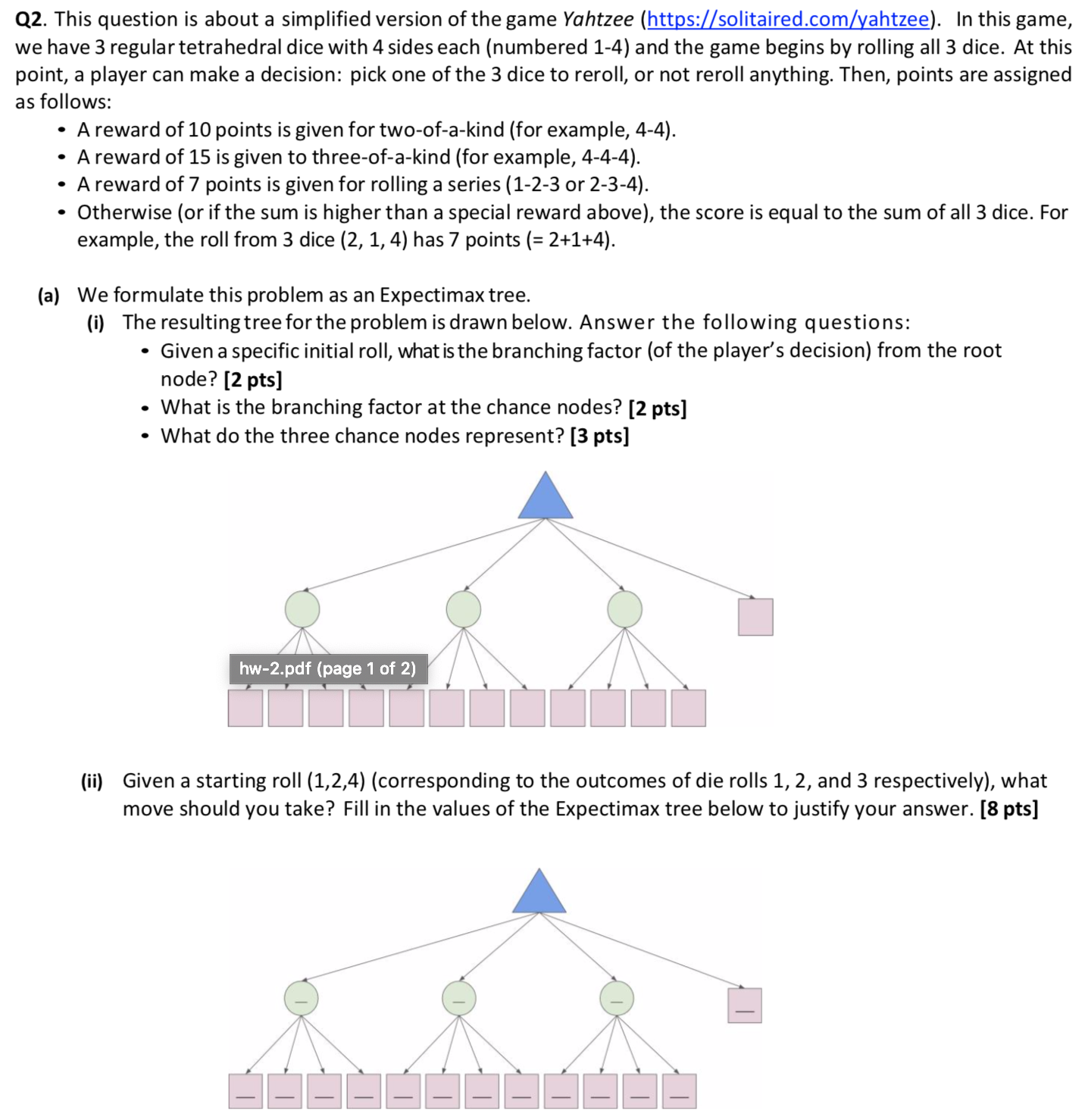
Q2. This question is about a simplified version of the game Yahtzee (https://solitaired.com/yahtzee). In this game, we have 3 regular tetrahedral dice with 4 sides each (numbered 1-4) and the game begins by rolling all 3 dice. At this point, a player can make a decision: pick one of the 3 dice to reroll, or not reroll anything. Then, points are assigned as follows: A reward of 10 points is given for two-of-a-kind (for example, 4-4). A reward of 15 is given to three-of-a-kind (for example, 4-4-4). A reward of 7 points is given for rolling a series (1-2-3 or 2-3-4). Otherwise (or if the sum is higher than a special reward above), the score is equal to the sum of all 3 dice. For example, the roll from 3 dice (2, 1, 4) has 7 points (= 2+1+4). (a) We formulate this problem as an Expectimax tree. (i) The resulting tree for the problem is drawn below. Answer the following questions: Given a specific initial roll, what is the branching node? [2 pts] What is the branching factor at the chance nodes? [2 pts] What do the three chance nodes represent? [3 pts] hw-2.pdf (page 1 of 2) TIT (of the player's decision) from the root (ii) Given a starting roll (1,2,4) (corresponding to the outcomes of die rolls 1, 2, and 3 respectively), what move should you take? Fill in the values of the Expectimax tree below to justify your answer. [8 pts] JAAAAAI
Step by Step Solution
There are 3 Steps involved in it

Get step-by-step solutions from verified subject matter experts