







Question: Q2. Using 5-bit sequence numbers, what is the maximum size of the send and receive windows for each of the following protocols? a. Stop-and-Wait ARQ
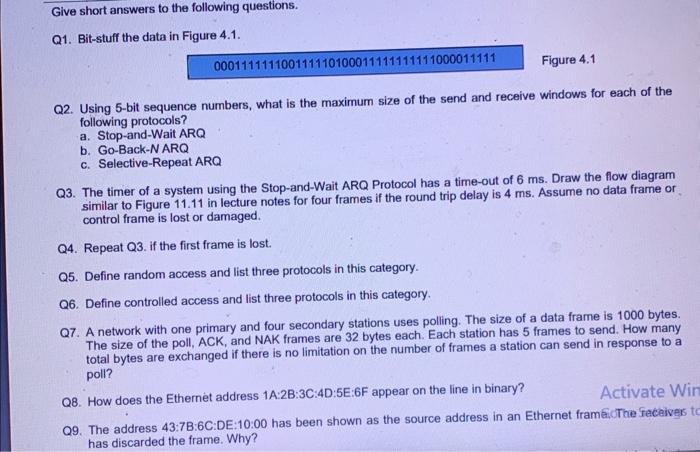
Q2. Using 5-bit sequence numbers, what is the maximum size of the send and receive windows for each of the following protocols? a. Stop-and-Wait ARQ b. Go-Back-N ARQ c. Selective-Repeat ARQ Q3. The timer of a system using the Stop-and-Wait ARQ Protocol has a time-out of 6ms. Draw the flow diagram similar to Figure 11.11 in lecture notes for four frames if the round trip delay is 4 ms. Assume no data frame or control frame is lost or damaged. Q4. Repeat Q3. if the first frame is lost. Q5. Define random access and list three protocols in this category. Q6. Define controlled access and list three protocols in this category. Q7. A network with one primary and four secondary stations uses polling. The size of a data frame is 1000 bytes. The size of the poll, ACK, and NAK frames are 32 bytes each. Each station has 5 frames to send. How many total bytes are exchanged if there is no limitation on the number of frames a station can send in response to a poll? Q8. How does the Ethernt address 1A:2B:3C:4D:5E:6F appear on the line in binary? Q9. The address 43:7B:6C:DE:10:00 has been shown as the source address in an Ethernet frama:oThe faceivers has discarded the frame. Why
Step by Step Solution
There are 3 Steps involved in it

Get step-by-step solutions from verified subject matter experts
 Study Help