Question: Q.2. Using outcrop data in the boxes below, draw two sections on appropriate scale parallel to one another and correlate these (preferably on graph paper).
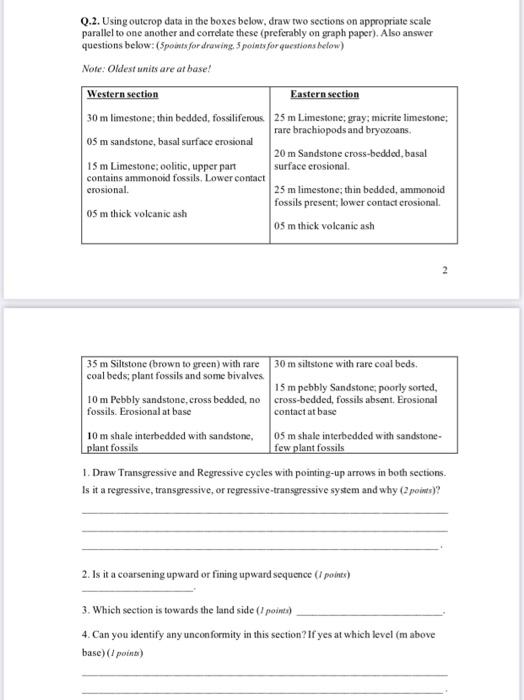
Q.2. Using outcrop data in the boxes below, draw two sections on appropriate scale parallel to one another and correlate these (preferably on graph paper). Also answer questions below: (Spoints for drawing, 3 points for questions below) Note:Oldest units are at base! Western section Eastern section 30 m limestone thin bedded, fossiliferous 25 m Limestone, gray, micrite limestone: rare brachiopods and bryozoans. 05 m sandstone, basal surface erosional 20 m Sandstone cross-bedded, basal 15 m Limestone; colitic, upper part surface erosional. contains ammonoid fossils, Lower contact crosional. 25 m limestone thin bedded, ammonoid fossils present; lower contact erosional. 05 m thick volcanic ash 05 m thick volcanic ash 35 m Siltstone (brown to green) with rare 30 m siltstone with rare coal beds. coal beds, plant fossils and some bivalves 15 mpebbly Sandstone, poorly sorted, 10 m Pebbly sandstone, cross bedded, no cross-bedded, fossils absent, Erosional fossils. Erosional at base contact at base 10 m shale interbedded with sandstone, 05 m shale interbedded with sandstone- plant fossils few plant fossils 1. Draw Transgressive and Regressive cycles with pointing-up arrows in both sections. Is it a regressive, transgressive, or regressive-transgressive system and why (2 points)? 2. Is it a coarsening upward or fining upward sequence (spoints) 3. Which section is towards the land side (I points) 4. Can you identify any unconformity in this section? If yes at which level (m above base) (1 points) Q.2. Using outcrop data in the boxes below, draw two sections on appropriate scale parallel to one another and correlate these (preferably on graph paper). Also answer questions below: (Spoints for drawing, 3 points for questions below) Note:Oldest units are at base! Western section Eastern section 30 m limestone thin bedded, fossiliferous 25 m Limestone, gray, micrite limestone: rare brachiopods and bryozoans. 05 m sandstone, basal surface erosional 20 m Sandstone cross-bedded, basal 15 m Limestone; colitic, upper part surface erosional. contains ammonoid fossils, Lower contact crosional. 25 m limestone thin bedded, ammonoid fossils present; lower contact erosional. 05 m thick volcanic ash 05 m thick volcanic ash 35 m Siltstone (brown to green) with rare 30 m siltstone with rare coal beds. coal beds, plant fossils and some bivalves 15 mpebbly Sandstone, poorly sorted, 10 m Pebbly sandstone, cross bedded, no cross-bedded, fossils absent, Erosional fossils. Erosional at base contact at base 10 m shale interbedded with sandstone, 05 m shale interbedded with sandstone- plant fossils few plant fossils 1. Draw Transgressive and Regressive cycles with pointing-up arrows in both sections. Is it a regressive, transgressive, or regressive-transgressive system and why (2 points)? 2. Is it a coarsening upward or fining upward sequence (spoints) 3. Which section is towards the land side (I points) 4. Can you identify any unconformity in this section? If yes at which level (m above base) (1 points)









 Study Help