







Question: Q2.1 (20 points) Now using the obtained power values at the forth iteration of running Q1.1, assume that a new pair of transmitter and receiver
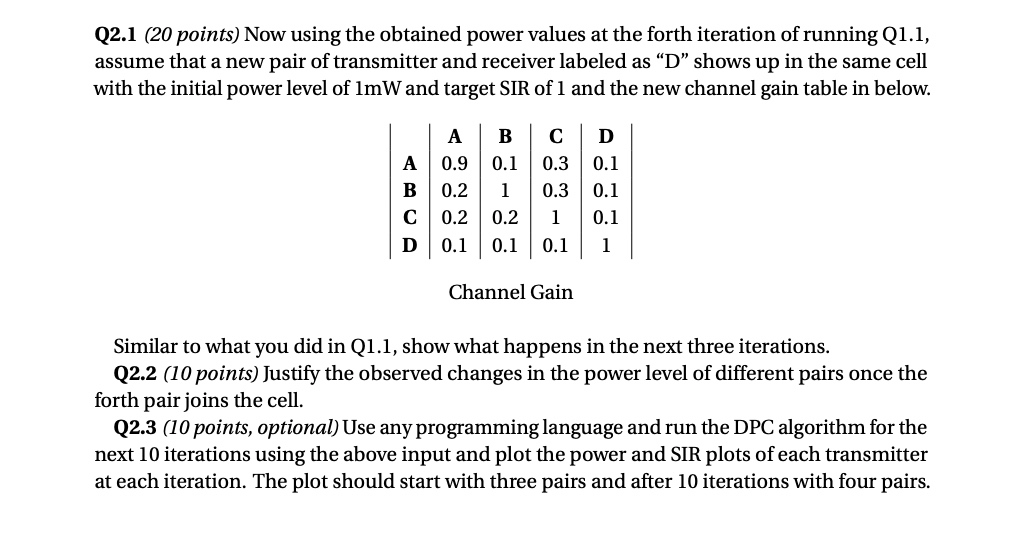
Q2.1 (20 points) Now using the obtained power values at the forth iteration of running Q1.1, assume that a new pair of transmitter and receiver labeled as D shows up in the same cell with the initial power level of ImW and target SIR of 1 and the new channel gain table in below. A B C D A 0.9 0. 2 0.2 0.1 B 0.1 1 0. 2 0.1 C 0.3 0.3 1 0. 1 D 0.1 0.1 0.1 1 Channel Gain Similar to what you did in Q1.1, show what happens in the next three iterations. Q2.2 (10 points) Justify the observed changes in the power level of different pairs once the forth pair joins the cell. Q2.3 (10 points, optional) Use any programming language and run the DPC algorithm for the next 10 iterations using the above input and plot the power and SIR plots of each transmitter at each iteration. The plot should start with three pairs and after 10 iterations with four pairs. Q2.1 (20 points) Now using the obtained power values at the forth iteration of running Q1.1, assume that a new pair of transmitter and receiver labeled as D shows up in the same cell with the initial power level of ImW and target SIR of 1 and the new channel gain table in below. A B C D A 0.9 0. 2 0.2 0.1 B 0.1 1 0. 2 0.1 C 0.3 0.3 1 0. 1 D 0.1 0.1 0.1 1 Channel Gain Similar to what you did in Q1.1, show what happens in the next three iterations. Q2.2 (10 points) Justify the observed changes in the power level of different pairs once the forth pair joins the cell. Q2.3 (10 points, optional) Use any programming language and run the DPC algorithm for the next 10 iterations using the above input and plot the power and SIR plots of each transmitter at each iteration. The plot should start with three pairs and after 10 iterations with four pairs
Step by Step Solution
There are 3 Steps involved in it

Get step-by-step solutions from verified subject matter experts
 Study Help