



Question: Q3. 17 points) Let P be the following compound proposition consisting of atoms A, B, and C: P: (AAC) +-((AVB)AC) For this question, you will
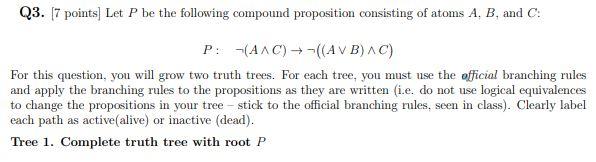

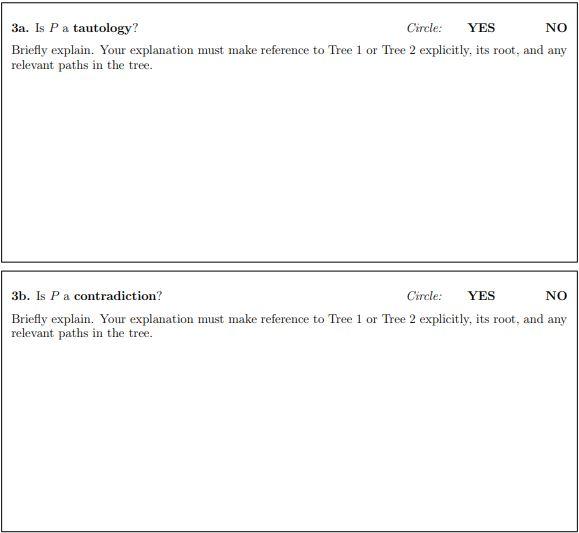
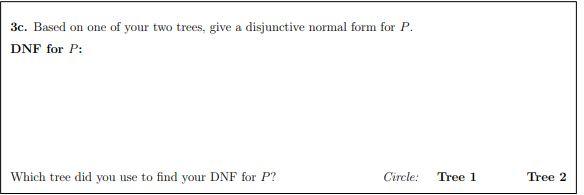
Q3. 17 points) Let P be the following compound proposition consisting of atoms A, B, and C: P: (AAC) +-((AVB)AC) For this question, you will grow two truth trees. For each tree, you must use the official branching rules and apply the branching rules to the propositions as they are written (i.e. do not use logical equivalences to change the propositions in your tree - stick to the official branching rules, seen in class). Clearly label each path as active(alive) or inactive (dead). Tree 1. Complete truth tree with root P Tree 2. Complete truth tree with root -P 3a. Is P a tautology? Circle: YES NO Briefly explain. Your explanation must make reference to Tree 1 or Tree 2 explicitly, its root, and any relevant paths in the tree. 3b. Is P a contradiction? Circle: YES NO Briefly explain. Your explanation must make reference to Tree 1 or Tree 2 explicitly, its root, and any relevant paths in the tree. 3c. Based on one of your two trees, give a disjunctive normal form for P. DNF for P: Which tree did you use to find your DNF for P? Circle: Tree 1 Tree 2
Step by Step Solution
There are 3 Steps involved in it

Get step-by-step solutions from verified subject matter experts