







Question: Q3. (50 marks) The overall transfer function of a second-order process is given by: G(s)=36s2+10s+120 a. What kind of damping is prevalent here? Why? (5
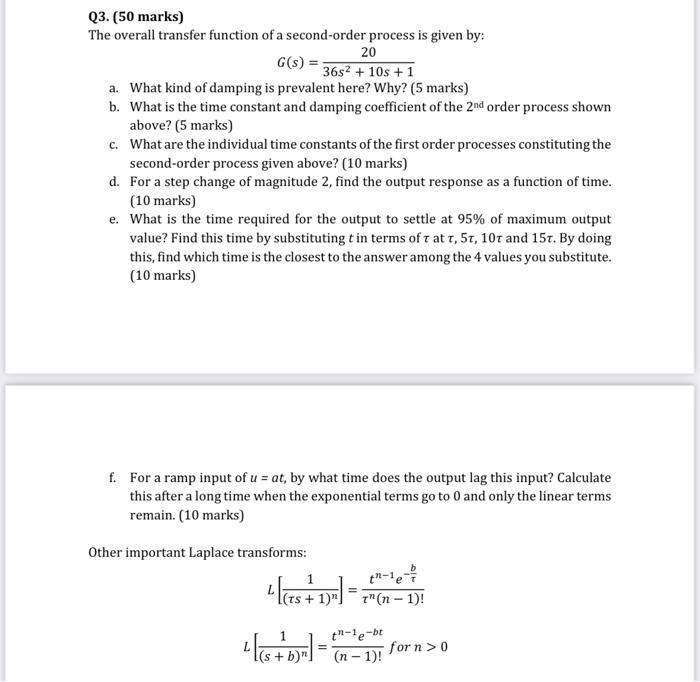
Q3. (50 marks) The overall transfer function of a second-order process is given by: G(s)=36s2+10s+120 a. What kind of damping is prevalent here? Why? (5 marks) b. What is the time constant and damping coefficient of the 2nd order process shown above? (5 marks) c. What are the individual time constants of the first order processes constituting the second-order process given above? (10 marks) d. For a step change of magnitude 2, find the output response as a function of time. (10 marks) e. What is the time required for the output to settle at 95% of maximum output value? Find this time by substituting t in terms of at ,5,10 and 15. By doing this, find which time is the closest to the answer among the 4 values you substitute. (10 marks) f. For a ramp input of u=at, by what time does the output lag this input? Calculate this after a long time when the exponential terms go to 0 and only the linear terms remain. (10 marks) Other important Laplace transforms: L[(s+1)n1]=n(n1)!tn1ebL[(s+b)n1]=(n1)!tn1ebtforn>0
Step by Step Solution
There are 3 Steps involved in it

Get step-by-step solutions from verified subject matter experts
 Study Help