







Question: Q3: A Network Queue Problem (30 pts) In a 5G network area, consider two network paths controlled by two distributed units (DUS) that merge
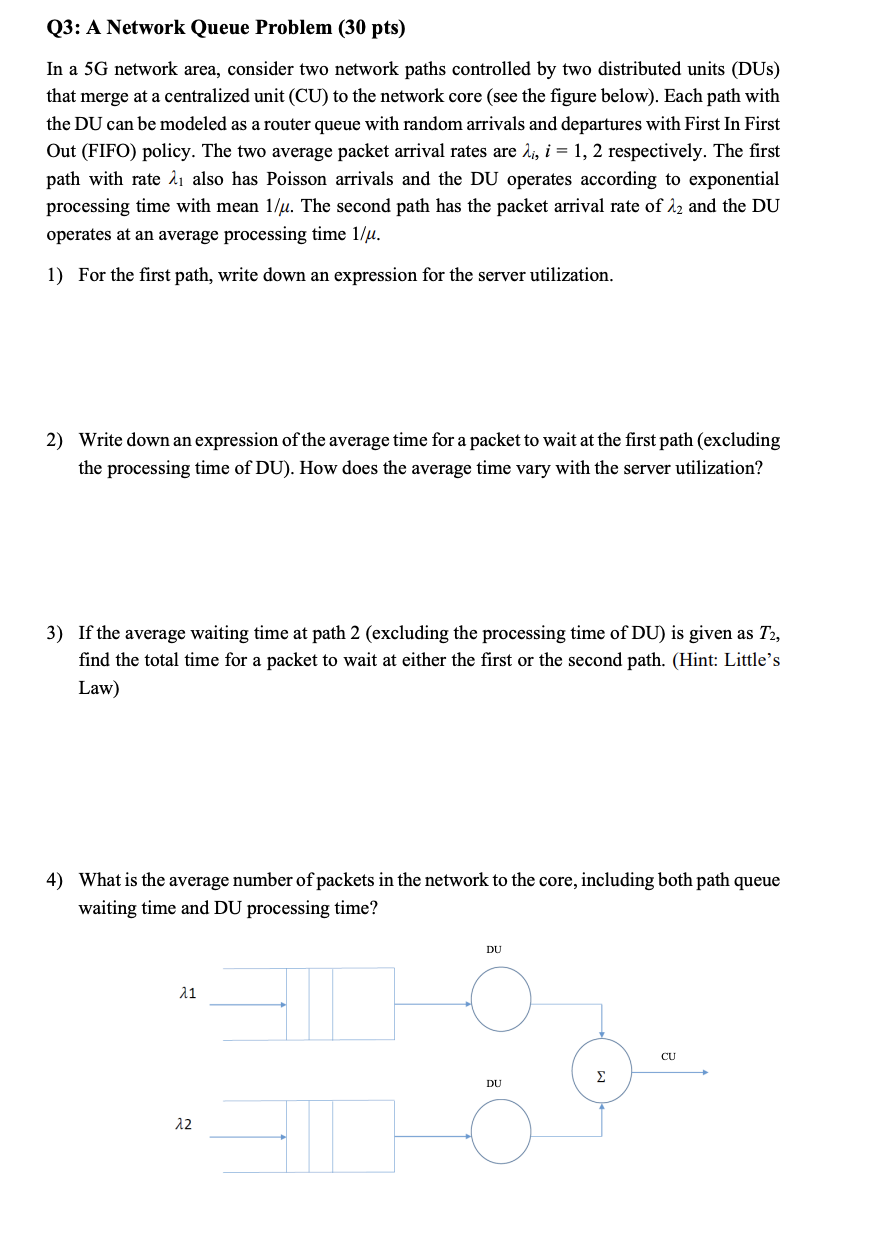
Q3: A Network Queue Problem (30 pts) In a 5G network area, consider two network paths controlled by two distributed units (DUS) that merge at a centralized unit (CU) to the network core (see the figure below). Each path with the DU can be modeled as a router queue with random arrivals and departures with First In First Out (FIFO) policy. The two average packet arrival rates are , i = 1, 2 respectively. The first path with rate 2 also has Poisson arrivals and the DU operates according to exponential processing time with mean 1/. The second path has the packet arrival rate of 22 and the DU operates at an average processing time 1/. 1) For the first path, write down an expression for the server utilization. 2) Write down an expression of the average time for a packet to wait at the first path (excluding the processing time of DU). How does the average time vary with the server utilization? 3) If the average waiting time at path 2 (excluding the processing time of DU) is given as T2, find the total time for a packet to wait at either the first or the second path. (Hint: Little's Law) 4) What is the average number of packets in the network to the core, including both path queue waiting time and DU processing time? 1 12 DU DU CU
Step by Step Solution
There are 3 Steps involved in it

Get step-by-step solutions from verified subject matter experts
 Study Help