







Question: Q3 Answer in Python. Use the code given in the answer when neccessary and follow all instructions. Problem #4: Banking Balance . Write a program
Q3
Answer in Python. Use the code given in the answer when neccessary and follow all instructions.
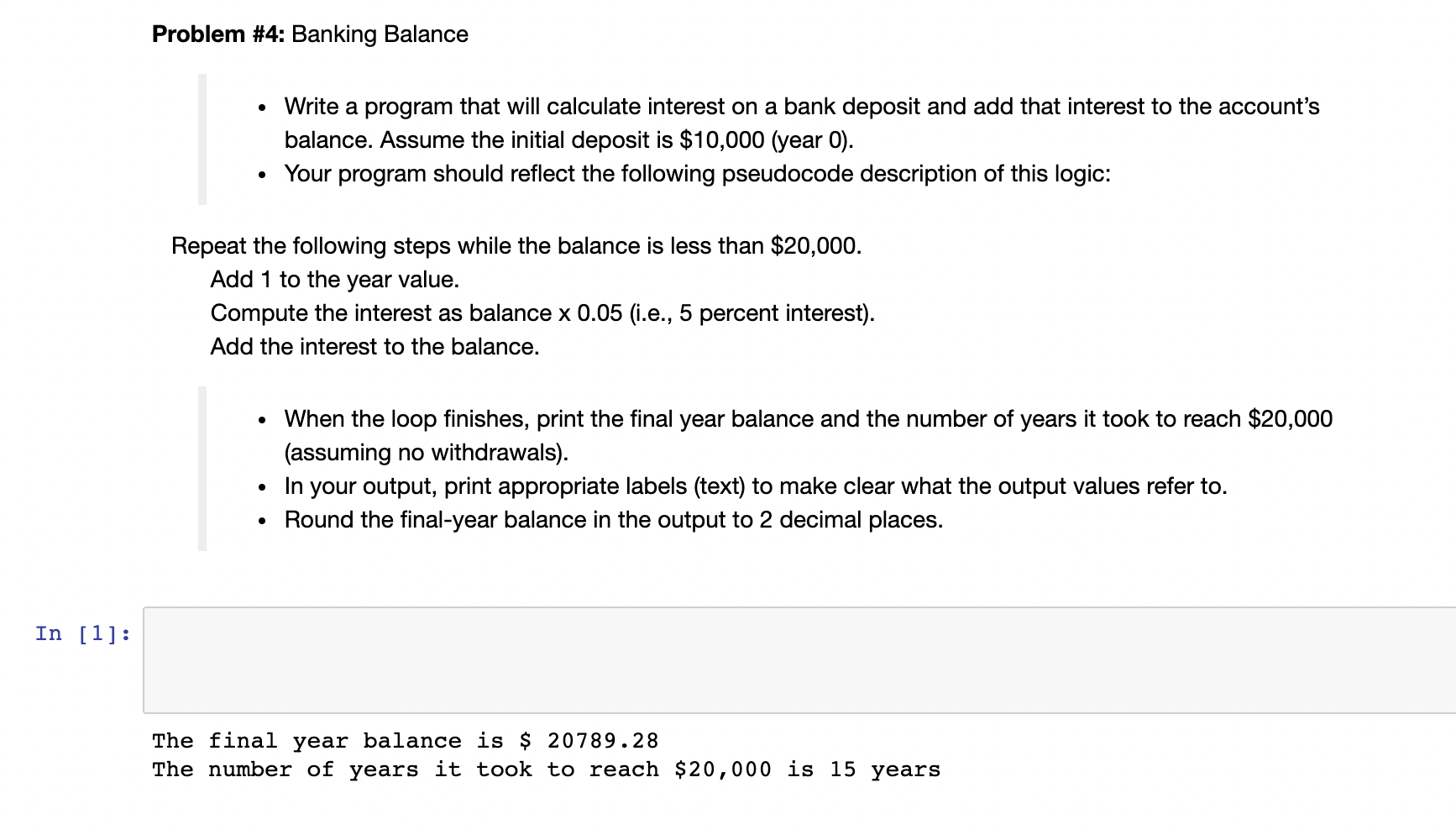
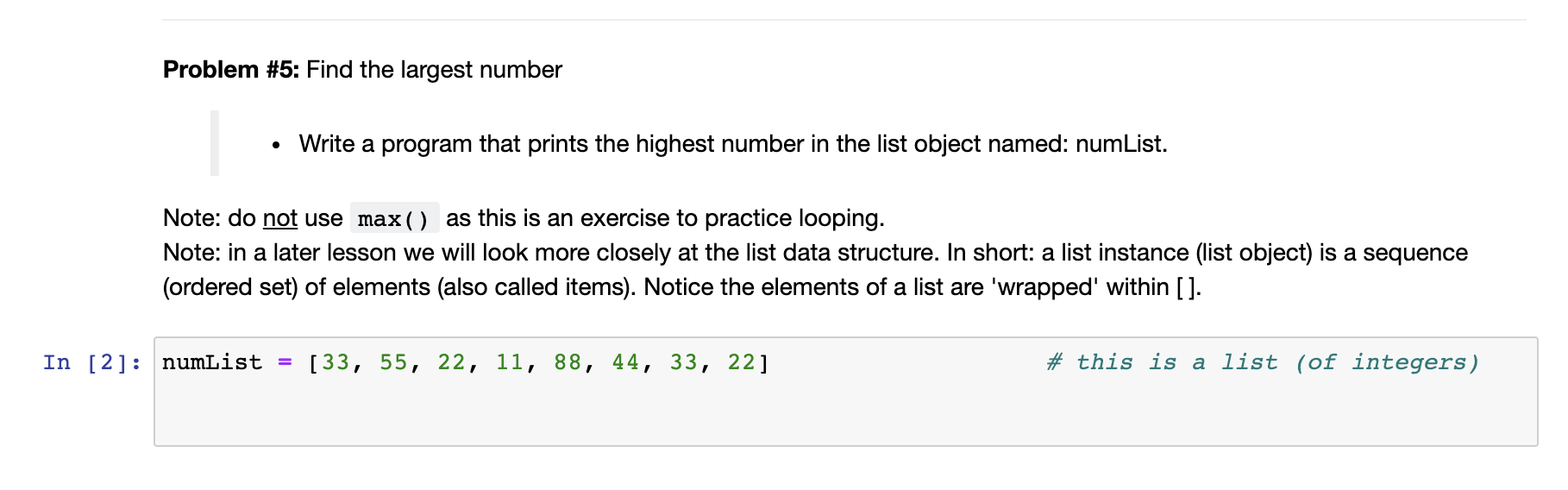
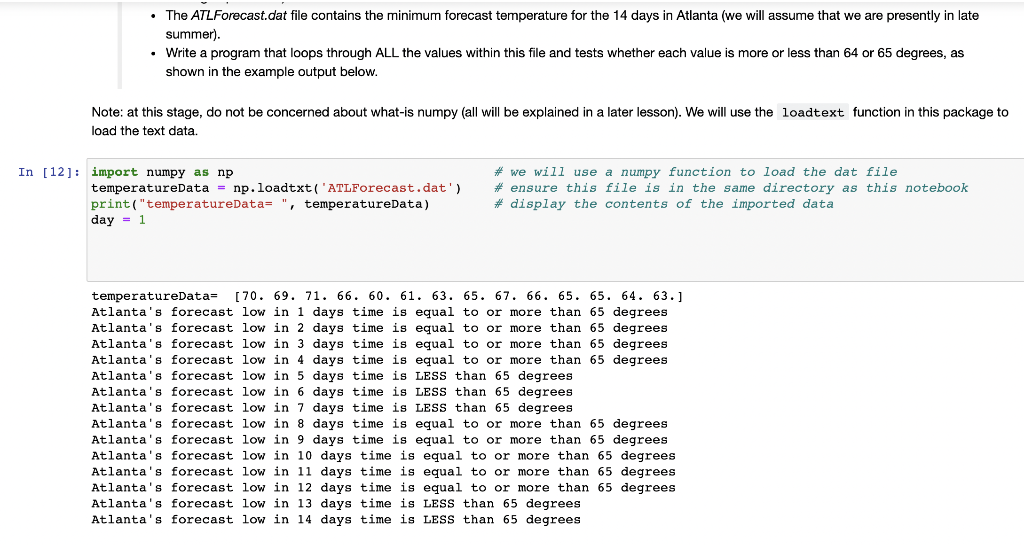
Problem #4: Banking Balance . Write a program that will calculate interest on a bank deposit and add that interest to the account's balance. Assume the initial deposit is $10,000 (year 0). Your program should reflect the following pseudocode description of this logic: . Repeat the following steps while the balance is less than $20,000. Add 1 to the year value. Compute the interest as balance x 0.05 (i.e., 5 percent interest). Add the interest to the balance. . When the loop finishes, print the final year balance and the number of years it took to reach $20,000 (assuming no withdrawals). In your output, print appropriate labels (text) to make clear what the output values refer to. Round the final-year balance in the output to 2 decimal places. In [1]: The final year balance is $ 20789.28 The number of years it took to reach $20,000 is 15 years Problem #5: Find the largest number Write a program that prints the highest number in the list object named: numList. Note: do not use max() as this is an exercise to practice looping. Note: in a later lesson we will look more closely at the list data structure. In short: a list instance (list object) is a sequence (ordered set) of elements (also called items). Notice the elements of a list are 'wrapped' within []. In [2]: numList = [33, 55, 22, 11, 88, 44, 33, 22] # this is a list (of integers) The ATLForecast.dat file contains the minimum forecast temperature for the 14 days in Atlanta (we will assume that we are presently in late summer). Write a program that loops through ALL the values within this file and tests whether each value is more or less than 64 or 65 degrees, as shown in the example output below. Note: at this stage, do not be concerned about what-is numpy (all will be explained in a later lesson). We will use the loadtext function in this package to load the text data. In [12] : import numpy as np temperatureData = np.loadtxt('ATLForecast.dat') print("temperatureData= ", temperatureData) day = 1 # we will use a numpy function to load the dat file # ensure this file is in the same directory as this notebook # display the contents of the imported data temperatureData= [70. 69. 71. 66. 60. 61. 63. 65. 67. 66. 65. 65. 64. 63. ] Atlanta's forecast low in 1 days time is equal to or more than 65 degrees Atlanta's forecast low in 2 days time is equal to or more than 65 degrees 2 Atlanta's forecast low in 3 days time is equal to or more than 65 degrees Atlanta's forecast low in 4 days time is equal to or more than 65 degrees ? Atlanta's forecast low in 5 days time is less than 65 degrees Atlanta's forecast low in 7 days time is less than 65 degrees Atlanta's forecast low in 6 days time is LESS than 65 degrees LESS Atlanta's forecast low in 8 days time is equal to or more than 65 degrees Atlanta's forecast low in 9 days time is equal to or more than 65 degrees Atlanta's forecast low in 10 days time is equal to or more than 65 degrees Atlanta's forecast low in 11 days time is equal to or more than 65 degrees Atlanta's forecast low in 12 days time is equal to or more than 65 degrees Atlanta's forecast low in 13 days time is LESS than 65 degrees Atlanta's forecast low in 14 days time is LESS than 65 degrees
Step by Step Solution
There are 3 Steps involved in it

Get step-by-step solutions from verified subject matter experts
 Study Help