







Question: Q3. Bayes Nets: Gibbs Sampling. (20 points) We will work on the same Bayes net and its corresponding CPTs as in Q2. We observe the
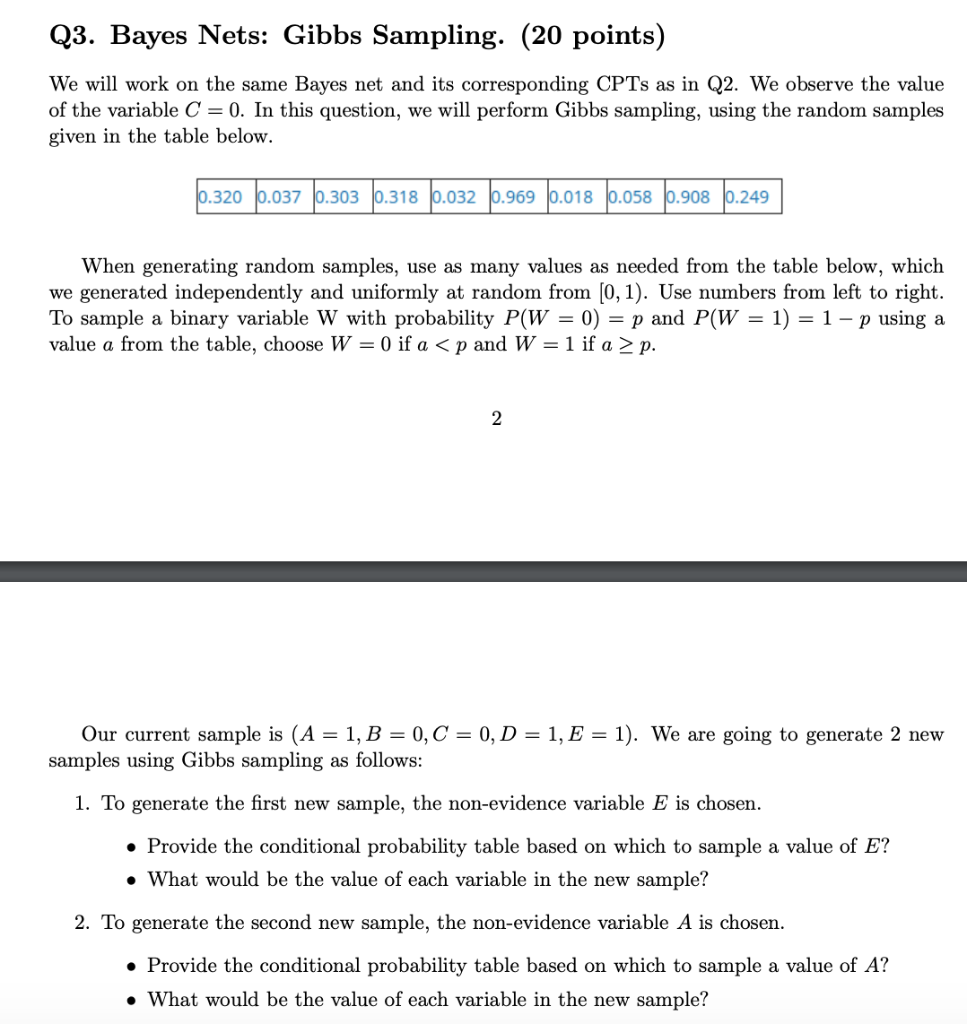
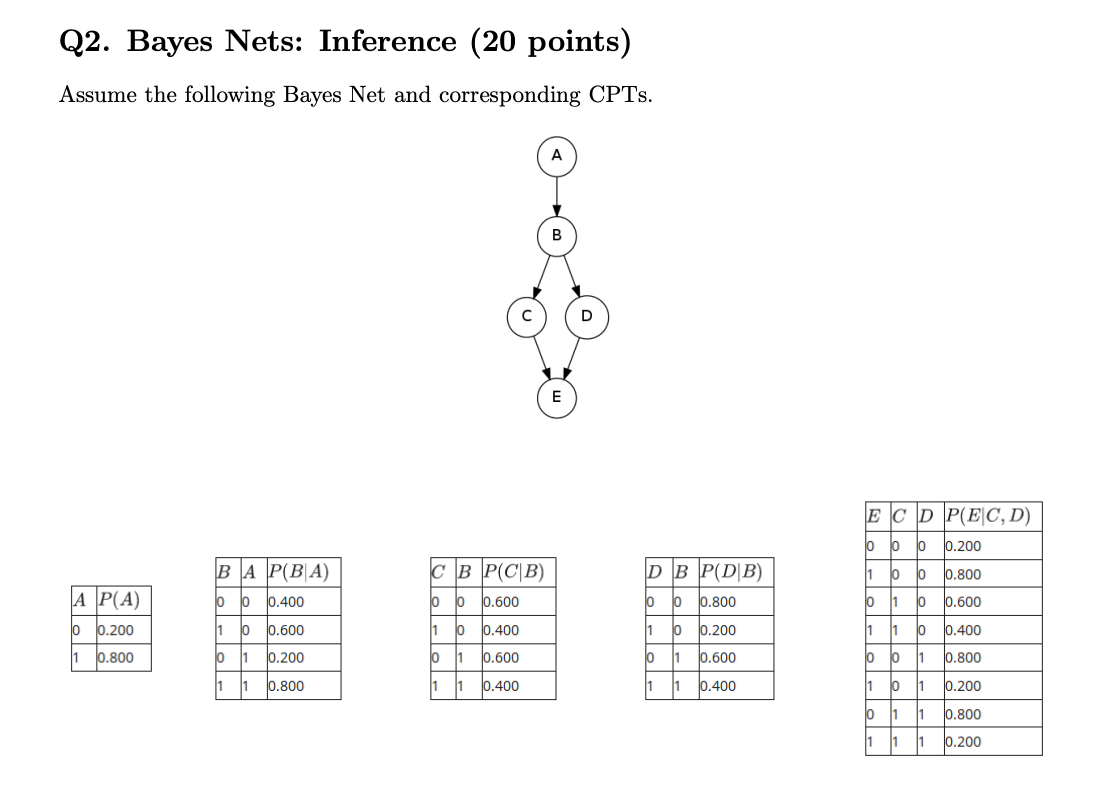
Q3. Bayes Nets: Gibbs Sampling. (20 points) We will work on the same Bayes net and its corresponding CPTs as in Q2. We observe the value of the variable C = 0. In this question, we will perform Gibbs sampling, using the random samples given in the table below. 0.320 0.037 0.303 0.318 0.032 0.969 0.018 0.058 0.908 0.249 When generating random samples, use as many values as needed from the table below, which we generated independently and uniformly at random from (0,1). Use numbers from left to right. To sample a binary variable W with probability P(W = 0) = p and P(W 1) = 1 - p using a value a from the table, choose W = 0 if a
p. 2 Our current sample is (A = 1, B = 0, C = 0, D = 1, E = 1). We are going to generate 2 new samples using Gibbs sampling as follows: 1. To generate the first new sample, the non-evidence variable E is chosen. Provide the conditional probability table based on which to sample a value of E? What would be the value of each variable in the new sample? 2. To generate the second new sample, the non-evidence variable A is chosen. Provide the conditional probability table based on which to sample a value of A? What would be the value of each variable in the new sample? Q3. Bayes Nets: Gibbs Sampling. (20 points) We will work on the same Bayes net and its corresponding CPTs as in Q2. We observe the value of the variable C = 0. In this question, we will perform Gibbs sampling, using the random samples given in the table below. 0.320 0.037 0.303 0.318 0.032 0.969 0.018 0.058 0.908 0.249 When generating random samples, use as many values as needed from the table below, which we generated independently and uniformly at random from (0,1). Use numbers from left to right. To sample a binary variable W with probability P(W = 0) = p and P(W 1) = 1 - p using a value a from the table, choose W = 0 if a
p. 2 Our current sample is (A = 1, B = 0, C = 0, D = 1, E = 1). We are going to generate 2 new samples using Gibbs sampling as follows: 1. To generate the first new sample, the non-evidence variable E is chosen. Provide the conditional probability table based on which to sample a value of E? What would be the value of each variable in the new sample? 2. To generate the second new sample, the non-evidence variable A is chosen. Provide the conditional probability table based on which to sample a value of A? What would be the value of each variable in the new sample
Step by Step Solution
There are 3 Steps involved in it

Get step-by-step solutions from verified subject matter experts
 Study Help