







Question: Q3) Let's perform gradient descent with our new data. Fill in values for thetalnit, eta (use 0.25 ), and epochs (use 500,000 ). This may
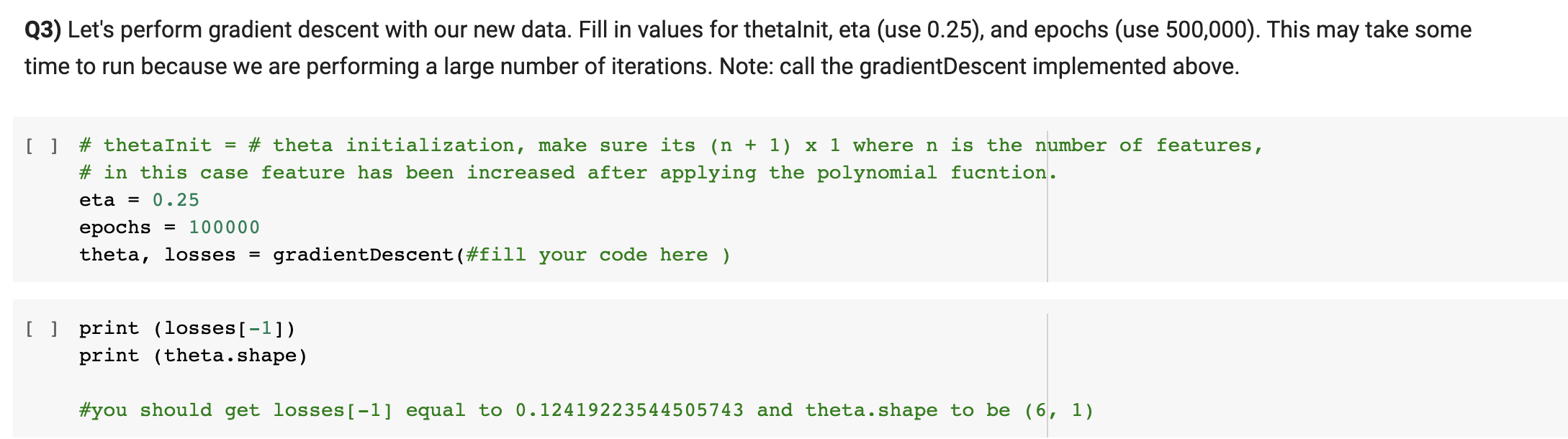
Q3) Let's perform gradient descent with our new data. Fill in values for thetalnit, eta (use 0.25 ), and epochs (use 500,000 ). This may take some time to run because we are performing a large number of iterations. Note: call the gradientDescent implemented above. [ ] \# thetainit = \# theta initialization, make sure its (n+1)x1 where n is the number of features, \# in this case feature has been increased after applying the polynomial fucntion. eta =0.25 epochs =100000 theta, losses = gradientdescent(\#fill your code here ) [ ] print (losses[-1]) print (theta.shape) \#you should get losses [1] equal to 0.12419223544505743 and theta.shape to be (6, 1)
Step by Step Solution
There are 3 Steps involved in it

Get step-by-step solutions from verified subject matter experts
 Study Help