Question: Q3. What is your recommendation regarding what FlexCon should do with its family of pistons? Support your arguments with evidence gathered during your analysis (5
Q3. What is your recommendation regarding what FlexCon should do with its family of pistons? Support your arguments with evidence gathered during your analysis (5 pts)
Q4. What are the differences between FOB origin and FOB destination? (5 pts). Google these incoterms.
Q6. At this moment, you must make your decision on Q3. Based on your learning in CH 16, describe how to improve your business performance in terms of the Lean Philosophy or Lean Supply Chain? There is no right/wrong answer here. However, demonstrate your knowledge in lean concepts and their applicability to business decision (10 pts)
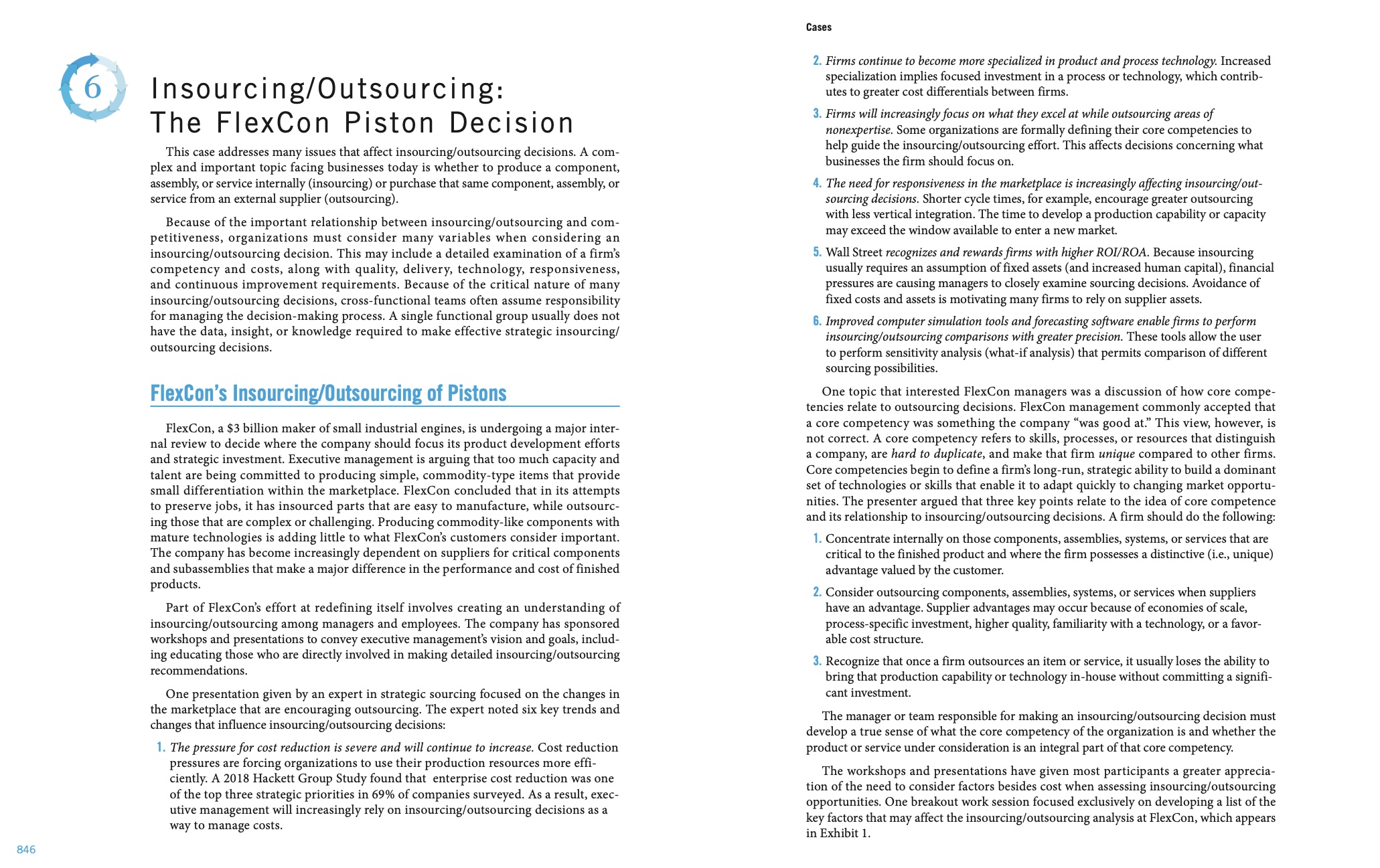
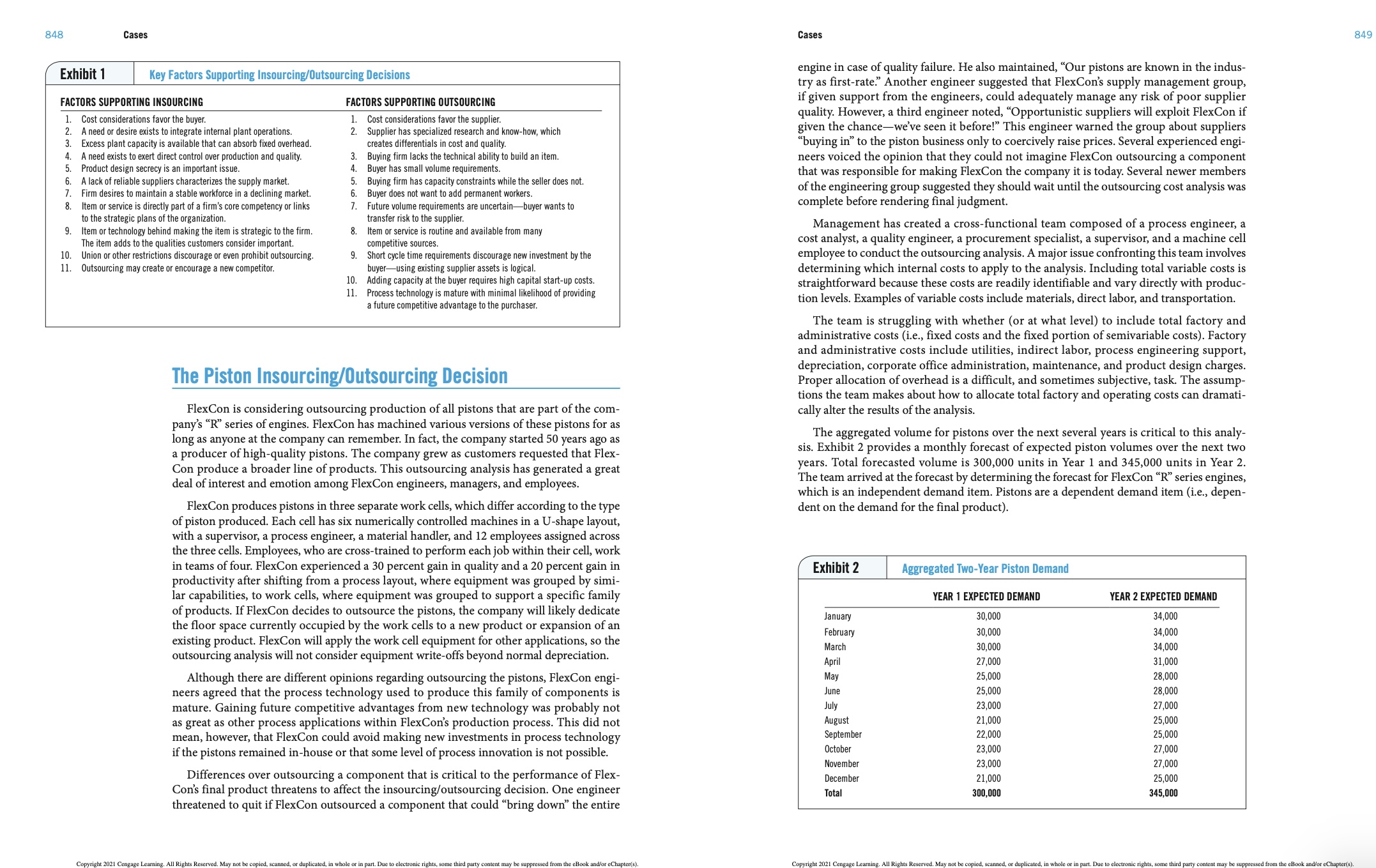
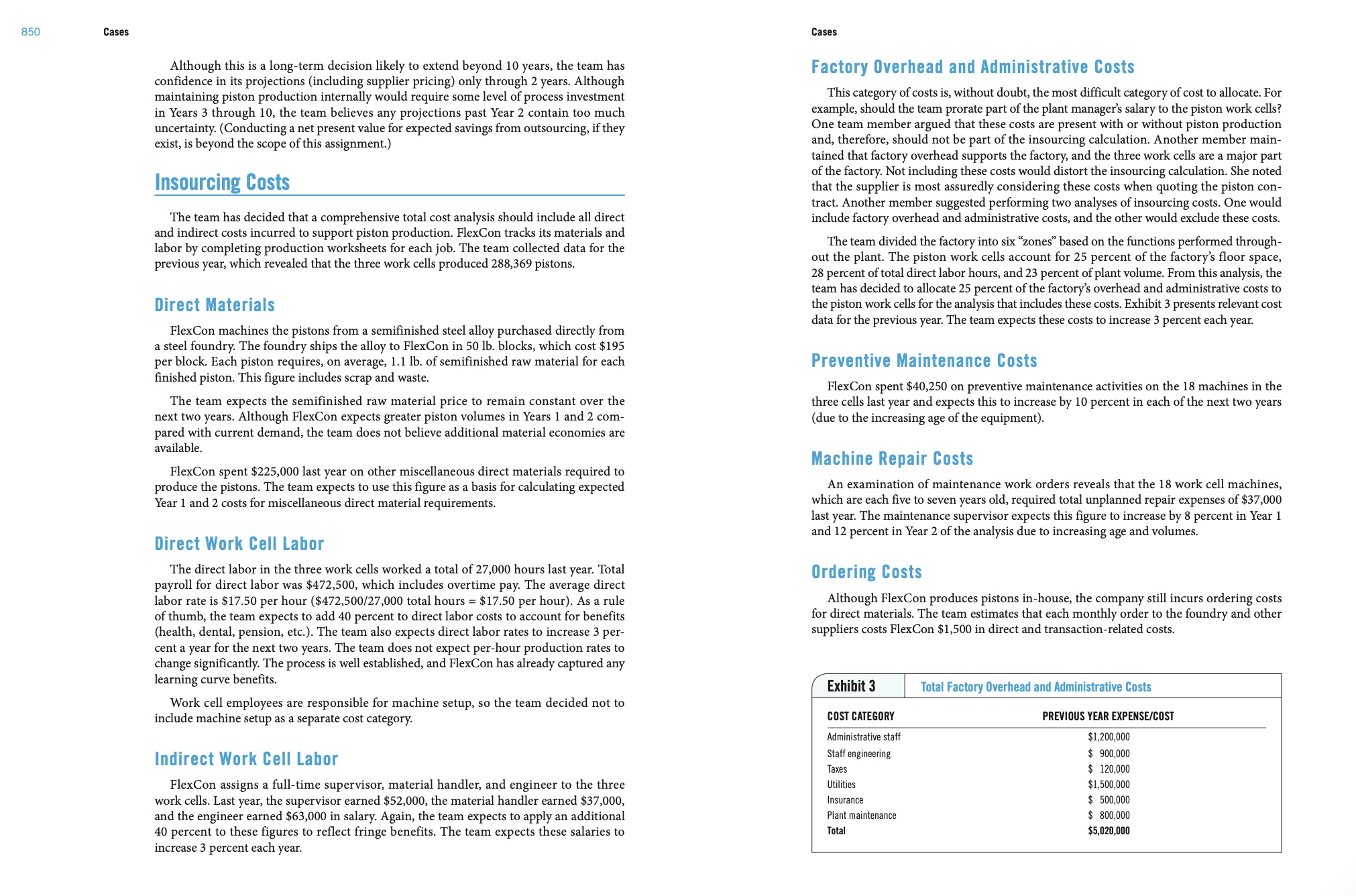
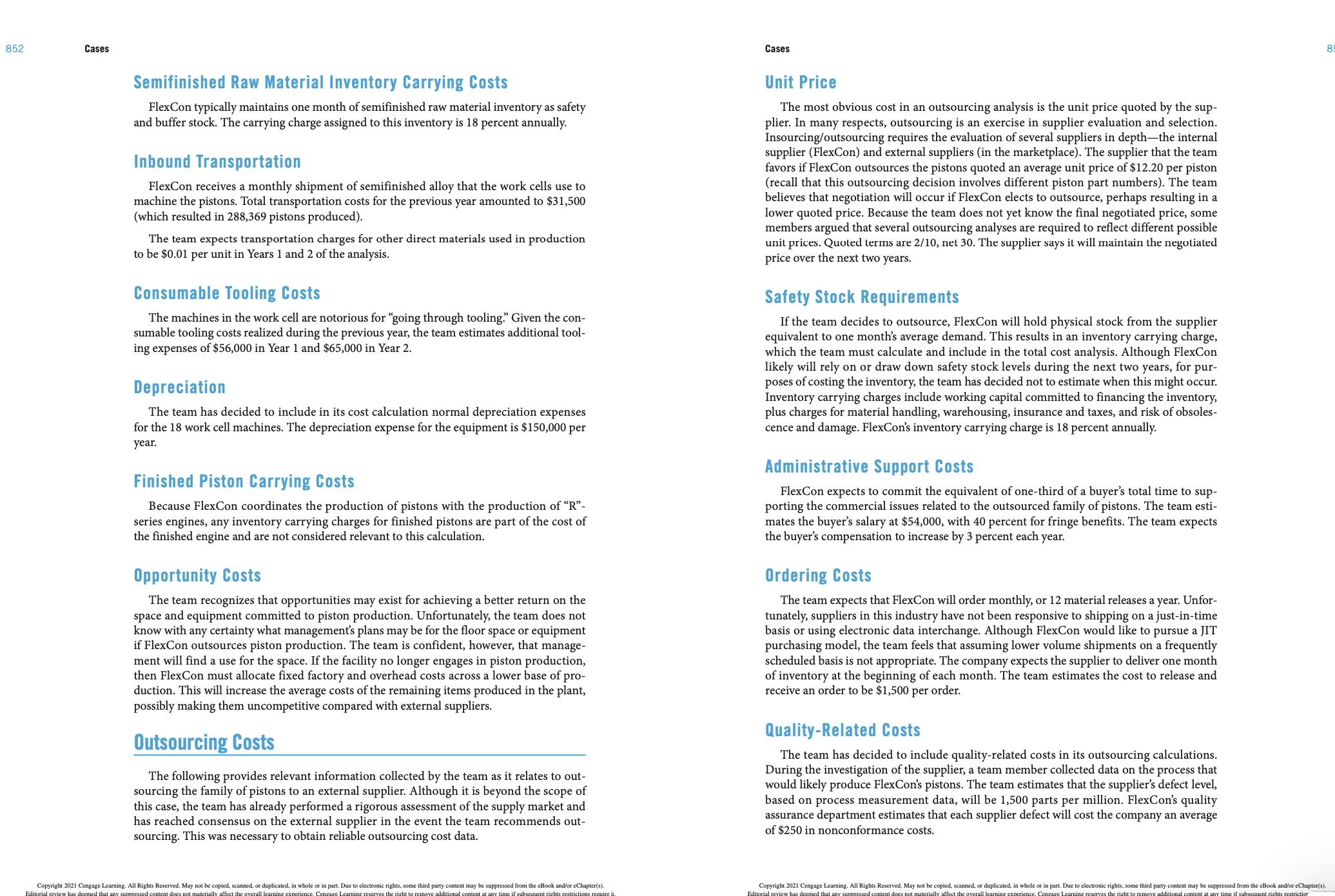
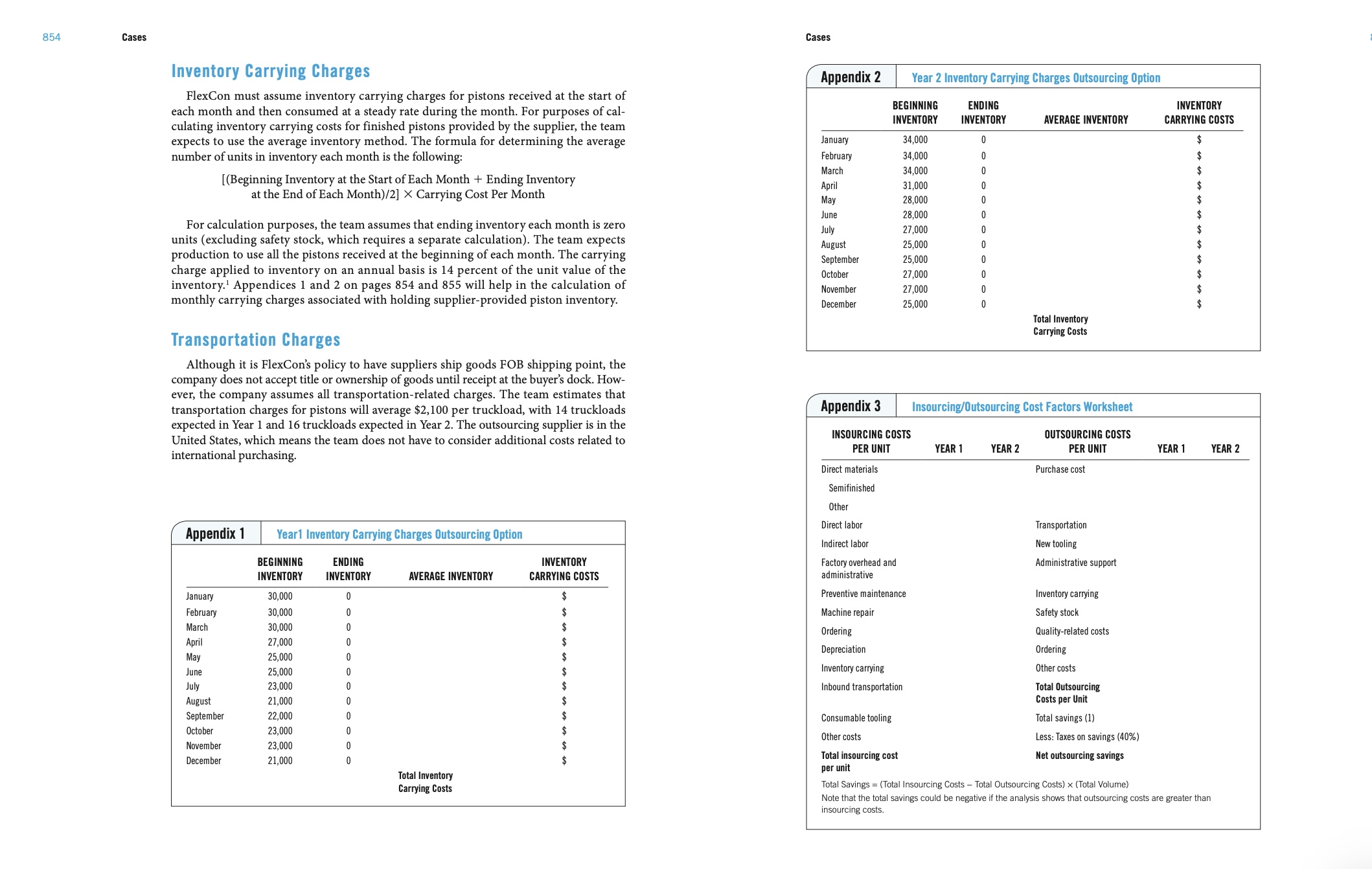
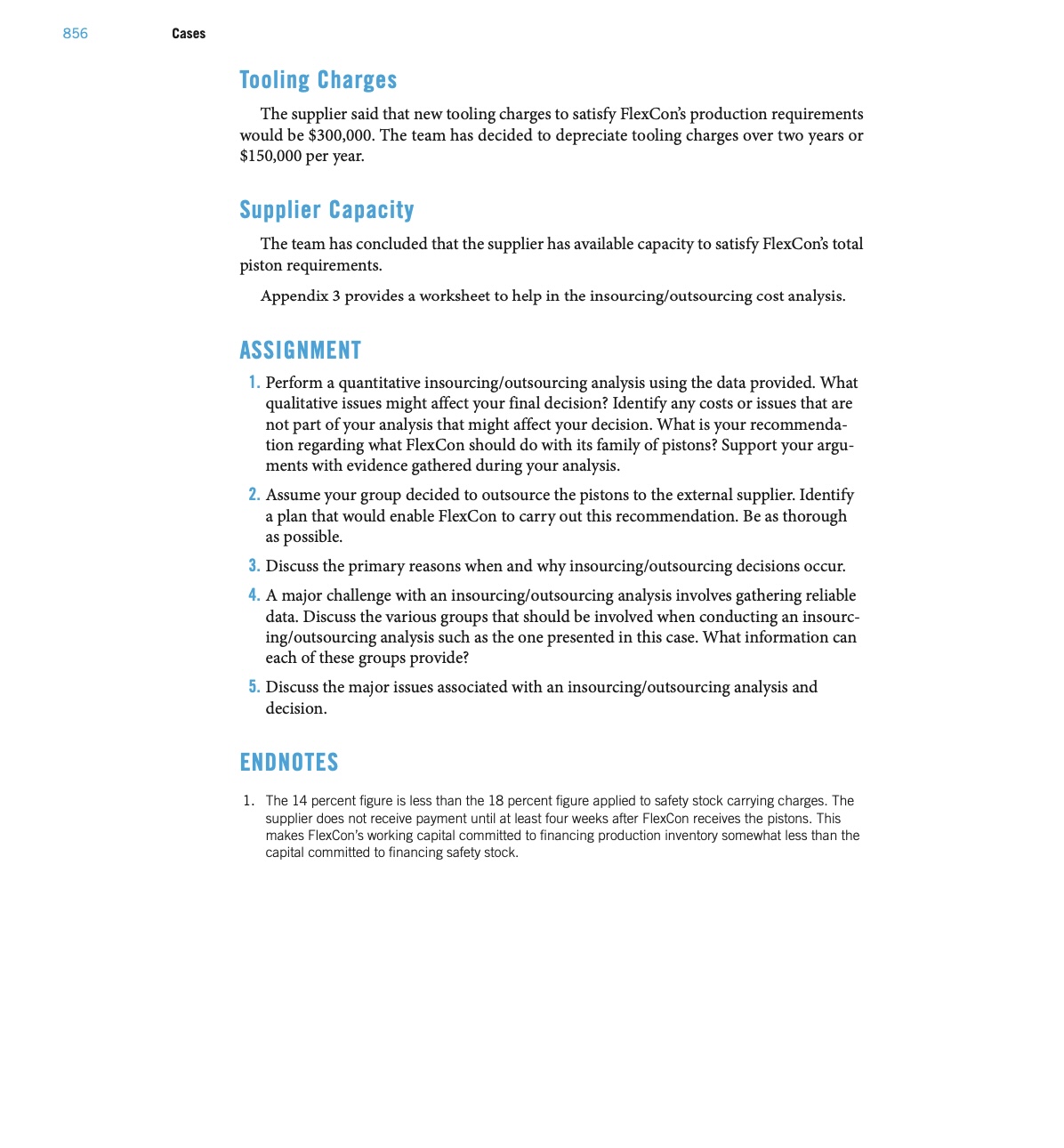
846 Insourcing/Outsourcing: The FlexCon Piston Decision This case addresses many issues that affect insourcing/outsourcing decisions. A com- plex and important topic facing businesses today is whether to produce a component, assembly, or service internally (insourcing) or purchase that same component, assembly, or service from an external supplier (outsourcing). Because of the important relationship between insourcing/outsourcing and com- petitiveness, organizations must consider many variables when considering an insourcing/outsourcing decision. This may include a detailed examination of a firm's competency and costs, along with quality, delivery, technology, responsiveness, and continuous improvement requirements. Because of the critical nature of many insourcing/outsourcing decisions, cross-functional teams often assume responsibility for managing the decision-making process. A single functional group usually does not have the data, insight, or knowledge required to make effective strategic insourcing/ outsourcing decisions. FlexCon's Insourcing/Outsourcing of Pistons FlexCon, a $3 billion maker of small industrial engines, is undergoing a major inter- nal review to decide where the company should focus its product development efforts and strategic investment. Executive management is arguing that too much capacity and talent are being committed to producing simple, commodity-type items that provide small differentiation within the marketplace. FlexCon concluded that in its attempts to preserve jobs, it has insourced parts that are easy to manufacture, while outsourc- ing those that are complex or challenging. Producing commodity-like components with mature technologies is adding little to what FlexCon's customers consider important. The company has become increasingly dependent on suppliers for critical components and subassemblies that make a major difference in the performance and cost of finished products. Part of FlexCon's effort at redefining itself involves creating an understanding of insourcing/outsourcing among managers and employees. The company has sponsored workshops and presentations to convey executive management's vision and goals, includ- ing educating those who are directly involved in making detailed insourcing/outsourcing recommendations. One presentation given by an expert in strategic sourcing focused on the changes in the marketplace that are encouraging outsourcing. The expert noted six key trends and changes that influence insourcing/outsourcing decisions: 1. The pressure for cost reduction is severe and will continue to increase. Cost reduction pressures are forcing organizations to use their production resources more effi- ciently. A 2018 Hackett Group Study found that enterprise cost reduction was one of the top three strategic priorities in 69% of companies surveyed. As a result, exec- utive management will increasingly rely on insourcing/outsourcing decisions as a way to manage costs. Cases ~ . Firms continue to become more specialized in product and process technology. Increased specialization implies focused investment in a process or technology, which contrib- utes to greater cost differentials between firms. w . Firms will increasingly focus on what they excel at while outsourcing areas of nonexpertise. Some organizations are formally defining their core competencies to help guide the insourcing/outsourcing effort. This affects decisions concerning what businesses the firm should focus on. -~ . The need for responsiveness in the marketplace is increasingly affecting insourcing/out- sourcing decisions. Shorter cycle times, for example, encourage greater outsourcing with less vertical integration. The time to develop a production capability or capacity may exceed the window available to enter a new market. en . Wall Street recognizes and rewards firms with higher ROI/ROA. Because insourcing usually requires an assumption of fixed assets (and increased human capital), financial Ppressures are causing managers to closely examine sourcing decisions. Avoidance of fixed costs and assets is motivating many firms to rely on supplier assets. . Improved computer simulation tools and forecasting software enable firms to perform insourcing/outsourcing comparisons with greater precision. These tools allow the user to perform sensitivity analysis (what-if analysis) that permits comparison of different sourcing possibilities. One topic that interested FlexCon managers was a discussion of how core compe- tencies relate to outsourcing decisions. FlexCon management commonly accepted that a core competency was something the company \"was good at\" This view, however, is not correct. A core competency refers to skills, processes, or resources that distinguish a company, are hard to duplicate, and make that firm unique compared to other firms. Core competencies begin to define a firm's long-run, strategic ability to build a dominant set of technologies or skills that enable it to adapt quickly to changing market opportu- nities. The presenter argued that three key points relate to the idea of core competence and its relationship to insourcing/outsourcing decisions. A firm should do the following: 1. Concentrate internally on those components, assemblies, systems, or services that are critical to the finished product and where the firm possesses a distinctive (i.e., unique) advantage valued by the customer. o . Consider outsourcing components, assemblies, systems, or services when suppliers have an advantage. Supplier advantages may occur because of economies of scale, process-specific investment, higher quality, familiarity with a technology, or a favor- able cost structure. w . Recognize that once a firm outsources an item or service, it usually loses the ability to bring that production capability or technology in-house without committing a signifi- cant investment. The manager or team responsible for making an insourcing/outsourcing decision must develop a true sense of what the core competency of the organization is and whether the product or service under consideration is an integral part of that core competency. The workshops and presentations have given most participants a greater apprecia- tion of the need to consider factors besides cost when assessing insourcing/outsourcing opportunities. One breakout work session focused exclusively on developing a list of the key factors that may affect the insourcing/outsourcing analysis at FlexCon, which appears in Exhibit 1. 848 Cases Exhibit 1 Key Factors Supporting Insourcing/Outsourcing Decisions FACTORS SUPPORTING INSOURCING FACTORS SUPPORTING OUTSOURCING 1. Cost considerations favor the buyer. 1. Cost considerations favor the supplier. 2. Aneed or desire exists to integrate internal plant operations. 2. Supplier has specialized research and know-how, which 3. Excess plant capacity is available that can absorb fixed overhead. creates differentials in cost and quality. 4. Aneed exists to exert direct control over production and quality. 3. Buying firm lacks the technical ability o build an item. 5. Product design secrecy is an important issue. 4. Buyer has small volume requirements. 6. Alackof reliable suppliers characterizes the supply market 5. Buying firm has capacity constraints while the seller does not 7. Firm desires to maintain a stable workforce in a declining market. 6. Buyer does not want to add permanent workers. 8. ltem or service is directly part of a firm's core competency or links 7. Future volume requirements are uncertainbuyer wants to 1o the strategic plans of the organization. transfer risk to the supplier. 9. Item or technology behind making the item is strategic to the firm. 8. ltem or service is routine and available from many The item adds to the qualities customers consider important. competitive sources. 10 Union or other restrictions discourage or even prohibit outsourcing. 9. Short cycle time requirements discourage new investment by the 11 Outsourcing may create or encourage a new competitor. buyerusing existing supplier assets is logical. 10. Adding capacity at the buyer requires high capital start-up costs. 11 Process technology is mature with minimallikelihood of providing a future competitive advantage to the purchaser. (Copyright 2021 Cengage Leaming. Al Rights Reserved, May o b copied.scanaed, o duplicted, i whole o i pat. D 1o eleceon ighs some hid pry contt ray be suppeesse fom the cBook adlor eChaptes). The Piston Insourcing/Outsourcing Decision FlexCon is considering outsourcing production of all pistons that are part of the com- pany's \"R\" series of engines. FlexCon has machined various versions of these pistons for as long as anyone at the company can remember. In fact, the company started 50 years ago as a producer of high-quality pistons. The company grew as customers requested that Flex- Con produce a broader line of products. This outsourcing analysis has generated a great deal of interest and emotion among FlexCon engineers, managers, and employees. FlexCon produces pistons in three separate work cells, which differ according to the type of piston produced. Each cell has six numerically controlled machines in a U-shape layout, with a supervisor, a process engineer, a material handler, and 12 employees assigned across the three cells. Employees, who are cross-trained to perform each job within their cell, work in teams of four. FlexCon experienced a 30 percent gain in quality and a 20 percent gain in productivity after shifting from a process layout, where equipment was grouped by simi- lar capabilities, to work cells, where equipment was grouped to support a specific family of products. If FlexCon decides to outsource the pistons, the company will likely dedicate the floor space currently occupied by the work cells to a new product or expansion of an existing product. FlexCon will apply the work cell equipment for other applications, so the outsourcing analysis will not consider equipment write-offs beyond normal depreciation. Although there are different opinions regarding outsourcing the pistons, FlexCon engi- neers agreed that the process technology used to produce this family of components is mature. Gaining future competitive advantages from new technology was probably not as great as other process applications within FlexCon's production process. This did not mean, however, that FlexCon could avoid making new investments in process technology if the pistons remained in-house or that some level of process innovation is not possible. Differences over outsourcing a component that is critical to the performance of Flex- Cons final product threatens to affect the insourcing/outsourcing decision. One engineer threatened to quit if FlexCon outsourced a component that could \"bring down\" the entire Cases engine in case of quality failure. He also maintained, \"Our pistons are known in the indus- try as first-rate\" Another engineer suggested that FlexCon's supply management group, if given support from the engineers, could adequately manage any risk of poor supplier quality. However, a third engineer noted, \"Opportunistic suppliers will exploit FlexCon if given the chancewe've seen it before!\" This engineer warned the group about suppliers \"buying in\" to the piston business only to coercively raise prices. Several experienced engi- neers voiced the opinion that they could not imagine FlexCon outsourcing a component that was responsible for making FlexCon the company it is today. Several newer members of the engineering group suggested they should wait until the outsourcing cost analysis was complete before rendering final judgment. Management has created a cross-functional team composed of a process engineer, a cost analyst, a quality engineer, a procurement specialist, a supervisor, and a machine cell employee to conduct the outsourcing analysis. A major issue confronting this team involves determining which internal costs to apply to the analysis. Including total variable costs is straightforward because these costs are readily identifiable and vary directly with produc- tion levels. Examples of variable costs include materials, direct labor, and transportation. The team is struggling with whether (or at what level) to include total factory and administrative costs (i.e., fixed costs and the fixed portion of semivariable costs). Factory and administrative costs include utilities, indirect labor, process engineering support, depreciation, corporate office administration, maintenance, and product design charges. Proper allocation of overhead is a difficult, and sometimes subjective, task. The assump- tions the team makes about how to allocate total factory and operating costs can dramati- cally alter the results of the analysis. The aggregated volume for pistons over the next several years is critical to this analy- sis. Exhibit 2 provides a monthly forecast of expected piston volumes over the next two years. Total forecasted volume is 300,000 units in Year 1 and 345,000 units in Year 2. The team arrived at the forecast by determining the forecast for FlexCon \"R\" series engines, which is an independent demand item. Pistons are a dependent demand item (i.e., depen- dent on the demand for the final product). Exhibit 2 Aggregated Two-Year Piston Demand YEAR 1 EXPECTED DEMAND YEAR 2 EXPECTED DEMAND January 30,000 34,000 February 30,000 34,000 March 30,000 34,000 April 21,000 31,000 May 25,000 28,000 June 25,000 28000 July 23,000 21,000 August 21,000 25,000 September 22,000 25000 October 23,000 27,000 November 23,000 27,000 December 21,000 25,000 Total 300,000 345,000 (Copyright 2021 Cengage Leaming. Al Rights Reserved. May ot b copied.scanaed,oe duplicated, i whole o i pat D 1o elecieon ights some hid pry contntray be suppeesse fom the ek anclor eChapte(s). 849 Cases Although this is a long-term decision likely to extend beyond 10 years, the team has confidence in its projections (including supplier pricing) only through 2 years. Although maintaining piston production internally would require some level of process investment in Years 3 through 10, the team believes any projections past Year 2 contain too much uncertainty. (Conducting a net present value for expected savings from outsourcing, if they exist, is beyond the scope of this assignment.) Insourcing Costs The team has decided that a comprehensive total cost analysis should include all direct and indirect costs incurred to support piston production. FlexCon tracks its materials and labor by completing production worksheets for each job. The team collected data for the previous year, which revealed that the three work cells produced 288,369 pistons. Direct Materials FlexCon machines the pistons from a semifinished steel alloy purchased directly from a steel foundry. The foundry ships the alloy to FlexCon in 50 Ib. blocks, which cost $195 per block. Each piston requires, on average, 1.1 Ib. of semifinished raw material for each finished piston. This figure includes scrap and waste. The team expects the semifinished raw material price to remain constant over the next two years. Although FlexCon expects greater piston volumes in Years 1 and 2 com- pared with current demand, the team does not believe additional material economies are available. FlexCon spent $225,000 last year on other miscellaneous direct materials required to produce the pistons. The team expects to use this figure as a basis for calculating expected Year 1 and 2 costs for miscellaneous direct material requirements. Direct Work Cell Labor The direct labor in the three work cells worked a total of 27,000 hours last year. Total payroll for direct labor was $472,500, which includes overtime pay. The average direct labor rate is $17.50 per hour ($472,500/27,000 total hours = $17.50 per hour). As a rule of thumb, the team expects to add 40 percent to direct labor costs to account for benefits (health, dental, pension, etc.). The team also expects direct labor rates to increase 3 per- cent a year for the next two years. The team does not expect per-hour production rates to change significantly. The process is well established, and FlexCon has already captured any learning curve benefits. Work cell employees are responsible for machine setup, so the team decided not to include machine setup as a separate cost category. Indirect Work Cell Labor FlexCon assigns a full-time supervisor, material handler, and engineer to the three work cells. Last year, the supervisor earned $52,000, the material handler earned $37,000, and the engineer earned $63,000 in salary. Again, the team expects to apply an additional 40 percent to these figures to reflect fringe benefits. The team expects these salaries to increase 3 percent each year. Cases Factory Overhead and Administrative Costs This category of costs is, without doubt, the most difficult category of cost to allocate. For example, should the team prorate part of the plant manager's salary to the piston work cells? One team member argued that these costs are present with or without piston production and, therefore, should not be part of the insourcing calculation. Another member main- tained that factory overhead supports the factory, and the three work cells are a major part of the factory. Not including these costs would distort the insourcing calculation. She noted that the supplier is most assuredly considering these costs when quoting the piston con- tract. Another member suggested performing two analyses of insourcing costs. One would include factory overhead and administrative costs, and the other would exclude these costs. The team divided the factory into six \"zones\" based on the functions performed through- out the plant. The piston work cells account for 25 percent of the factory's floor space, 28 percent of total direct labor hours, and 23 percent of plant volume. From this analysis, the team has decided to allocate 25 percent of the factory's overhead and administrative costs to the piston work cells for the analysis that includes these costs. Exhibit 3 presents relevant cost data for the previous year. The team expects these costs to increase 3 percent each year. Preventive Maintenance Costs FlexCon spent $40,250 on preventive maintenance activities on the 18 machines in the three cells last year and expects this to increase by 10 percent in each of the next two years (due to the increasing age of the equipment). Machine Repair Costs An examination of maintenance work orders reveals that the 18 work cell machines, which are each five to seven years old, required total unplanned repair expenses of $37,000 last year. The maintenance supervisor expects this figure to increase by 8 percent in Year 1 and 12 percent in Year 2 of the analysis due to increasing age and volumes. Ordering Costs Although FlexCon produces pistons in-house, the company still incurs ordering costs for direct materials. The team estimates that each monthly order to the foundry and other suppliers costs FlexCon $1,500 in direct and transaction-related costs. ( Exhibit 3 Total Factory Overhead and Administrative Costs COST CATEGORY PREVIOUS YEAR EXPENSE/COST Administrative staff $1,200000 Staff engineering $ 900,000 Tares $ 120,000 Utilities $1,500,000 Insurance $ 500,000 Plant maintenance $ 800,000 Total $5,020,000 852 Cases Cases Semifinished Raw Material Inventory Carrying Costs Unit Price FlexCon typically maintains one month of semifinished raw material inventory as safety The most obvious cost in an outsourcing analysis is the unit price quoted by the sup- and buffer stock. The carrying charge assigned to this inventory is 18 percent annually. plier. In many respects, outsourcing is an exercise in supplier evaluation and selection Insourcing/outsourcing requires the evaluation of several suppliers in depth-the internal Inbound Transportation supplier (FlexCon) and external suppliers (in the marketplace). The supplier that the team favors if FlexCon outsources the pistons quoted an average unit price of $12.20 per piston FlexCon receives a monthly shipment of semifinished alloy that the work cells use to (recall that this outsourcing decision involves different piston part numbers). The team machine the pistons. Total transportation costs for the previous year amounted to $31,500 believes that negotiation will occur if FlexCon elects to outsource, perhaps resulting in a which resulted in 288,369 pistons produced). lower quoted price. Because the team does not yet know the final negotiated price, some members argued that several outsourcing analyses are required to reflect different possible The team expects transportation charges for other direct materials used in production unit prices. Quoted terms are 2/10, net 30. The supplier says it will maintain the negotiated to be $0.01 per unit in Years 1 and 2 of the analysis. price over the next two years. Consumable Tooling Costs Safety Stock Requirements The machines in the work cell are notorious for "going through tooling." Given the con- If the team decides to outsource, FlexCon will hold physical stock from the supplier sumable tooling costs realized during the previous year, the team estimates additional tool- equivalent to one month's average demand. This results in an inventory carrying charge, ing expenses of $56,000 in Year 1 and $65,000 in Year 2. which the team must calculate and include in the total cost analysis. Although FlexCon likely will rely on or draw down safety stock levels during the next two years, for pur- Depreciation poses of costing the inventory, the team has decided not to estimate when this might occur. Inventory carrying charges include working capital committed to financing the inventory, The team has decided to include in its cost calculation normal depreciation expenses plus charges for material handling, warehousing, insurance and taxes, and risk of obsoles- for the 18 work cell machines. The depreciation expense for the equipment is $150,000 per cence and damage. FlexCon's inventory carrying charge is 18 percent annually. year. Administrative Support Costs Finished Piston Carrying Costs FlexCon expects to commit the equivalent of one-third of a buyer's total time to sup- Because FlexCon coordinates the production of pistons with the production of "R"- porting the commercial issues related to the outsourced family of pistons. The team esti- series engines, any inventory carrying charges for finished pistons are part of the cost of mates the buyer's salary at $54,000, with 40 percent for fringe benefits. The team expects the finished engine and are not considered relevant to this calculation. the buyer's compensation to increase by 3 percent each year. Opportunity Costs Ordering Costs The team recognizes that opportunities may exist for achieving a better return on the The team expects that FlexCon will order monthly, or 12 material releases a year. Unfor- space and equipment committed to piston production. Unfortunately, the team does not tunately, suppliers in this industry have not been responsive to shipping on a just-in-time know with any certainty what management's plans may be for the floor space or equipment basis or using electronic data interchange. Although FlexCon would like to pursue a JIT if FlexCon outsources piston production. The team is confident, however, that manage- purchasing model, the team feels that assuming lower volume shipments on a frequently ment will find a use for the space. If the facility no longer engages in piston production, scheduled basis is not appropriate. The company expects the supplier to deliver one month then FlexCon must allocate fixed factory and overhead costs across a lower base of pro- of inventory at the beginning of each month. The team estimates the cost to release and duction. This will increase the average costs of the remaining items produced in the plant, receive an order to be $1,500 per order. possibly making them uncompetitive compared with external suppliers. Quality-Related Costs Outsourcing Costs The team has decided to include quality-related costs in its outsourcing calculations. The following provides relevant information collected by the team as it relates to out- During the investigation of the supplier, a team member collected data on the process that sourcing the family of pistons to an external supplier. Although it is beyond the scope of would likely produce FlexCon's pistons. The team estimates that the supplier's defect level, this case, the team has already performed a rigorous assessment of the supply market and based on process measurement data, will be 1,500 parts per million. FlexCon's quality has reached consensus on the external supplier in the event the team recommends out- assurance department estimates that each supplier defect will cost the company an average sourcing. This was necessary to obtain reliable outsourcing cost data. of $250 in nonconformance costs.Inventory Carrying Charges FlexCon must assume inventory carrying charges for pistons received at the start of each month and then consumed at a steady rate during the month. For purposes of cal- culating inventory carrying costs for finished pistons provided by the supplier, the team expects to use the average inventory method. The formula for determining the average number of units in inventory each month is the following: [(Beginning Inventory at the Start of Each Month + Ending Inventory at the End of Each Month)/2] X Carrying Cost Per Month For calculation purposes, the team assumes that ending inventory each month is zero units (excluding safety stock, which requires a separate calculation). The team expects production to use all the pistons received at the beginning of each month. The carrying charge applied to inventory on an annual basis is 14 percent of the unit value of the inventory." Appendices 1 and 2 on pages 854 and 855 will help in the calculation of monthly carrying charges associated with holding supplier-provided piston inventory. Transportation Charges Although it is FlexCon's policy to have suppliers ship goods FOB shipping point, the company does not accept title or ownership of goods until receipt at the buyer's dock. How- ever, the company assumes all transportation-related charges. The team estimates that transportation charges for pistons will average $2,100 per truckload, with 14 truckloads expected in Year 1 and 16 truckloads expected in Year 2. The outsourcing supplier is in the United States, which means the team does not have to consider additional costs related to international purchasing. Appendix 1 Year1 Inventory Carrying Charges Outsourcing Option BEGINNING ENDING INVENTORY INVENTORY INVENTORY AVERAGE INVENTORY CARRYING COSTS January 30,000 0 s February 30,000 0 $ March 30,000 0 $ Apiil 27,000 0 $ May 25,000 0 $ June 25,000 0 $ July 23,000 0 $ Rugust 21,000 0 $ September 22,000 0 $ October 23,000 0 $ November 23,000 0 $ December 21,000 0 $ Total Inventory Carrying Costs Cases Appendix 2 Year 2 Inventory Carrying Charges Outsourcing Option Factory overhead and administrative Preventive maintenance Machine repair Ordering Depreciation Inventory carrying Inbound transportation Consumable tooling Other costs. Total insoureing cost per unit insourcing costs. BEGINNING ENDING INVENTORY INVENTORY INVENTORY AVERAGE INVENTORY CARRYING COSTS January 34,000 0 $ February 34,000 0 $ March 34,000 0 $ April 31,000 0 $ May 28,000 0 $ June 28,000 0 $ July 21,000 0 $ August 25,000 0 $ September 25,000 0 $ October 27,000 0 $ November 21,000 0 $ December 25,000 0 $ Total Inventory Carrying Costs Appendix 3 Insourcing/Outsourcing Cost Factors Worksheet INSOURCING COSTS OUTSOURCING COSTS PER UNIT PER UNIT YEAR 1 YEAR 2 Direct materials Purchase cost Semifinished Other Direct labor Transportation Indirect labor New tooling Administrative support Inventory carrying Safety stock Quality-related costs Ordering Other costs Total Outsourcing Costs per Unit Total savings (1) Less: Taxes on savings (40%) Net outsourcing savings Total Savings = (Total Insourcing Costs Total Outsourcing Costs) x (Total Volume) Note that the total savings could be negative if the analysis shows that outsourcing costs are greater than 856 Cases Tooling Charges The supplier said that new tooling charges to satisfy FlexCon's production requirements would be $300,000. The team has decided to depreciate tooling charges over two years or $150,000 per year. Supplier Capacity The team has concluded that the supplier has available capacity to satisfy FlexCon' total piston requirements. Appendix 3 provides a worksheet to help in the insourcing/outsourcing cost analysis. ASSIGNMENT 1 . Perform a quantitative insourcing/outsourcing analysis using the data provided. What qualitative issues might affect your final decision? Identify any costs or issues that are not part of your analysis that might affect your decision. What is your recommenda- tion regarding what FlexCon should do with its family of pistons? Support your argu- ments with evidence gathered during your analysis. . Assume your group decided to outsource the pistons to the external supplier. Identify a plan that would enable FlexCon to carry out this recommendation. Be as thorough as possible. . Discuss the primary reasons when and why insourcing/outsourcing decisions occur. . A major challenge with an insourcing/outsourcing analysis involves gathering reliable data. Discuss the various groups that should be involved when conducting an insourc- ing/outsourcing analysis such as the one presented in this case. What information can each of these groups provide? . Discuss the major issues associated with an insourcing/outsourcing analysis and decision. ENDNOTES 1. The 14 percent figure is less than the 18 percent figure applied to safety stock carrying charges. The supplier does not receive payment until at least four weeks after FlexCon receives the pistons. This makes FlexCon's working capital committed to financing production inventory somewhat less than the capital committed to financing safety stock
Step by Step Solution
There are 3 Steps involved in it
1 Expert Approved Answer
Step: 1 Unlock
Question Has Been Solved by an Expert!
Get step-by-step solutions from verified subject matter experts
Step: 2 Unlock
Step: 3 Unlock
Students Have Also Explored These Related Law Questions!









 Study Help