







Question: Q3 When a firm uses debt financing, it needs to find the cost of this source. When debt is A. The Yield to Maturity (I/Y)
Q3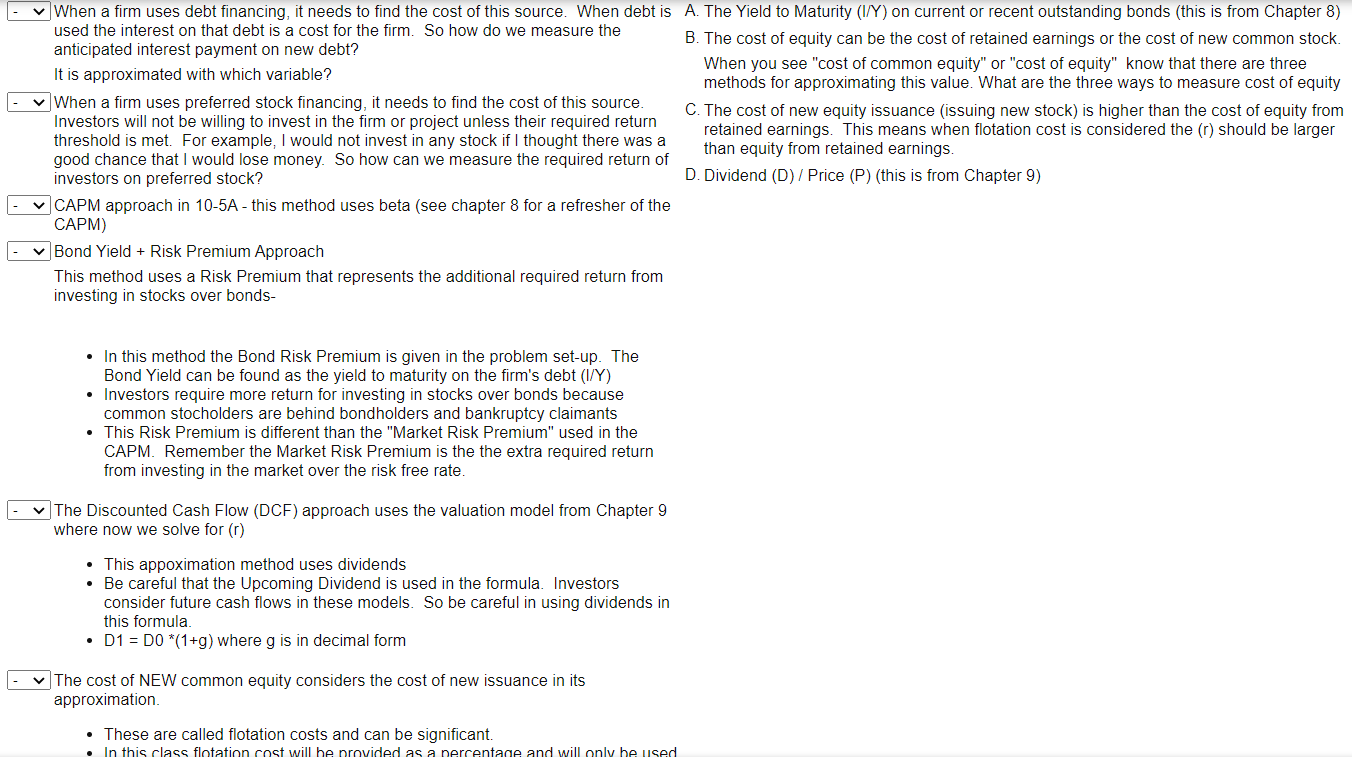
When a firm uses debt financing, it needs to find the cost of this source. When debt is A. The Yield to Maturity (I/Y) on current or recent outstanding bonds (this is from Chapter 8) used the interest on that debt is a cost for the firm. So how do we measure the B. The cost of equity can be the cost of retained earnings or the cost of new common stock. anticipated interest payment on new debt? When you see "cost of common equity" or "cost of equity" know that there are three It is approximated with which variable? methods for approximating this value. What are the three ways to measure cost of equity When a firm uses preferred stock financing, it needs to find the cost of this source. Investors will not be willing to invest in the firm or project unless their required return C. The cost of new equity issuance (issuing new stock) is higher than the cost of equity from retained earnings. This means when flotation cost is considered the () should be larger threshold is met. For example, I would not invest in any stock if I thought there was a than equity from retained earnings good chance that I would lose money. So how can we measure the required return of investors on preferred stock? D. Dividend (D) / Price (P) (this is from Chapter 9) V CAPM approach in 10-5A - this method uses beta (see chapter 8 for a refresher of the CAPM) Bond Yield + Risk Premium Approach This method uses a Risk Premium that represents the additional required return from investing in stocks over bonds- In this method the Bond Risk Premium is given in the problem set-up. The Bond Yield can be found as the yield to maturity on the firm's debt (I/Y) Investors require more return for investing in stocks over bonds because common stocholders are behind bondholders and bankruptcy claimants This Risk Premium is different than the "Market Risk Premium" used in the CAPM. Remember the Market Risk Premium is the the extra required return from investing in the market over the risk free rate The Discounted Cash Flow (DCF) approach uses the valuation model from Chapter 9 where now we solve for (O) This appoximation method uses dividends Be careful that the Upcoming Dividend is used in the formula. Investors consider future cash flows in these models. So be careful in using dividends in this formula D1 = DO *(1+g) where g is in decimal form The cost of NEW common equity considers the cost of new issuance in its approximation These are called flotation costs and can be significant. In this class flotation cost will be provided as a percentage and will only be used When a firm uses debt financing, it needs to find the cost of this source. When debt is A. The Yield to Maturity (I/Y) on current or recent outstanding bonds (this is from Chapter 8) used the interest on that debt is a cost for the firm. So how do we measure the B. The cost of equity can be the cost of retained earnings or the cost of new common stock. anticipated interest payment on new debt? When you see "cost of common equity" or "cost of equity" know that there are three It is approximated with which variable? methods for approximating this value. What are the three ways to measure cost of equity When a firm uses preferred stock financing, it needs to find the cost of this source. Investors will not be willing to invest in the firm or project unless their required return C. The cost of new equity issuance (issuing new stock) is higher than the cost of equity from retained earnings. This means when flotation cost is considered the () should be larger threshold is met. For example, I would not invest in any stock if I thought there was a than equity from retained earnings good chance that I would lose money. So how can we measure the required return of investors on preferred stock? D. Dividend (D) / Price (P) (this is from Chapter 9) V CAPM approach in 10-5A - this method uses beta (see chapter 8 for a refresher of the CAPM) Bond Yield + Risk Premium Approach This method uses a Risk Premium that represents the additional required return from investing in stocks over bonds- In this method the Bond Risk Premium is given in the problem set-up. The Bond Yield can be found as the yield to maturity on the firm's debt (I/Y) Investors require more return for investing in stocks over bonds because common stocholders are behind bondholders and bankruptcy claimants This Risk Premium is different than the "Market Risk Premium" used in the CAPM. Remember the Market Risk Premium is the the extra required return from investing in the market over the risk free rate The Discounted Cash Flow (DCF) approach uses the valuation model from Chapter 9 where now we solve for (O) This appoximation method uses dividends Be careful that the Upcoming Dividend is used in the formula. Investors consider future cash flows in these models. So be careful in using dividends in this formula D1 = DO *(1+g) where g is in decimal form The cost of NEW common equity considers the cost of new issuance in its approximation These are called flotation costs and can be significant. In this class flotation cost will be provided as a percentage and will only be used
Step by Step Solution
There are 3 Steps involved in it

Get step-by-step solutions from verified subject matter experts
 Study Help