







Question: Q4. A complex-valued sequence x (n) can be decomposed into a conjugate symmetric part xe(n) and a conjugate anti-symmetric part xo(n) as discussed in Chapter
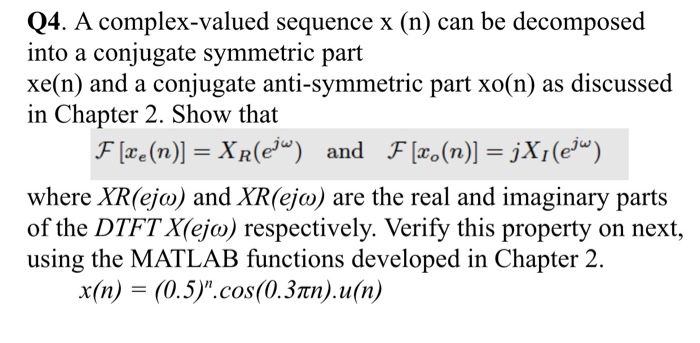
Q4. A complex-valued sequence x (n) can be decomposed into a conjugate symmetric part xe(n) and a conjugate anti-symmetric part xo(n) as discussed in Chapter 2. Show that F [Xe(n)] = XR(ew) and F [x.(n)] = jX1(e)") where XR(ejo) and XR(ejo) are the real and imaginary parts of the DTFT X(ejo) respectively. Verify this property on next, using the MATLAB functions developed in Chapter 2. x(n) = (0.5)".cos(0.3an).u(n) Q4. A complex-valued sequence x (n) can be decomposed into a conjugate symmetric part xe(n) and a conjugate anti-symmetric part xo(n) as discussed in Chapter 2. Show that F [Xe(n)] = XR(ew) and F [x.(n)] = jX1(e)") where XR(ejo) and XR(ejo) are the real and imaginary parts of the DTFT X(ejo) respectively. Verify this property on next, using the MATLAB functions developed in Chapter 2. x(n) = (0.5)".cos(0.3an).u(n)
Step by Step Solution
There are 3 Steps involved in it

Get step-by-step solutions from verified subject matter experts
 Study Help