


Question: Q4 (a) Distinguish between managing large 'breakthrough' improvements and managing continuous improvement. (10 marks) (b) There are limits to the ability of any organization to
Q4 (a) Distinguish between managing large
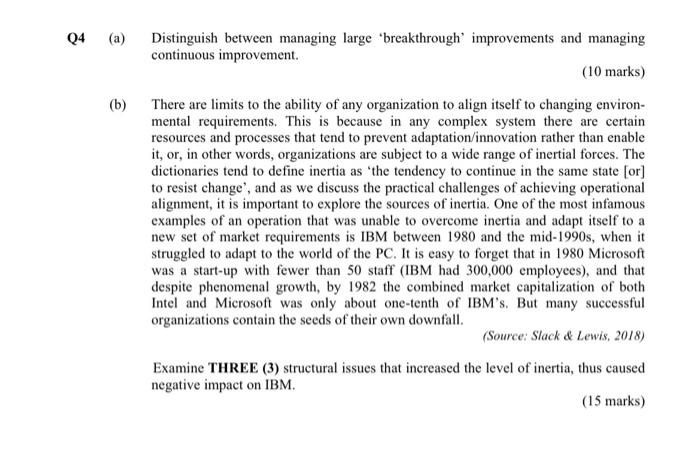
Q4 (a) Distinguish between managing large 'breakthrough' improvements and managing continuous improvement. (10 marks) (b) There are limits to the ability of any organization to align itself to changing environ- mental requirements. This is because in any complex system there are certain resources and processes that tend to prevent adaptation/innovation rather than enable it, or, in other words, organizations are subject to a wide range of inertial forces. The dictionaries tend to define inertia as "the tendency to continue in the same state (or) to resist change', and as we discuss the practical challenges of achieving operational alignment, it is important to explore the sources of inertia. One of the most infamous examples of an operation that was unable to overcome inertia and adapt itself to a new set of market requirements is IBM between 1980 and the mid-1990s, when it struggled to adapt to the world of the PC. It is easy to forget that in 1980 Microsoft was a start-up with fewer than 50 staff (IBM had 300,000 employees), and that despite phenomenal growth, by 1982 the combined market capitalization of both Intel and Microsoft was only about one-tenth of IBM's. But many successful organizations contain the seeds of their own downfall. (Source: Slack & Lewis, 2018) Examine THREE (3) structural issues that increased the level of inertia, thus caused negative impact on IBM. (15 marks)

Step by Step Solution

There are 3 Steps involved in it

1 Expert Approved Answer
Step: 1 Unlock blur-text-image

Question Has Been Solved by an Expert!

Get step-by-step solutions from verified subject matter experts

Step: 2 Unlock
Step: 3 Unlock

Students Have Also Explored These Related General Management Questions!