



Question: Q4. REQ.1 Payback period ----> Product A ______ Years Product B ______ Years REQ 2. Net Present Value ----> Product A ______ Product B ______
Q4. 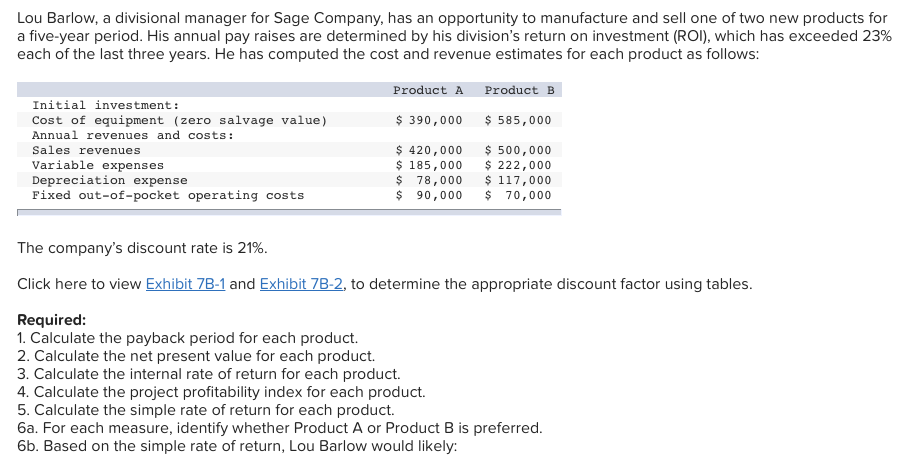
REQ.1
Payback period ----> Product A ______ Years Product B ______ Years
REQ 2.
Net Present Value ----> Product A ______ Product B ______
REQ 3.
Internal rate of return ----> Product A ______ % Product B ______ %
REQ 4.
Project profitability ----> Product A ______ Product B ______
REQ 5.
Simple rate of return ----> Product A ______% Product B ______%
REQ. 6 For each measure, identify whether Product A or Product B is preferred.
Net Value ______ A or B
Profitability ______ A or B
Payback period ______ A or B
Internal Rate of return ______ A or B
Simple Rate of return ______ A or B
REQ.6B
Based on the simple rate of return, Lou Barlow would likely: Pick 1
|
Lou Barlow, a divisional manager for Sage Company, has an opportunity to manufacture and sell one of two new products for a five-year period. His annual pay raises are determined by his division's return on investment (ROI), which has exceeded 23% each of the last three years. He has computed the cost and revenue estimates for each product as follows: Product A Product B $ 390,000 $ 585,000 Initial investment: Cost of equipment (zero salvage value) Annual revenues and costs: Sales revenues Variable expenses Depreciation expense Fixed out-of-pocket operating costs $ 420,000 $ 185,000 $ 78,000 $ 90,000 $ 500,000 $ 222,000 $ 117,000 $ 70,000 The company's discount rate is 21%. Click here to view Exhibit 7B-1 and Exhibit 7B-2, to determine the appropriate discount factor using tables. Required: 1. Calculate the payback period for each product. 2. Calculate the net present value for each product. 3. Calculate the internal rate of return for each product. 4. Calculate the project profitability index for each product. 5. Calculate the simple rate of return for each product. 6a. For each measure, identify whether Product A or Product B is preferred. 6b. Based on the simple rate of return, Lou Barlow would likely: Lou Barlow, a divisional manager for Sage Company, has an opportunity to manufacture and sell one of two new products for a five-year period. His annual pay raises are determined by his division's return on investment (ROI), which has exceeded 23% each of the last three years. He has computed the cost and revenue estimates for each product as follows: Product A Product B $ 390,000 $ 585,000 Initial investment: Cost of equipment (zero salvage value) Annual revenues and costs: Sales revenues Variable expenses Depreciation expense Fixed out-of-pocket operating costs $ 420,000 $ 185,000 $ 78,000 $ 90,000 $ 500,000 $ 222,000 $ 117,000 $ 70,000 The company's discount rate is 21%. Click here to view Exhibit 7B-1 and Exhibit 7B-2, to determine the appropriate discount factor using tables. Required: 1. Calculate the payback period for each product. 2. Calculate the net present value for each product. 3. Calculate the internal rate of return for each product. 4. Calculate the project profitability index for each product. 5. Calculate the simple rate of return for each product. 6a. For each measure, identify whether Product A or Product B is preferred. 6b. Based on the simple rate of return, Lou Barlow would likely
Step by Step Solution
There are 3 Steps involved in it

Get step-by-step solutions from verified subject matter experts