



Question: The random experiment consists of throwing two fair dice. Let us define the events: D = {the sum of the dice equals 6} E
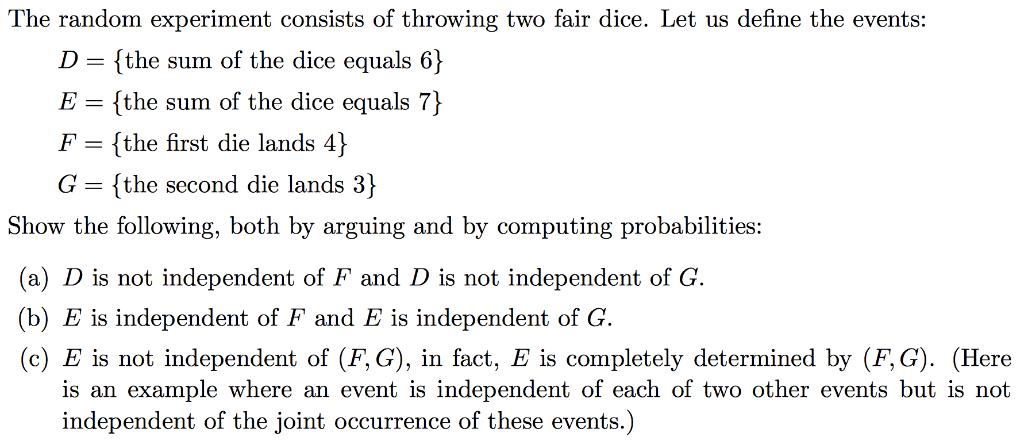
The random experiment consists of throwing two fair dice. Let us define the events: D = {the sum of the dice equals 6} E = {the sum of the dice equals 7} F {the first die lands 4} %3D {the second die lands 3} Show the following, both by arguing and by computing probabilities: (a) D is not independent of F and D is not independent of G. (b) E is independent of F and E is independent of G. (c) E is not independent of (F, G), in fact, E is completely determined by (F,G). (Here is an example where an event is independent of each of two other events but is not independent of the joint occurrence of these events.)
Step by Step Solution
3.38 Rating (154 Votes )
There are 3 Steps involved in it
The vandom fxpnment consints of throwiny two fair drce then samp... View full answer

Get step-by-step solutions from verified subject matter experts