







Question: Q47 This question is on a recent NPR article on cashless stores, the link to which was in the PDF of the assignment. Answer all
Q47 This question is on a recent NPR article on cashless stores, the link to which was in the PDF of the assignment. Answer all four parts of the question: A) According to the article, what reasons do some stores and restaurants give for not accepting cash? Are these the same disadvantages of cash that Cecchetti and Schoenholtz discuss in the article on the reading list? B) What laws have some local governments enacted to ensure that cash continues to be accepted at stores and restaurants? How do these laws compare to the legal tender law of the federal government? Are they the same, or are they different? C) What reason do local politicians give for not allowing stores and restaurants to become cashless? Is this the same reason Cecchetti and Schoenholtz give for keeping cash? Are they the same, and are any of them different? D) What is the behavioral or psychological argument mentioned in the article for making sure consumers can pay by cash? Do you agree or disagree? Make sure to explain your answers but keep them concise. The absolute maximum is 500 words.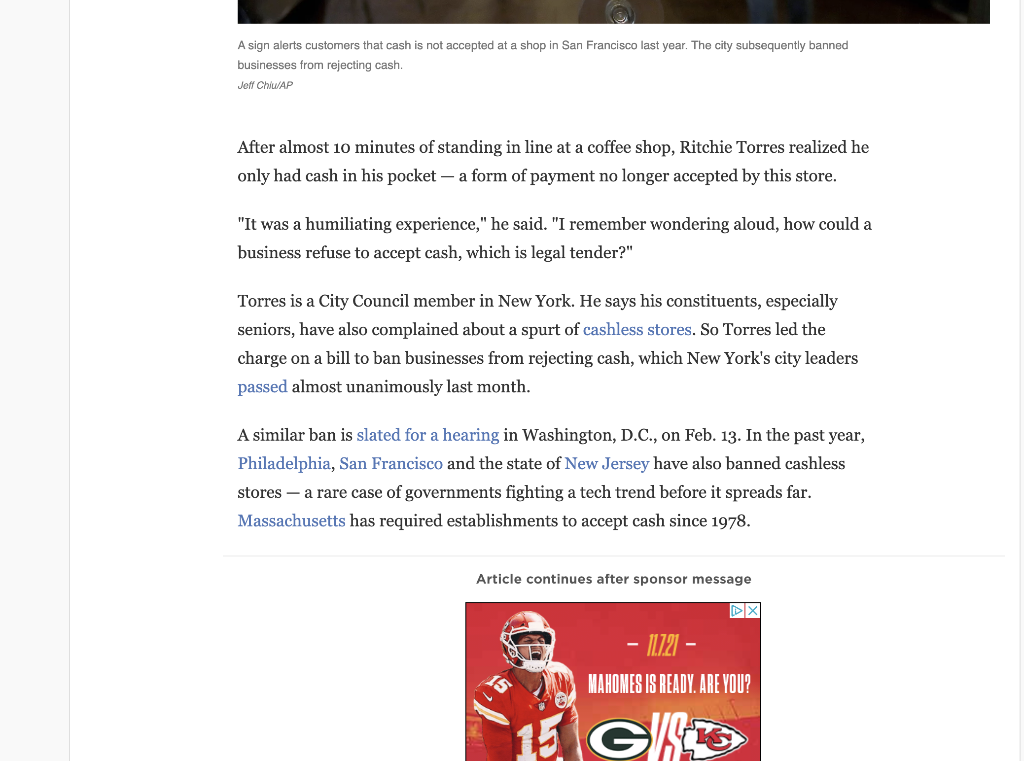
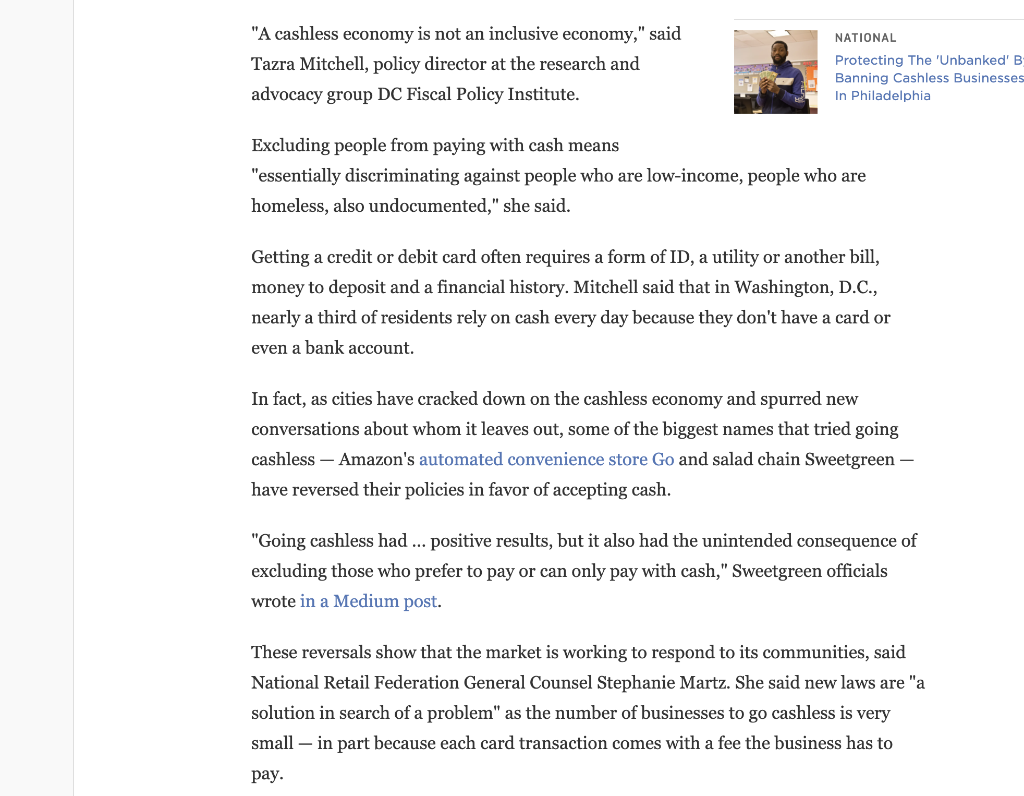
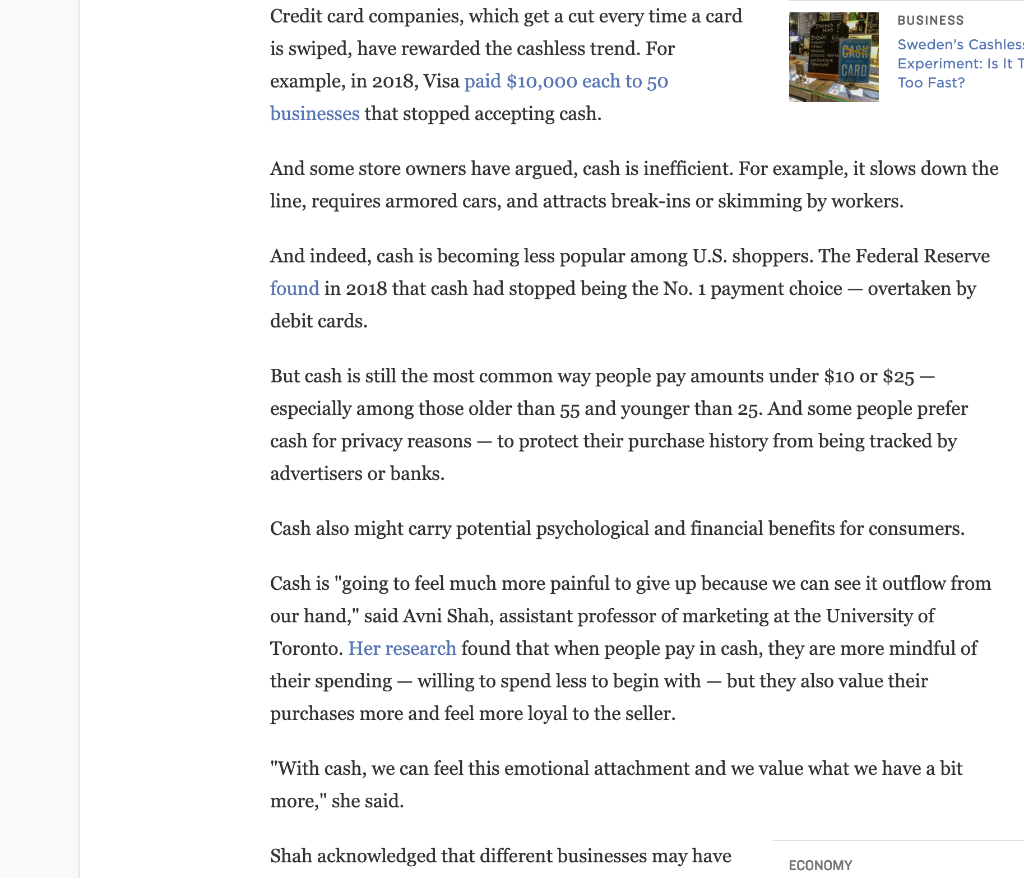
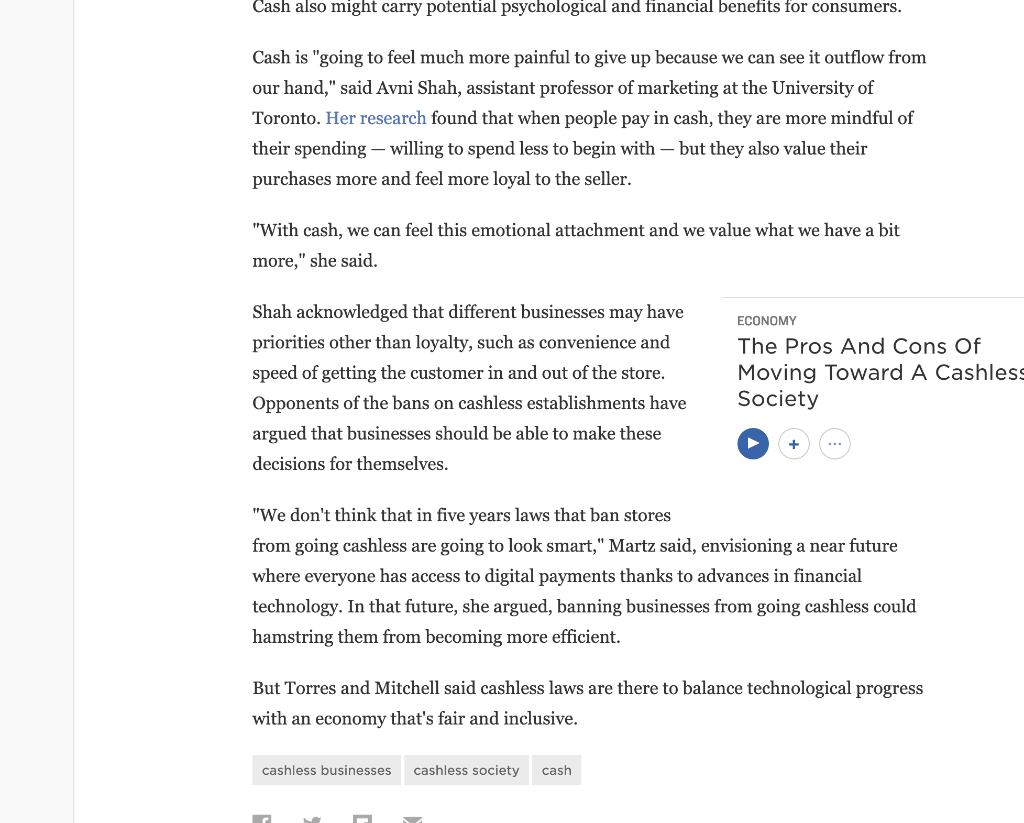
A sign alerts customers that cash is not accepted at a shop in San Francisco last year. The city subsequently banned businesses from rejecting cash. Jeff Chlu/AP After almost 10 minutes of standing in line at a coffee shop, Ritchie Torres realized he only had cash in his pocket a form of payment no longer accepted by this store. "It was a humiliating experience," he said. "I remember wondering aloud, how could a business refuse to accept cash, which is legal tender?" Torres is a City Council member in New York. He says his constituents, especially seniors, have also complained about a spurt of cashless stores. So Torres led the charge on a bill to ban businesses from rejecting cash, which New York's city leaders passed almost unanimously last month. A similar ban is slated for a hearing in Washington, D.C., on Feb. 13. In the past year, Philadelphia, San Francisco and the state of New Jersey have also banned cashless stores - a rare case of governments fighting a tech trend before it spreads far. Massachusetts has required establishments to accept cash since 1978. Article continues after sponsor message DX 1.721 - MAHOMES IS READY, ARE YOU? 15 G "A cashless economy is not an inclusive economy," said Tazra Mitchell, policy director at the research and advocacy group DC Fiscal Policy Institute. NATIONAL Protecting The 'Unbanked' B Banning Cashless Businesses In Philadelphia Excluding people from paying with cash means "essentially discriminating against people who are low-income, people who are homeless, also undocumented," she said. Getting a credit or debit card often requires a form of ID, a utility or another bill, money to deposit and a financial history. Mitchell said that in Washington, D.C., nearly a third of residents rely on cash every day because they don't have a card or even a bank account. In fact, as cities have cracked down on the cashless economy and spurred new conversations about whom it leaves out, some of the biggest names that tried going cashless - Amazon's automated convenience store Go and salad chain Sweetgreen - have reversed their policies in favor of accepting cash. "Going cashless had ... positive results, but it also had the unintended consequence of excluding those who prefer to pay or can only pay with cash," Sweetgreen officials wrote in a Medium post. These reversals show that the market is working to respond to its communities, said National Retail Federation General Counsel Stephanie Martz. She said new laws are "a solution in search of a problem" as the number of businesses to go cashless is very small in part because each card transaction comes with a fee the business has to pay. Credit card companies, which get a cut every time a card is swiped, have rewarded the cashless trend. For example, in 2018, Visa paid $10,000 each to 50 businesses that stopped accepting cash. CASH CARDS BUSINESS Sweden's Cashles: Experiment: Is It T Too Fast? And some store owners have argued, cash is inefficient. For example, it slows down the line, requires armored cars, and attracts break-ins or skimming by workers. And indeed, cash is becoming less popular among U.S. shoppers. The Federal Reserve found in 2018 that cash had stopped being the No. 1 payment choice overtaken by debit cards. But cash is still the most common way people pay amounts under $10 or $25 especially among those older than 55 and younger than 25. And some people prefer cash for privacy reasons to protect their purchase history from being tracked by advertisers or banks. Cash also might carry potential psychological and financial benefits for consumers. Cash is "going to feel much more painful to give up because we can see it outflow from our hand," said Avni Shah, assistant professor of marketing at the University of Toronto. Her research found that when people pay in cash, they are more mindful of their spending - willing to spend less to begin with but they also value their purchases more and feel more loyal to the seller. "With cash, we can feel this emotional attachment and we value what we have a bit more," she said. Shah acknowledged that different businesses may have ECONOMY Cash also might carry potential psychological and financial benefits for consumers. Cash is "going to feel much more painful to give up because we can see it outflow from our hand," said Avni Shah, assistant professor of marketing at the University of Toronto. Her research found that when people pay in cash, they are more mindful of their spending - willing to spend less to begin with but they also value their purchases more and feel more loyal to the seller. "With cash, we can feel this emotional attachment and we value what we have a bit more," she said. Shah acknowledged that different businesses may have priorities other than loyalty, such as convenience and speed of getting the customer in and out of the store. Opponents of the bans on cashless establishments have argued that businesses should be able to make these decisions for themselves. ECONOMY The Pros And Cons Of Moving Toward A Cashless Society "We don't think that in five years laws that ban stores from going cashless are going to look smart," Martz said, envisioning a near future where everyone has access to digital payments thanks to advances in financial technology. In that future, she argued, banning businesses from going cashless could hamstring them from becoming more efficient. But Torres and Mitchell said cashless laws are there to balance technological progress with an economy that's fair and inclusive. cashless businesses cashless society cash A sign alerts customers that cash is not accepted at a shop in San Francisco last year. The city subsequently banned businesses from rejecting cash. Jeff Chlu/AP After almost 10 minutes of standing in line at a coffee shop, Ritchie Torres realized he only had cash in his pocket a form of payment no longer accepted by this store. "It was a humiliating experience," he said. "I remember wondering aloud, how could a business refuse to accept cash, which is legal tender?" Torres is a City Council member in New York. He says his constituents, especially seniors, have also complained about a spurt of cashless stores. So Torres led the charge on a bill to ban businesses from rejecting cash, which New York's city leaders passed almost unanimously last month. A similar ban is slated for a hearing in Washington, D.C., on Feb. 13. In the past year, Philadelphia, San Francisco and the state of New Jersey have also banned cashless stores - a rare case of governments fighting a tech trend before it spreads far. Massachusetts has required establishments to accept cash since 1978. Article continues after sponsor message DX 1.721 - MAHOMES IS READY, ARE YOU? 15 G "A cashless economy is not an inclusive economy," said Tazra Mitchell, policy director at the research and advocacy group DC Fiscal Policy Institute. NATIONAL Protecting The 'Unbanked' B Banning Cashless Businesses In Philadelphia Excluding people from paying with cash means "essentially discriminating against people who are low-income, people who are homeless, also undocumented," she said. Getting a credit or debit card often requires a form of ID, a utility or another bill, money to deposit and a financial history. Mitchell said that in Washington, D.C., nearly a third of residents rely on cash every day because they don't have a card or even a bank account. In fact, as cities have cracked down on the cashless economy and spurred new conversations about whom it leaves out, some of the biggest names that tried going cashless - Amazon's automated convenience store Go and salad chain Sweetgreen - have reversed their policies in favor of accepting cash. "Going cashless had ... positive results, but it also had the unintended consequence of excluding those who prefer to pay or can only pay with cash," Sweetgreen officials wrote in a Medium post. These reversals show that the market is working to respond to its communities, said National Retail Federation General Counsel Stephanie Martz. She said new laws are "a solution in search of a problem" as the number of businesses to go cashless is very small in part because each card transaction comes with a fee the business has to pay. Credit card companies, which get a cut every time a card is swiped, have rewarded the cashless trend. For example, in 2018, Visa paid $10,000 each to 50 businesses that stopped accepting cash. CASH CARDS BUSINESS Sweden's Cashles: Experiment: Is It T Too Fast? And some store owners have argued, cash is inefficient. For example, it slows down the line, requires armored cars, and attracts break-ins or skimming by workers. And indeed, cash is becoming less popular among U.S. shoppers. The Federal Reserve found in 2018 that cash had stopped being the No. 1 payment choice overtaken by debit cards. But cash is still the most common way people pay amounts under $10 or $25 especially among those older than 55 and younger than 25. And some people prefer cash for privacy reasons to protect their purchase history from being tracked by advertisers or banks. Cash also might carry potential psychological and financial benefits for consumers. Cash is "going to feel much more painful to give up because we can see it outflow from our hand," said Avni Shah, assistant professor of marketing at the University of Toronto. Her research found that when people pay in cash, they are more mindful of their spending - willing to spend less to begin with but they also value their purchases more and feel more loyal to the seller. "With cash, we can feel this emotional attachment and we value what we have a bit more," she said. Shah acknowledged that different businesses may have ECONOMY Cash also might carry potential psychological and financial benefits for consumers. Cash is "going to feel much more painful to give up because we can see it outflow from our hand," said Avni Shah, assistant professor of marketing at the University of Toronto. Her research found that when people pay in cash, they are more mindful of their spending - willing to spend less to begin with but they also value their purchases more and feel more loyal to the seller. "With cash, we can feel this emotional attachment and we value what we have a bit more," she said. Shah acknowledged that different businesses may have priorities other than loyalty, such as convenience and speed of getting the customer in and out of the store. Opponents of the bans on cashless establishments have argued that businesses should be able to make these decisions for themselves. ECONOMY The Pros And Cons Of Moving Toward A Cashless Society "We don't think that in five years laws that ban stores from going cashless are going to look smart," Martz said, envisioning a near future where everyone has access to digital payments thanks to advances in financial technology. In that future, she argued, banning businesses from going cashless could hamstring them from becoming more efficient. But Torres and Mitchell said cashless laws are there to balance technological progress with an economy that's fair and inclusive. cashless businesses cashless society cash
Step by Step Solution
There are 3 Steps involved in it

Get step-by-step solutions from verified subject matter experts
 Study Help