







Question: Q5. (25pt.) In the figure below, frames are generated at node A and sent to node C through node B . Determine the minimum transmission
Q5. (25pt.) In the figure below, frames are generated at node
Aand sent to node
Cthrough node
B.\ Determine the minimum transmission rate required between nodes
Band
Cso that the frames at node
B\ are not lost, considering the following:\ The data rate between
Aand
Bis 100 Kbps.\ The propagation delay on both links is
10\\\\mu sec/km.\ The lines are full duplex.\
,All data frames are 1000 bits long; ACK frames are separate frames of negligible length.\ Between
Aand
B, the go-back-n protocol with a window size of 4 is used.\ Between
Band
C, the stop-and-wait protocol is used.\ There is no error, and the processing delay at the nodes is negligible,\ The buffer space at B is limited with the requirements of the protocols.
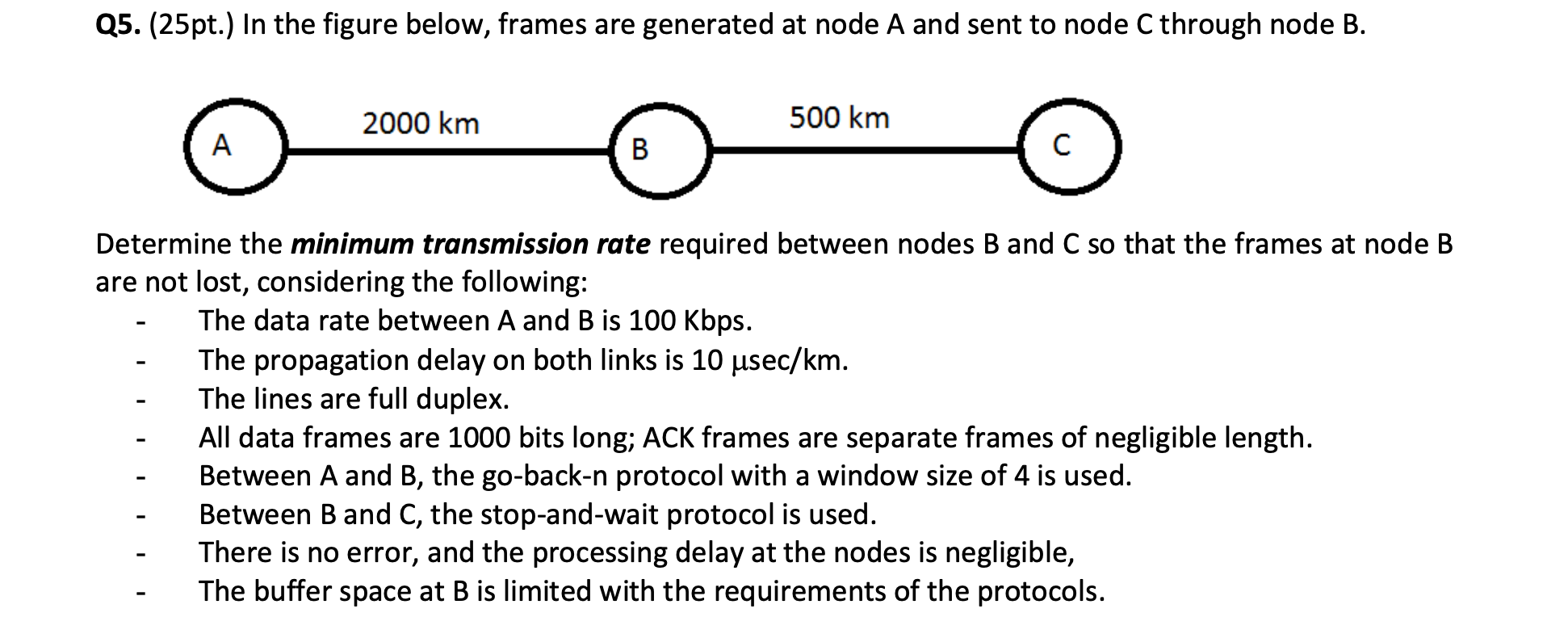
Q5. (25pt.) In the figure below, frames are generated at node A and sent to node C through node B. Determine the minimum transmission rate required between nodes B and C so that the frames at node are not lost, considering the following: - The data rate between A and B is 100 Kbps. - The propagation delay on both links is 10sec/km. - The lines are full duplex. - All data frames are 1000 bits long; ACK frames are separate frames of negligible length. - Between A and B, the go-back-n protocol with a window size of 4 is used. - Between B and C, the stop-and-wait protocol is used. - There is no error, and the processing delay at the nodes is negligible, - The buffer space at B is limited with the requirements of the protocols
Step by Step Solution
There are 3 Steps involved in it

Get step-by-step solutions from verified subject matter experts
 Study Help