







Question: Q5: Assume the Following Process. Process Burst Time Priority Arrival Time P1 15 3 0 P2 2 1 1 P3 4 5 2 2 4
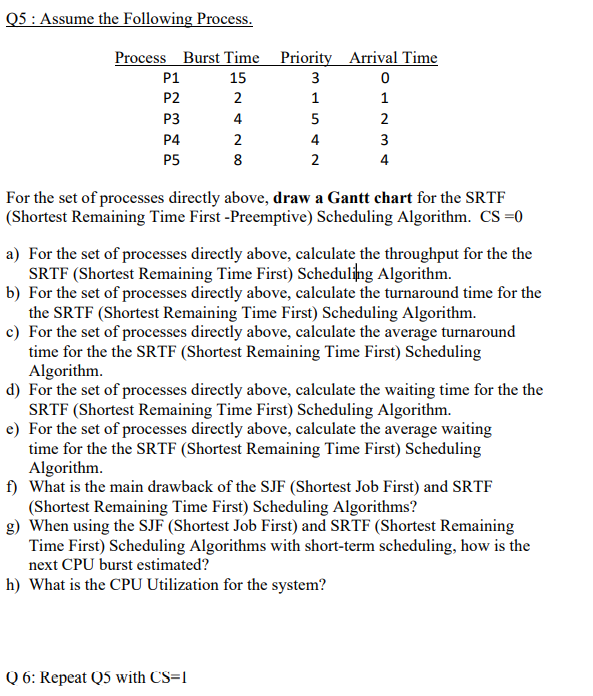
Q5: Assume the Following Process. Process Burst Time Priority Arrival Time P1 15 3 0 P2 2 1 1 P3 4 5 2 2 4 3 P5 8 2 4 P4 For the set of processes directly above, draw a Gantt chart for the SRTF (Shortest Remaining Time First - Preemptive) Scheduling Algorithm. CS=0 a) For the set of processes directly above, calculate the throughput for the the SRTF (Shortest Remaining Time First) Scheduling Algorithm. b) For the set of processes directly above, calculate the turnaround time for the the SRTF (Shortest Remaining Time First) Scheduling Algorithm. c) For the set of processes directly above, calculate the average turnaround time for the the SRTF (Shortest Remaining Time First) Scheduling Algorithm d) For the set of processes directly above, calculate the waiting time for the the SRTF (Shortest Remaining Time First) Scheduling Algorithm. e) For the set of processes directly above, calculate the average waiting time for the the SRTF (Shortest Remaining Time First) Scheduling Algorithm. f) What is the main drawback of the SJF (Shortest Job First) and SRTF (Shortest Remaining Time First) Scheduling Algorithms? g) When using the SJF (Shortest Job First) and SRTF (Shortest Remaining Time First) Scheduling Algorithms with short-term scheduling, how is the next CPU burst estimated? h) What is the CPU Utilization for the system? Q6: Repeat Q5 with CS=1
Step by Step Solution
There are 3 Steps involved in it

Get step-by-step solutions from verified subject matter experts
 Study Help