







Question: Q5. Consider an IEEE 802.11 network comprised of Node A, Node B, Node C and an Access Point (AP). The network parameters are as follows.
Q5. Consider an IEEE 802.11 network comprised of Node A, Node B, Node C and an Access Point (AP). The network parameters are as follows. 1 Slot time = 1 time unit SIFS = 1 slot time DIFS = 2 slot times Data frame size = 5 slot times ACK frame size = 1 slot time The three nodes (A, B, and C) have the following data frames to be sent to the AP. o At time = 0, Node A has one data frame to be sent to the AP. o At time = 0, Node B has one data frame to be sent to the AP. o At time = 0, Node C has one data frame to be sent to the AP. Suppose that in transmitting the data frame from Node A, the random backoff number chosen by Node A was = 4, that in transmitting the data frame from Node B, the random backoff number chosen by Node B was = 5, and that in transmitting the data frame from Node C, the random backoff number chosen by Node C was = 2. In such a scenario, draw a diagram to show the communication activities in the network. Also, identify the time at which all communications end (including reception of acknowledgments).
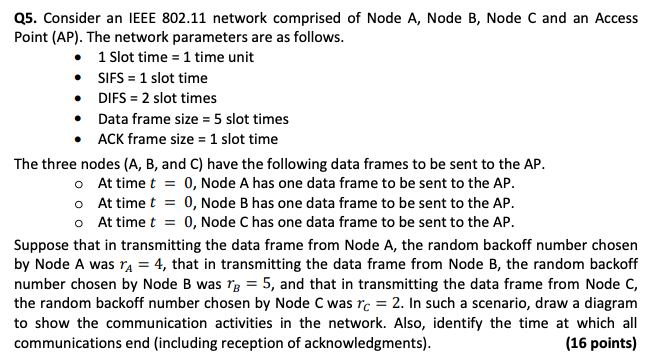
Q5. Consider an IEEE 802.11 network comprised of Node A, Node B, Node C and an Access Point (AP). The network parameters are as follows. 1 Slot time = 1 time unit SIFS = 1 slot time DIFS = 2 slot times Data frame size = 5 slot times ACK frame size = 1 slot time The three nodes (A, B, and C) have the following data frames to be sent to the AP. At time t = 0, Node A has one data frame to be sent to the AP. At time t = 0, Node B has one data frame to be sent to the AP. o At time t = 0, Node C has one data frame to be sent to the AP. Suppose that in transmitting the data frame from Node A, the random backoff number chosen by Node A was ra = 4, that in transmitting the data frame from Node B, the random backoff number chosen by Node B was to = 5, and that in transmitting the data frame from Node C, the random backoff number chosen by Node C was rc = 2. In such a scenario, draw a diagram to show the communication activities in the network. Also, identify the time at which all communications end (including reception of acknowledgments). (16 points) Q5. Consider an IEEE 802.11 network comprised of Node A, Node B, Node C and an Access Point (AP). The network parameters are as follows. 1 Slot time = 1 time unit SIFS = 1 slot time DIFS = 2 slot times Data frame size = 5 slot times ACK frame size = 1 slot time The three nodes (A, B, and C) have the following data frames to be sent to the AP. At time t = 0, Node A has one data frame to be sent to the AP. At time t = 0, Node B has one data frame to be sent to the AP. o At time t = 0, Node C has one data frame to be sent to the AP. Suppose that in transmitting the data frame from Node A, the random backoff number chosen by Node A was ra = 4, that in transmitting the data frame from Node B, the random backoff number chosen by Node B was to = 5, and that in transmitting the data frame from Node C, the random backoff number chosen by Node C was rc = 2. In such a scenario, draw a diagram to show the communication activities in the network. Also, identify the time at which all communications end (including reception of acknowledgments). (16 points)
Step by Step Solution
There are 3 Steps involved in it

Get step-by-step solutions from verified subject matter experts
 Study Help