







Question: Q5. What is the direct material efficiency variance? _________ Show calculation below. Q6. Given the info above, what is the direct labor rate variance? _________
Q5. What is the direct material efficiency variance? _________ Show calculation below.
Q6. Given the info above, what is the direct labor rate variance? _________ Show calculation below.
Q7. Given the info above, the fixed overhead controllable variance is: _________ Show calculation below.
Q8. What is the variable overhead controllable variance? _________ Show calculation below.
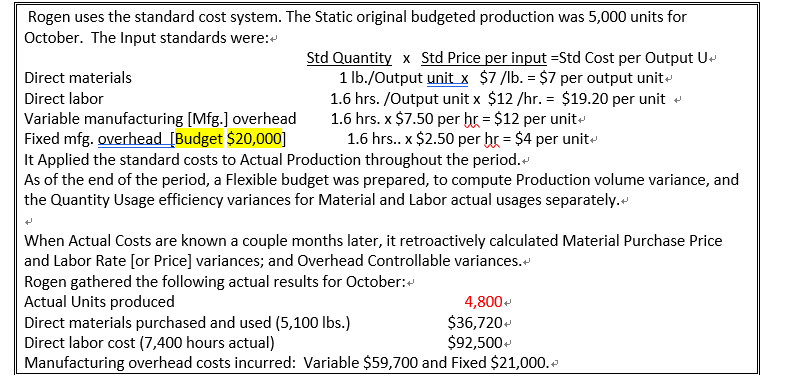
Rogen uses the standard cost system. The Static original budgeted production was 5,000 units for October. The Input standards were: Std Quantity x Std Price per input =Std Cost per Output U- Direct materials 1 lb./Output unit x $7/1b. = $7 per output unit Direct labor 1.6 hrs. /Output unit x $12/hr. = $19.20 per unit Variable manufacturing (Mfg.] overhead 1.6 hrs. x $7.50 per hr = $12 per unit- Fixed mfg. overhead [Budget $20,000] 1.6 hrs.. x $2.50 per hr = $4 per unit It Applied the standard costs to Actual Production throughout the period. As of the end of the period, a Flexible budget was prepared, to compute Production volume variance, and the Quantity Usage efficiency variances for Material and Labor actual usages separately. When Actual Costs are known a couple months later, it retroactively calculated Material Purchase Price and Labor Rate (or Price] variances; and Overhead Controllable variances. Rogen gathered the following actual results for October: Actual Units produced 4,800+ Direct materials purchased and used (5,100 lbs.) $36,720- Direct labor cost (7,400 hours actual) $92,500+ Manufacturing overhead costs incurred: Variable $59,700 and Fixed $21,000
Step by Step Solution
There are 3 Steps involved in it

Get step-by-step solutions from verified subject matter experts
 Study Help