







Question: Q6: A blockcipher normally can be considered as a pseudorandom permutation, i.e. E:Xx{0,1}128 {0,1}128, where K is the key space. When encrypting a picture m,
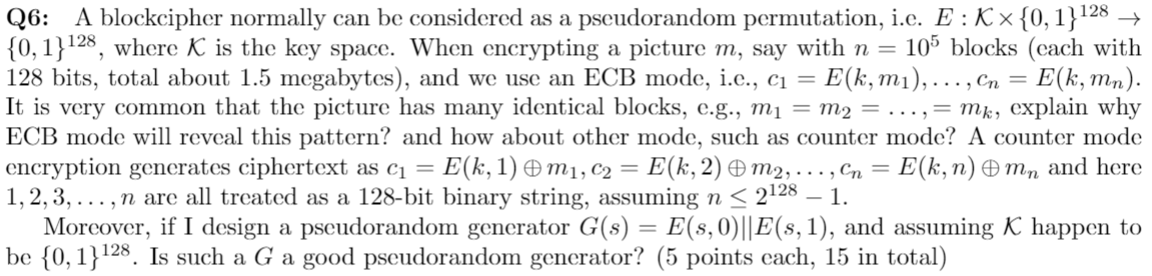
Q6: A blockcipher normally can be considered as a pseudorandom permutation, i.e. E:Xx{0,1}128 {0,1}128, where K is the key space. When encrypting a picture m, say with n = 105 blocks (each with 128 bits, total about 1.5 megabytes), and we use an ECB mode, i.e., ci = E(k, mi), ..., Cn = E(k, mn). It is very common that the picture has many identical blocks, e.g., m = m2 = ...,= mk, explain why ECB mode will reveal this pattern? and how about other mode, such as counter mode? A counter mode encryption generates ciphertext as c = E(k, 1) @m1, C2 = E(k, 2) Om2, ..., Cn = E(k, n) Omn and here 1, 2, 3, ..., n are all treated as a 128-bit binary string, assuming n
Step by Step Solution
There are 3 Steps involved in it

Get step-by-step solutions from verified subject matter experts
 Study Help