







Question: q7 What is the squared error for week 5? 02.0000 04.0000 O 6.0000 O 10.0000 O 25.0000 John rents a tractor to contractors and walk-in
q7 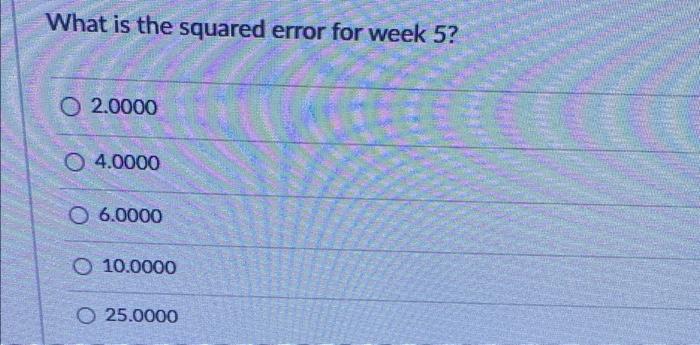
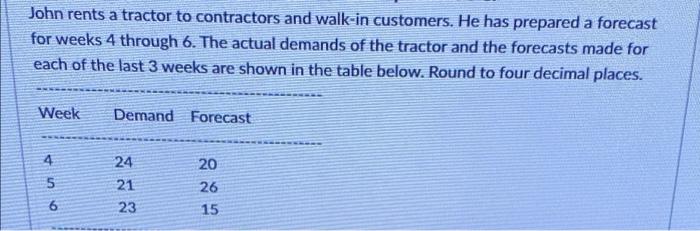
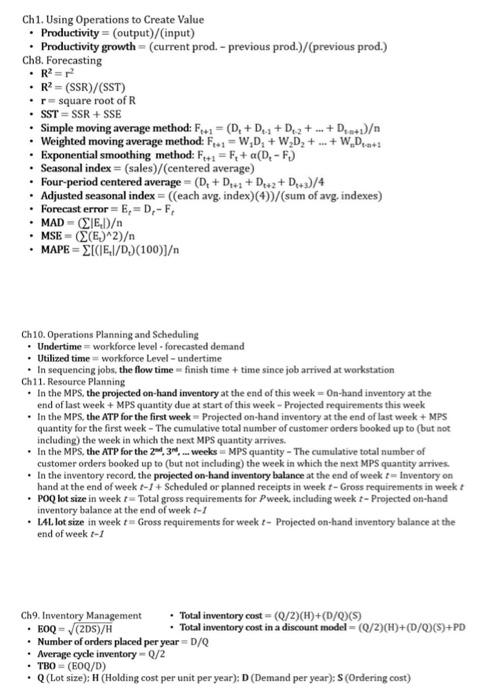
What is the squared error for week 5? 02.0000 04.0000 O 6.0000 O 10.0000 O 25.0000 John rents a tractor to contractors and walk-in customers. He has prepared a forecast for weeks 4 through 6. The actual demands of the tractor and the forecasts made for each of the last 3 weeks are shown in the table below. Round to four decimal places. Week Demand Forecast 4 24 20 26 15 56 222 21 23 Ch1. Using Operations to Create Value Productivity (output)/(input) Productivity growth = (current prod. - previous prod.)/(previous prod.) Ch8. Forecasting R=2 R = (SSR)/(SST) r square root of R . SST = SSR + SSE . Simple moving average method: F+1 = (D + D + D + ...+D+1) Weighted moving average method: F1WD + WD+...+ WD+ Exponential smoothing method: F+1=F,+ a(D,-F) . Seasonal index = (sales)/(centered average) . Four-period centered average = (D, + D+2+ D+2+D+3)/4 . Adjusted seasonal index = ((each avg, index) (4))/(sum of avg. indexes) Forecast error = E=D-F . MAD-(E) MSE- ((E)^2) MAPE=[(IEI/D)(100)] . Ch 10. Operations Planning and Scheduling Undertime = workforce level - forecasted demand Utilized time workforce Level-undertime In sequencing jobs, the flow time finish time + time since job arrived at workstation Ch11. Resource Planning In the MPS, the projected on-hand inventory at the end of this week - On-hand inventory at the end of last week + MPS quantity due at start of this week - Projected requirements this week . In the MPS, the ATP for the first week Projected on-hand inventory at the end of last week + MPS quantity for the first week-The cumulative total number of customer orders booked up to (but not including) the week in which the next MPS quantity arrives. In the MPS, the ATP for the 2nd, 3,... weeks MPS quantity - The cumulative total number of customer orders booked up to (but not including) the week in which the next MPS quantity arrives. In the inventory record, the projected on-hand inventory balance at the end of week - Inventory on hand at the end of week t-1+ Scheduled or planned receipts in week t-Gross requirements in week t POQ lot size in week = Total gross requirements for Pweek, including week - Projected on-hand inventory balance at the end of week 1-1 L4L lot size in week t= Gross requirements for week - Projected on-hand inventory balance at the end of week 1-1 Ch9. Inventory Management Total inventory cost = (Q/2)(H)+(D/Q)(S) BOQ=(2DS)/H Total inventory cost in a discount model = (Q/2)(H)+(D/Q)(S)+PD Number of orders placed per year = D/Q Average cycle inventory - Q/2 TBO=(EOQ/D) Q (Lot size): H (Holding cost per unit per year): D (Demand per year): S (Ordering cost) Step by Step Solution
There are 3 Steps involved in it
1 Expert Approved Answer
Step: 1 Unlock

Question Has Been Solved by an Expert!
Get step-by-step solutions from verified subject matter experts
Step: 2 Unlock
Step: 3 Unlock
 Study Help