







Question: Q.8 Aggregate vs. per-worker production function (8 points) Assume a country has an aggregate production function as follows: 12 Y = f(K, L) = AK3L3
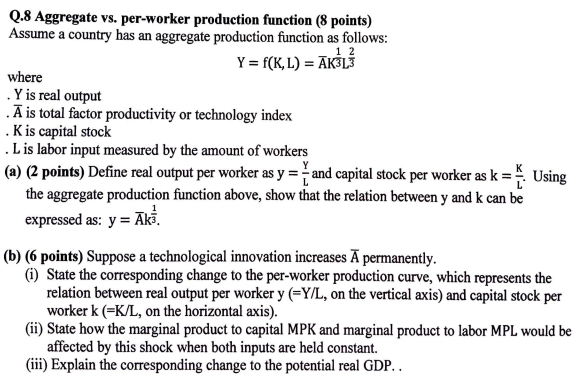
Q.8 Aggregate vs. per-worker production function (8 points) Assume a country has an aggregate production function as follows: 12 Y = f(K, L) = AK3L3 where .Y is real output .A is total factor productivity or technology index . K is capital stock . L is labor input measured by the amount of workers (a) (2 points) Define real output per worker as y=and capital stock per worker as k == Using the aggregate production function above, show that the relation between y and k can be expressed as: y = Ak. (b) (6 points) Suppose a technological innovation increases A permanently. (i) State the corresponding change to the per-worker production curve, which represents the relation between real output per worker y (=Y/L, on the vertical axis) and capital stock per worker k (=K/L, on the horizontal axis). (ii) State how the marginal product to capital MPK and marginal product to labor MPL would be affected by this shock when both inputs are held constant. (iii) Explain the corresponding change to the potential real GDP.. Q.8 Aggregate vs. per-worker production function (8 points) Assume a country has an aggregate production function as follows: 12 Y = f(K, L) = AK3L3 where .Y is real output .A is total factor productivity or technology index . K is capital stock . L is labor input measured by the amount of workers (a) (2 points) Define real output per worker as y=and capital stock per worker as k == Using the aggregate production function above, show that the relation between y and k can be expressed as: y = Ak. (b) (6 points) Suppose a technological innovation increases A permanently. (i) State the corresponding change to the per-worker production curve, which represents the relation between real output per worker y (=Y/L, on the vertical axis) and capital stock per worker k (=K/L, on the horizontal axis). (ii) State how the marginal product to capital MPK and marginal product to labor MPL would be affected by this shock when both inputs are held constant. (iii) Explain the corresponding change to the potential real GDP
Step by Step Solution
There are 3 Steps involved in it

Get step-by-step solutions from verified subject matter experts
 Study Help